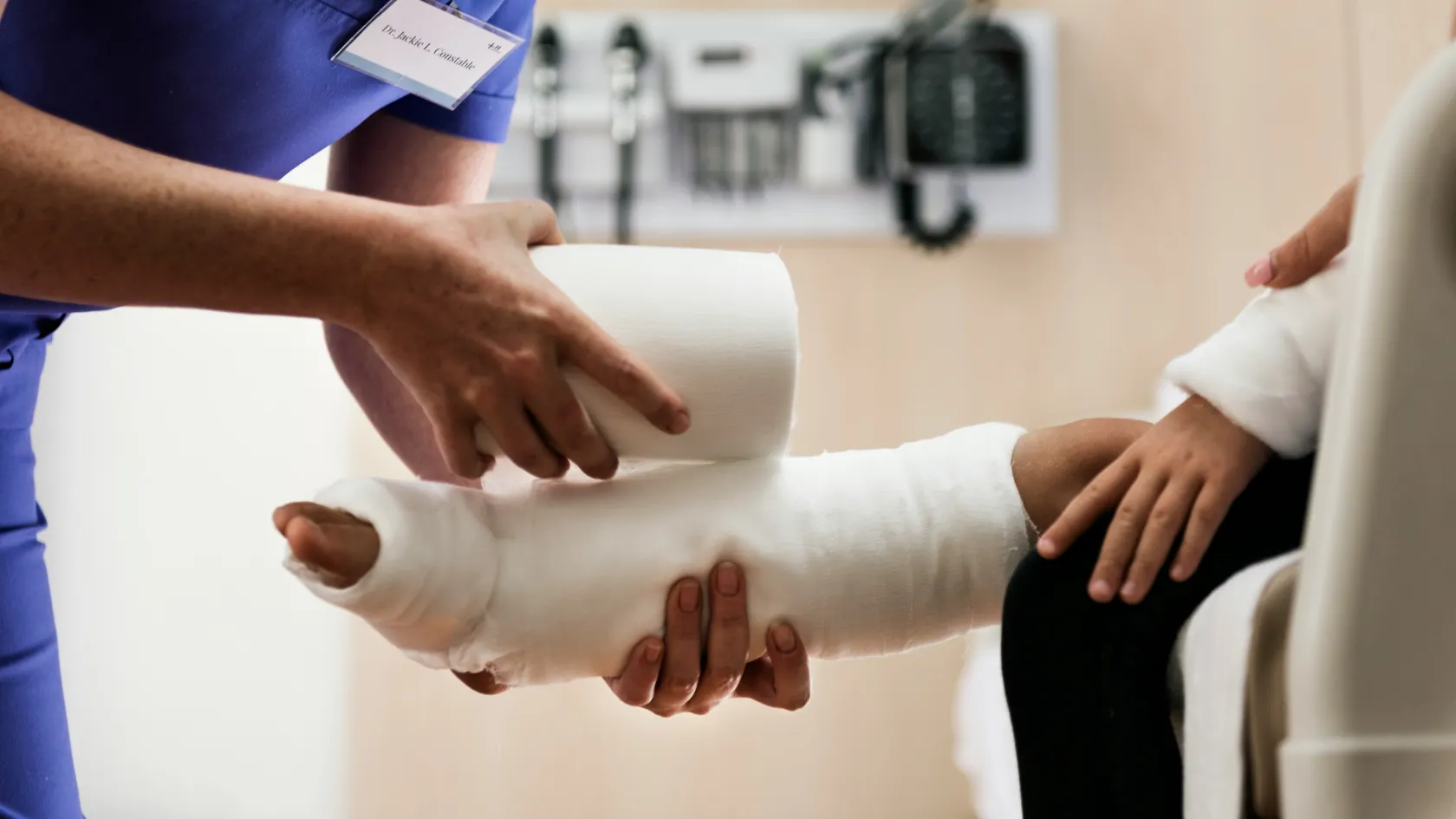
When a sarcoma grows in the bone or soft tissue of an arm or leg, limb salvage surgery removes it with a clear margin and rebuilds the bone, joint and muscle cover, and in a randomized trial survival matched amputation while the limb stayed.
About This Department
Orthopedics
The aim is a clear margin around the tumor. Keeping the limb comes with it whenever that margin allows.
In a randomized trial of soft tissue sarcoma, five-year overall survival was 83 percent after limb-sparing surgery with radiotherapy and 88 percent after amputation, a difference that was not significant.
83% vs 88%
Five-year survival with limb-sparing surgery and with amputation in a randomized trial
2,174
Patients with tumor implants in a five-center failure review
3 to 4 weeks
Usual surgical stay before flying home
Free
Sarcoma team review of your scans and biopsy
Free consultation
The review costs nothing and carries no obligation. Send MRI and CT scans, the biopsy report and slides if available, and any treatment already given, and the sarcoma team will tell you whether the limb can be saved, how it would be rebuilt, and how the treatment would be timed. A coordinator replies in your own language.
A scan has shown a tumor in the bone or the soft tissue of an arm or a leg, a biopsy has named it, and the question now is whether the limb can be kept. Limb salvage surgery, also called limb-sparing surgery, removes the tumor with a margin of healthy tissue around it and rebuilds the bone, joint and soft tissue so that the arm or leg stays and keeps working. Below you will find which tumors it treats, how chemotherapy and radiotherapy fit around it, what the studies comparing it with amputation found, the ways bone and joints are rebuilt, when amputation is still the better choice, the risks of large implants, the recovery, how long to plan in Istanbul, and the follow-up at home.
What limb salvage surgery treats
Most patients come with a sarcoma.
Bone sarcomas, mainly osteosarcoma, Ewing sarcoma and chondrosarcoma, start in the bone itself and favor the areas around the knee, the upper arm and the pelvis, while soft tissue sarcomas grow in muscle, fat and the tissue around nerves and vessels, most often in the thigh. Aggressive benign tumors such as giant cell tumor of bone, and cancer that has spread to a long bone from elsewhere, are treated with similar techniques when a simple scrape or a nail will not hold. Four decades ago amputation was the standard answer for most of these tumors, and today the large majority of patients with a limb sarcoma keep the limb, because chemotherapy, radiotherapy, imaging and implant design have all moved forward together. Age matters too, since bone sarcomas peak in teenagers and young adults while soft tissue sarcomas and chondrosarcoma are more common later in life, and the reconstruction has to suit a body that is still growing in one case and a lifetime of use in the other.
Injuries and infections
Severe injuries and bone infections are also salvaged, with free flaps and bone transport. Our microsurgery page describes that side.
Symptoms that call for a scan
Bone pain that is worse at night or does not settle with rest, swelling around a joint in a teenager or young adult, or a lump deep in the muscle that is larger than a golf ball or growing. Most turn out to be benign, but each deserves an X-ray or MRI before any treatment.
1
Staging scans
MRI of the whole bone or compartment, chest CT, and a bone scan or PET-CT.
2
Planned biopsy
A needle biopsy along a track the surgeon will later remove.
3
Team meeting
Surgeons, oncologists, radiologists and pathologists agree one plan.
The biopsy decides more than the diagnosis
A biopsy taken through the wrong path can spread tumor cells into tissue that then has to be removed, sometimes ending the chance to save the limb. The needle track is planned by the team that will operate, so send scans before any biopsy if one has not been done yet.
Chemotherapy, radiotherapy and timing
Surgery is one part of a larger plan.
This table scrolls sideways on a narrow screen. Swipe or drag to see every column.
Usual treatment sequence by tumor type
Tumor
Before surgery
After surgery
Osteosarcoma
Chemotherapy for around ten weeks
More chemotherapy, guided by how much of the tumor died
Ewing sarcoma
Chemotherapy
Chemotherapy, with radiotherapy if margins are close
Chondrosarcoma
Usually surgery alone
Scans, as chemotherapy works poorly
High-grade soft tissue sarcoma
Radiotherapy in many cases
Radiotherapy if not given before, chemotherapy for some types
Why chemotherapy often comes first in bone sarcoma
It treats cells that may already have spread, shrinks the tumor and firms its edge, and the share of tumor killed, measured under the microscope after surgery, guides treatment afterward.
Radiotherapy and chemotherapy are delivered on the same site as the surgery. The team around each patient includes
an orthopedic oncologist and, where needed, a plastic surgeon,
medical and radiation oncologists,
a musculoskeletal radiologist and a sarcoma pathologist,
and physiotherapists who start before surgery.
Is keeping the limb as safe as amputation
Same survival, and the limb stays.
The question was tested directly in a randomized trial at the US National Cancer Institute, published in 1982. Forty-three adults with high-grade soft tissue sarcoma of a limb were assigned either to amputation or to limb-sparing surgery followed by radiotherapy, and both groups received chemotherapy.
On a phone, slide the table left to read the right-hand column.
Five-year results of the National Cancer Institute trial
Measure
Limb-sparing surgery with radiotherapy
Amputation
Patients
27
16
Local recurrences
4
0
Disease-free survival
71 percent
78 percent
Overall survival
83 percent
88 percent
Neither survival difference was significant. The only factor linked to recurrence was a positive margin, tumor cells at the cut edge.
The margin matters more than the method.
Osteosarcoma has no randomized trial. A 2016 meta-analysis pooled the comparative studies instead.
Scroll sideways on small screens to see both columns.
Osteosarcoma meta-analysis, limb salvage compared with amputation
Outcome
Finding
Local recurrence
No difference
Two-year survival
No difference
Five-year survival
Higher in the limb salvage groups
Function score
Better with limb salvage
Part of the survival gap reflects which patients were offered each operation, since surgeons recommend amputation for the largest tumors, those with a fracture through them and those that respond poorly to chemotherapy, all of which carry a worse outlook whatever the operation.
Rebuilding bone and joints
Once the tumor is out, the gap has to be filled with something that bears weight and, where a joint was removed, moves.
Metal endoprostheses
A modular tumor prosthesis replaces the end of the bone and the joint together, for example the lower femur and the knee, and allows walking within days. In growing children an expandable version is lengthened in small steps as the other leg grows.
Biological options
Used where the joint is preserved or in younger patients, these take longer to heal but can last a lifetime once united.
A donor bone graft from a tissue bank.
The patient's own fibula, moved with its blood supply.
The tumor bone itself, treated to kill the cells and put back.
Rotationplasty
For some children with a tumor around the knee, the lower leg is turned and attached to the thigh so that the ankle works as a knee inside a prosthesis. It looks unusual, but it gives durable function for sport without implants that wear out.
When amputation is still the better choice
Sometimes the limb should go.
Signs it may be time
A tumor that can be removed with a clear margin, main nerves and vessels free or reconstructable, healthy soft tissue to cover an implant, and a patient able to follow months of rehabilitation.
Talk to us first
A tumor wrapped around the main nerve to the leg, a badly placed earlier biopsy, a deep infection, a fracture that has spread tumor widely, or a reconstruction so fragile that it would fail before it served.
A modern amputation with a well-fitted prosthesis lets many people walk, work and play sport, and in these situations it can give a faster, safer and more durable result than a limb kept at any cost.
Before the operation
1
Slide review
Pathologists re-examine biopsy slides made elsewhere.
2
Implant planning
Resection levels and implant size are planned on the scans, sometimes with custom cutting guides printed for your bone.
3
Blood counts
Surgery waits until counts recover from chemotherapy.
4
Infections first
Teeth, skin and urine infections are treated before an implant goes in, because a tumor prosthesis that becomes infected is far harder to save than an ordinary joint.
Risks of large implants
Tumor implants carry heavier risks than everyday joint replacements, because they replace long segments of bone and the muscles that attach to them. A review from five centers of 2,174 patients with large tumor endoprostheses found 534 failures, grouped into five types, and infection was the most common type in that series.
Soft tissue failure
Instability or poor function of the rebuilt joint, treated with tissue repair or a flap.
Aseptic loosening
The implant comes loose from bone over years and is revised.
Structural failure
A break in the implant or the bone around it.
Infection
More common after chemotherapy and radiotherapy. Antibiotics, washouts or a staged exchange answer it, and rarely amputation.
Tumor recurrence
Treated with further surgery and other therapy.
The recovery
Movement starts early.
After a knee or hip tumor prosthesis, patients stand with a physiotherapist within the first days and walk with crutches before discharge, while biological reconstructions with grafts protect the leg from full weight until the bone unites, which takes months. Upper arm reconstructions keep the elbow and hand working well, though lifting the arm overhead is often limited when the shoulder muscles were removed with the tumor. Chemotherapy restarts within a few weeks of surgery once the wound has healed, so rehabilitation runs alongside it, and most of the walking gain comes over the first six to twelve months. Physiotherapy continues at home with a written program, and the team adjusts it at each visit. Teenagers return to school within weeks, adults to desk work within a few months, while running and jumping on a tumor prosthesis stay off the list for good to protect the implant, and swimming and cycling become the usual sports.
How long to plan in Istanbul
Plan for months.
Published Istanbul programs for tumor resection with an endoprosthesis are inpatient programs that cover the examinations, imaging, biopsy, the operation, physiotherapy and nursing. When chemotherapy comes before and after surgery, the whole treatment runs for several months, either in Istanbul or shared with an oncology team at home, and the surgical stay itself, from admission to fitness to fly, commonly needs three to four weeks so the wound heals and walking is safe. Many families choose to complete the chemotherapy cycles before surgery at home, travel for the operation and the first weeks of rehabilitation, and then continue chemotherapy at home under a plan written jointly by both teams, with results shared through the coordinator so that nothing is delayed. A child's treatment stays in one place from start to finish where possible, because the family, school and therapists all need a single schedule they can rely on. Adults have more room to split care.
What decides the cost
Tumor site sets the figure first. The implant or graft, a flap, chemotherapy and radiotherapy given in Istanbul, nights in hospital and rehabilitation follow.
Published programs list imaging, biopsy and pathology, the resection with the implant, medicines, physiotherapy and nursing, while a companion's accommodation and interpreter services appear as separate items at some centers. A quote you can compare names the implant, the treatments given in Istanbul and the planned stay, and that figure comes only from the sarcoma team after reading your scans, the pathology report and the slides, since the margin needed and the reconstruction both follow from them.
The review costs nothing.
Arranging the trip
Start on WhatsApp. Send the scans and biopsy report there, and one coordinator takes the case from the team review through surgery and every later visit. Staff speak English, Arabic, French, Russian, Serbian, Romanian and Spanish, and an interpreter covers other languages, while a parent or relative sleeps in the room on the companion bed, the international office reserves a hotel for longer stays, sends the visa invitation letter ten days before travel and arranges transfers. Halal, vegetarian and diabetic meals, a prayer room and a female physician on request are available.
Once you are back home
Sarcoma follow-up lasts years, with chest scans and imaging of the limb at set intervals, closest together in the first two years, and the coordinator passes them to the team in Istanbul. Implants are checked with X-rays for loosening and wear. Scans never stop entirely.
Fever, a red or draining wound, new pain or swelling in the limb, or a new lump. Each needs a doctor soon.
Limb salvage surgery FAQ
Is limb salvage surgery as safe as amputation?
In a randomized trial of soft tissue sarcoma, overall survival at five years was 83 percent with limb-sparing surgery and radiotherapy against 88 percent with amputation, a difference that was not significant.
What replaces the bone that is removed?
A metal tumor prosthesis, a donor bone graft, the patient's own fibula with its blood supply, or the treated tumor bone itself.
How long does a tumor prosthesis last?
Many last years, but failures from infection, loosening and breakage are more common than with ordinary joint replacements, and some need revision.
Can children have limb salvage surgery?
Yes. Expandable prostheses grow with the child, and rotationplasty is an option for some tumors around the knee.
When is amputation better?
When the tumor surrounds the main nerve, the soft tissue cannot cover an implant, or a deep infection or poorly placed biopsy makes a safe margin impossible.
Can a family member stay with me?
Yes. A parent or relative sleeps in the room on the companion bed for the whole admission.
References
Rosenberg SA, Tepper J, Glatstein E, et al. The treatment of soft-tissue sarcomas of the extremities. Prospective randomized evaluations of limb-sparing surgery plus radiation therapy compared with amputation and the role of adjuvant chemotherapy. Ann Surg. 1982;196(3):305-315.
Han G, Bi WZ, Xu M, Jia JP, Wang Y. Amputation versus limb-salvage surgery in patients with osteosarcoma. A meta-analysis. World J Surg. 2016;40(8):2016-2027.
Henderson ER, Groundland JS, Pala E, et al. Failure mode classification for tumor endoprostheses. Retrospective review of five institutions and a literature review. J Bone Joint Surg Am. 2011;93(5):418-429.
Editor's note
Written by the Biruni Hospital medical editorial team. Reviewed by Assoc. Prof. Dr. Suat BATAR, Orthopedics and Traumatology.