
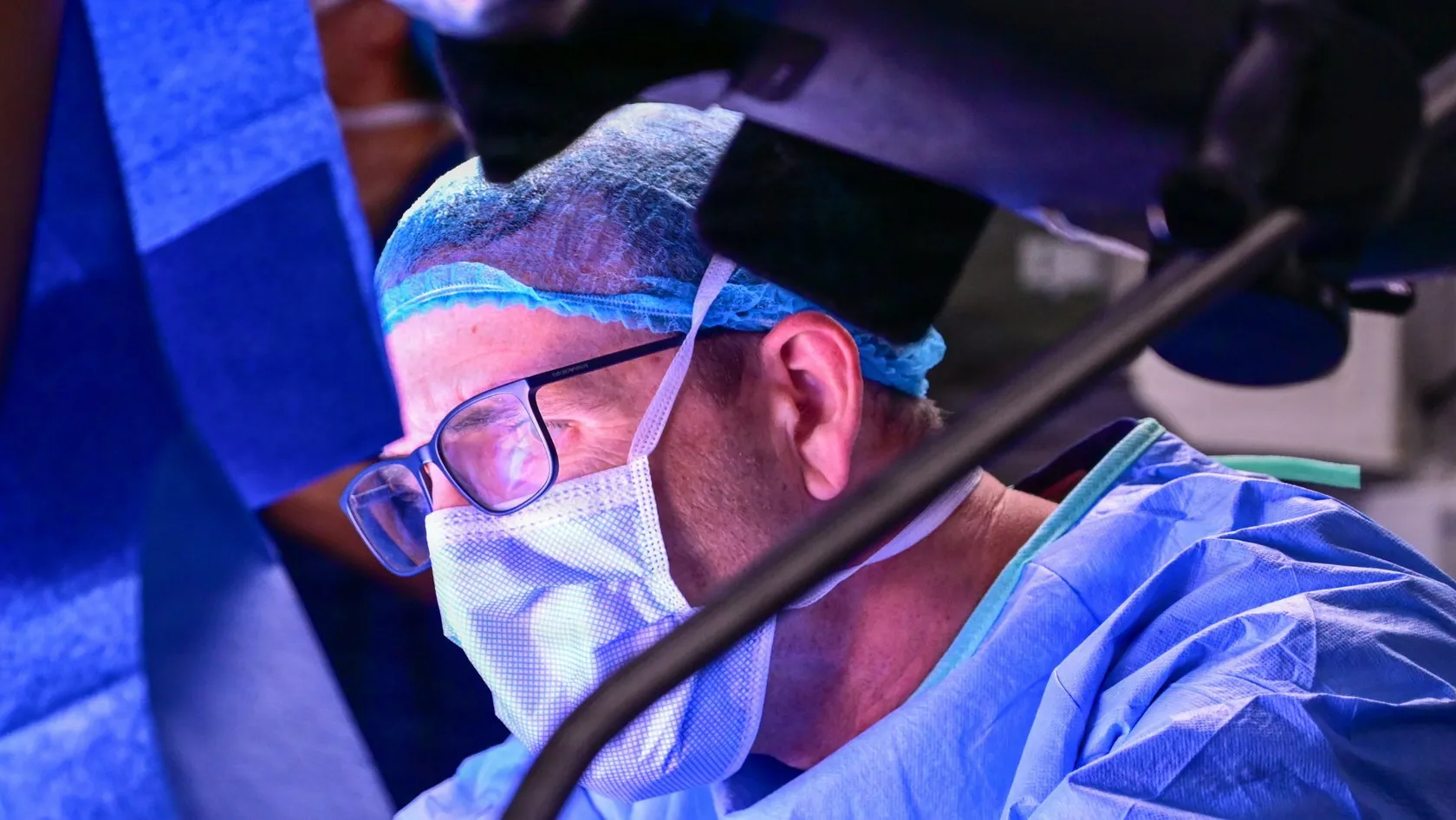
Laparoscopic Urology Surgery
Keyhole surgery in urology gives smaller wounds, less blood loss and a shorter stay, and the survival figures that appear to favor it mostly reflect which tumors got sent to which list. In one pooled series of 1,098 kidney operations the approach stopped predicting anything once tumor stage entered the analysis. This guide separates what the route genuinely changes from what the surgeon changes, covers open, keyhole and robotic, conversion, risks, recovery, and the questions worth asking.
About This Department
The route into your body is chosen by your surgeon's training. Your result is chosen by his case count.
Patients arrive asking whether their operation can be done through small holes. It is the wrong first question. Across kidney, prostate and adrenal surgery the published comparisons show smaller wounds and less blood loss with keyhole surgery, and cancer results that track the surgeon and the tumor rather than the incision. Here is what the evidence actually separates, and what it does not.
Who chooses the route
Two men with the same kidney tumor, the same age and the same fitness walk into two hospitals in the same city. One leaves with three small scars and goes home on the third day. The other leaves with a scar running under his ribs and goes home on the sixth. Neither was offered a choice, and neither man's tumor decided anything. What decided it was which operation the surgeon in front of him had been trained to do and does most often, and nobody said that out loud in either consultation. Start there, because that opening survives contact with the literature better than any claim that one approach beats another. Laparoscopic surgery, meaning the operation done through small ports with a camera and long instruments, is genuinely gentler on the body wall. Wounds come out smaller, blood loss lower, the stay shorter. Those advantages are real, measurable and repeatedly demonstrated. None of them substitutes for the thing that actually predicts how a cancer operation turns out.
One surgeon, operating on 165 men, halved his own complication rate and cut his positive margin rate from 29.1 percent to 5.5 percent without changing technique at all. He simply did more of them.
Same hands. Same instruments. Five times the difference.
So the question to put to a hospital is never whether it offers keyhole surgery at all, since almost every hospital now says it does. Ask instead how many of your particular operation this particular surgeon performs in a year, and by which route he performs them best. Somebody doing forty open partial nephrectomies a year will serve you better than somebody doing four laparoscopic ones. The reverse is equally true. This page sets out where the approach genuinely matters, where it does not, and what to ask so that the answer comes back describing you instead of the equipment.
What keyhole surgery means here
Gas, ports and a camera
The abdomen gets filled with carbon dioxide to lift the wall away from the organs and make a working space. Three or four ports, each five to twelve millimeters across, go through that wall. A camera enters through one and instruments through the others, and the surgeon works watching a screen instead of the field itself. At the end, whatever has been removed comes out through a slightly enlarged port site or a small separate incision, inside a bag so that nothing touches the wound on its way through. That bag matters more than it sounds, since dragging a tumor across a port site is how cancer cells get planted where they were never growing, and the discipline of using one every time is part of what separates a properly trained keyhole surgeon from somebody improvising with the same equipment.
The words that appear in your letters
Reports and consent forms in this field use a small vocabulary repeatedly, and the terms below cover almost all of it.
Two ways in, and why it matters
Kidney and adrenal operations can be reached from the front, through the abdominal cavity, or from the flank, through the space behind it. The front route gives more room and landmarks that every surgeon recognizes. The back route reaches the kidney directly without disturbing bowel, which matters a great deal in somebody who has had previous abdominal surgery and whose intestines are stuck down with adhesions. Surgeons hold strong preferences here and both routes work well in trained hands. Where you have had previous surgery in the abdomen, ask whether the back route is available, because that single question occasionally changes the whole plan.
Three routes to the same organ
Nearly every major urological operation can now be performed three ways, and the three differ less in what gets removed than in how the surgeon's hands reach it.
Open. Keyhole. Keyhole with a console.
Open surgery has not disappeared
An open operation gives direct sight, direct touch and the fastest possible control if something bleeds, at a cost of a longer wound, more pain and a slower recovery. Those trades are worth making in specific situations, including very large tumors, tumors growing into the great vein, a field scarred by previous surgery or radiation, and any case where speed of control matters more than cosmetics. A surgeon who reaches for the open approach in those settings is exercising judgment. A department that never performs an open operation at all has lost a capability it will need one day, and the day it needs that capability is a day when somebody is bleeding.
The hand assisted middle ground
Hand assisted laparoscopy puts one of the surgeon's hands inside through a port big enough to admit it, keeping the sense of touch while most of the wound advantage survives. In one comparison of 124 kidney cancer operations, the hand assisted group took longer in theater, 204 minutes against 181, and lost far less blood, 161 milliliters against 630. Complication rates were similar at 7.4 and 10 percent, nothing had to be converted to an open operation, and the five year cancer results matched.
Robot assisted is laparoscopy with better wrists
A robotic operation counts as a laparoscopic operation. Same ports, same gas, same camera. The instruments are driven from a console a few meters away, and they carry wrists that bend. That difference matters most where fine sewing deep in the pelvis is involved and least where the job comes down to dissection and clipping. Cost matters too, and it falls on somebody, so the fair comparison between the two comes out narrower than the marketing around it.
Better wrists. Same operation.
The trap in the survival figures
Five Korean institutions pooled 1,098 kidney cancer operations performed between 2000 and 2011, comparing 197 done through the keyhole route against 901 done open. On the face of it the keyhole group did considerably better. Five year disease free survival came out at 90.6 percent against 79.6, cancer specific survival at 95.7 against 91.1, and overall survival at 93.4 against 85.4. Every one of those gaps reached statistical significance, and a brochure could be built out of that paragraph without a single word of it being false. Clinics do build brochures out of paragraphs like it. The figures are real, the arithmetic is correct, the follow up is long enough, and the conclusion a reader draws from them is wrong in a way that takes one more sentence of the original paper to see.
Now read the next sentence in the same paper. Among the keyhole patients, 79.9 percent had the earliest stage of tumor. Among the open patients, 54.7 percent did. The surgeons had been sending small tumors to the keyhole list and large ones to the open list, exactly as good surgeons should, and the survival gap was measuring which tumors each group had rather than which operation they received. When the authors put stage into the same statistical model, the surgical approach stopped predicting death or recurrence altogether.
Nothing else on this page is more useful than the next sentence. Any clinic quoting you survival figures that favor its preferred technique, without telling you what stage of disease each group had, is quoting an artifact at you. You want a comparison between equivalent patients, and the moment somebody makes that adjustment the cancer results converge. A separate study of tumors larger than seven centimeters, followed for five years, found no significant difference in overall, cancer specific or recurrence free survival between the two approaches either, and those were the large tumors that surgeons had been most reluctant to take on through ports. Once the comparison is made fairly, the approach stops carrying the weight that everybody wants it to carry, and what remains carrying that weight is the tumor and the person operating.
What the approach genuinely changes
Strip out the survival claims and a short list of real advantages remains, every item of which has been demonstrated repeatedly across different organs and different countries. These are the things a patient actually feels.
All five are real. None of them is survival.
- Blood loss falls substantially. In the five center kidney series it ran at 245.9 milliliters against 422.4, and in a smaller single center comparison at 161 against 630.
- Hospital stay shortens, typically by two to three days for a kidney operation, which matters more than it sounds to anybody who has flown in for treatment and is counting hotel nights as well as ward nights.
- Wound length drops from twenty centimeters or more to a handful of small holes, and with it the pain and the amount of strong painkiller needed.
- Return to ordinary activity comes earlier, since the muscle wall has been punctured rather than divided.
- Long term wound problems, meaning hernias and chronic incisional pain, become far less likely with several small holes than with one long cut across muscle.
One consistent cost sits against those five. Operating time runs longer, sometimes by half an hour, which means a longer anesthetic and a longer period with the abdomen under pressure from gas. For a fit man of fifty that trade is clearly worth making. For a frail man of eighty with a weak heart, a longer anesthetic carries a real price of its own, and that is precisely the calculation an anesthetist should be making out loud before the list is booked.
Age alone decides none of this. Fitness does.
What stays the same
The operation inside is identical
Whatever the route, the same tissue comes out, the same vessels get divided and tied, and the same margins are aimed for. A kidney removed through ports is the same kidney removed through a flank incision, and the pathologist reports it the same way. Patients misunderstand this part more than any other, because the phrase minimally invasive suggests that less is being done, when the thing that shrank was the damage on the way in and on the way out.
Cancer outcomes follow from the disease and from how completely it was removed, and the published comparisons keep landing in the same place. In tumors over seven centimeters, where surgeons were slowest to trust the keyhole route, one series with a median follow up of five years found no significant difference in overall survival, cancer specific survival or recurrence free survival between the two approaches. In localized disease the same conclusion has been reached repeatedly.
The complication rate barely moves either. Serious complications ran at 7.4 percent for the keyhole group and 10 percent for the open group in one comparison, a difference well inside the range that chance produces in numbers that size. Keyhole surgery trades one set of risks for another and removes none of them, which is the subject of a section further down this page. What it does remove is a long incision across muscle, and everything that follows from one.
The number that moves your result
A Brazilian urologist published something few surgeons publish, which is his own first 165 laparoscopic prostate operations broken into three consecutive blocks of 55 and compared with each other. The same man, the same technique, the same hospital, three groups of patients separated only by when they happened to arrive.
Read that margin figure again. Anybody operated on in the first year had more than five times the chance of cancer being left at the cut edge compared with a man operated on by the identical surgeon three years later, and no patient in either group could have known which year he was standing in. The author concluded that his numbers stabilized after around 110 cases, and a separate analysis of two high volume surgeons found long learning curves for both laparoscopic and robotic prostatectomy even among specialists who do little else. Which is the uncomfortable part. These are not surgeons learning on the side between other work. They are specialists whose practice is largely this one operation, and the curve still ran for well over a hundred cases before their numbers settled, so a unit that performs fifteen of these a year takes seven years to arrive where a busy unit arrives in eighteen months.
Nothing here criticizes anybody. Every surgeon has a first case and the curve is a property of the work rather than a failing of the person. It does mean that the most consequential question in this entire subject has nothing to do with technology, and that a patient who spends his consultation on the robot and none of it on the number of cases has spent the wrong twenty minutes.
Volume, and the operation you get offered
Volume affects more than how well an operation is performed. It also affects which operation gets offered in the first place, and that second effect is larger and less visible than the first.
Take kidney cancer. Where a small tumor can be removed while the rest of the kidney is left in place, that is generally the better operation, since kidney tissue spared is kidney function kept. Removing only part of a kidney is technically much harder than removing all of it, particularly through ports, and a review of the evidence on volume found that partial nephrectomy is underused in low volume centers. A man whose tumor was perfectly suitable for partial removal loses his whole kidney, and nobody along the way decided that losing it was better. The unit he walked into simply does that operation rarely, and what a unit does rarely it tends not to offer.
That review also found hospital volume linked to outcomes after partial nephrectomy, with the contribution of the individual surgeon's volume less clearly established, and noted that the robotic version of the operation has a shorter learning curve than the laparoscopic one, which may be widening access to kidney sparing surgery for reasons that have nothing to do with the robot being better in expert hands, and which is an unusual example of a technology helping patients by being easier to learn rather than by producing a better result in the hands of somebody who has already learned it. What that means for a patient is one specific question and never a general worry. Ask what proportion of small kidney tumors this unit treats by removing part of the kidney rather than all of it. Any unit that knows its own figure has been paying attention. One that has never counted has told you something else.
Where the robot genuinely wins
Two surgeons matched for experience and case volume, one working laparoscopically and one robotically, were compared across 1,081 prostate operations performed between 2003 and 2012. Learning curves for blood loss, operating time and serious complications looked similar across the two. The margin rate took longer to settle in the robotic surgeon's hands, and early continence settled sooner.
Generalize that carefully. It compares two individual surgeons and never two technologies across the world, and the authors say so themselves. What it supports is a narrow and useful claim. Where an operation turns on precise suturing deep in the pelvis, the robot earns its place. Where the work is mostly dissection, clipping and removal in an open space, such as taking out a kidney or an adrenal gland, straight laparoscopic instruments do the job and the console adds cost without adding much else.
Which operations are done this way
Urology adopted keyhole surgery earlier and more thoroughly than most specialties, partly because so many of its organs sit in places that are awkward to reach through a long incision and comfortable to reach with a camera.
Kidneys sit deep. Cameras do not mind.
Removing a whole kidney for cancer is where the approach became standard first and where the evidence is strongest. Removing part of a kidney, removing an adrenal gland, rebuilding a blocked junction between kidney and ureter, removing a prostate for cancer, removing a bladder, taking out lymph nodes, dealing with a kidney destroyed by stones or infection, unroofing large kidney cysts and taking a kidney from a living donor are all performed through ports in units that do them often.
Conversion to open surgery
Sometimes a surgeon starts through ports and finishes through an incision. That is conversion. Bleeding that cannot be controlled from the outside, anatomy obscured by scarring, a tumor found to be stuck to something it should not be stuck to, or simply a view that will not come right after a reasonable attempt. Conversion happens in a small percentage of cases and the figure rises with tumor size, previous surgery and obesity. Not one of those reasons reflects badly on anybody. A surgeon who converts has looked at a situation, judged that continuing through the ports would take longer and carry more risk than opening, and acted on that judgment while there was still time to act on it.
Treat conversion as a sign of good judgment and not of failure. Converting early because the view is poor protects you. One who persists through the keyhole for another ninety minutes to keep a conversion out of his figures has protected his figures. Ask, before the operation, what would make him convert and how often it has happened, because the answer tells you which of those two people you are dealing with.
Practically this means consenting for both operations on the same form and preparing for the longer recovery in case the shorter one proves impossible. In the single surgeon learning curve series described earlier, all four conversions happened among the first 55 patients and none among the remaining 110, which is another way of saying that experience narrows the range of situations a surgeon cannot handle. Practically, the consent form matters here more than patients realize. A man who has signed for a keyhole operation alone, and who wakes with a long wound because the surgeon had no consent for anything else, has been badly served by paperwork, and the fix is a single conversation before the morning in which both operations are described and both are agreed to. Have that conversation. It takes two minutes and it removes the worst version of waking up.
What can go wrong
Keyhole surgery swaps one set of hazards for another.
Some belong to any major operation, and some belong specifically to working through ports under gas pressure, and a consent conversation covering only the first group leaves out the half of the list that a patient could not have guessed at. The second group is short, mostly minor, and better heard before the morning of surgery than afterward when a shoulder hurts for no reason anybody explained.
Narrow screens scroll this table sideways. Swipe or drag to reach every column.
| Problem | Why it happens here |
|---|---|
| Injury while placing the first port | The first entry is made with limited vision, which is why the technique used for it matters |
| Shoulder tip pain for a day or two | Residual carbon dioxide irritating the diaphragm, harmless and almost universal |
| Gas trapped under the skin | Leakage around a port site, alarming to feel and resolving on its own |
| Bowel or vessel injury during dissection | Working with long instruments and no direct touch, and the reason experience counts |
| Hernia at a port site | Uncommon, and largely prevented by closing the larger port sites properly |
Recovery, and what small wounds buy
Recovery after keyhole surgery differs from recovery after an open operation in one specific way, and men who expect the wrong thing get frightened by something entirely ordinary. The surface heals fast because the surface was barely damaged. What happened inside took exactly as long as it always did. A kidney removed through three small holes leaves the same raw surface behind it, the same divided vessels, the same inflammatory response running through the whole body for two weeks, and none of that is visible from outside. So the useful mental model is to judge your recovery by how you feel rather than by how the skin looks, and to assume that the operation was major even where the scars suggest otherwise. Employers and insurers sometimes need telling this in writing, since a line on a discharge summary saying minimally invasive gets read by people with no medical training as meaning minor, and a man pushed back to physical work at ten days because of that wording has been failed by a phrase rather than by his surgery.
Which produces the classic mistake of the second week. A man whose wounds look healed, who feels reasonably well and who has been told he had minimally invasive surgery goes back to lifting, and discovers that the inside of him disagrees. Fatigue after a major operation done through ports is the same fatigue as after the open version, and it lasts weeks.
Columns run past the edge on a small screen. Slide the table across to read them.
| Point in time | What usually happens |
|---|---|
| Day of surgery | Sitting up, sips of fluid, first walk with help, shoulder tip discomfort begins |
| Days one and two | Eating, walking the corridor, drains and catheters coming out depending on the operation |
| Days two to four | Discharge for most kidney and adrenal operations, later where a bladder was removed |
| Weeks one to two | Light activity, no lifting, fatigue that surprises people who were told the surgery was minor |
| Weeks four to six | Normal activity resumed, lifting and sport last, the pathology result discussed |
Choosing where to have it
Everything above reduces to a handful of questions that a patient can ask and a unit can answer in under five minutes, and the answers separate hospitals far more reliably than any brochure does. Ask them by email before you fly anywhere, because the quality of a written answer to a specific number tells you most of what a visit would tell you, and it costs nothing to find out. Units that answer in figures have counted. Units that answer in adjectives have not.
- How many of this exact operation do you perform in a year, and how many has this surgeon performed in total.
- What proportion of small kidney tumors does this unit treat by removing part of the kidney instead of all of it.
- What is your conversion rate for this operation, and what circumstances usually cause it.
- Can the same team perform the open version competently if the keyhole route has to be abandoned.
- Who operates if the named surgeon is unavailable on the day.
This table also scrolls sideways on a narrow screen. Swipe or drag to reach every column.
| Question | A good answer | A poor answer |
|---|---|---|
| Case numbers | A specific figure, given without hesitation | A description of the equipment instead |
| Conversion rate | A percentage, plus the situations that cause it | A claim that it never happens |
| Kidney sparing rate | A figure the unit has counted for itself | A general statement about doing it when possible |
| Who operates | A named surgeon, with a named alternative | A team, unnamed |
Having this done in Istanbul
Send the imaging itself and not just the report, meaning the scan files on a disc or through a transfer link, since a urologist reading the images makes a judgment that no radiology report can substitute for. Add your blood results, a list of previous abdominal or pelvic operations with their notes if you have them, your medication list with any blood thinner named clearly, and any biopsy report. A urologist reads all of it and replies in writing, at no charge and with no obligation.
- Plan seven to ten nights for a kidney or adrenal operation, longer where a bladder is involved, covering the assessment, the operation, the ward stay and two wound checks.
- Fitness to fly is confirmed in writing by a doctor who examined you that morning, generally at day five to seven.
- A companion sleeps in the room on a bed the ward provides, and hotel nights either side of the admission and every transfer are booked before you land.
- An invitation letter for a visa application leaves our office around ten days ahead of the flight.
Language, the ward, and what follows
We work in seven languages without booking an interpreter, those being English, Arabic, French, Russian, Serbian, Romanian and Spanish, and anything else is arranged before you arrive. One coordinator takes your first message and stays with you through discharge, then answers on WhatsApp once you are home. Meals come halal, vegetarian or adjusted for diabetes, and a prayer room sits on the ward floor. The pathology result arrives within about a week of the operation, which for most patients who travel is after they have flown, so we send it in writing with an explanation of what it means and what follow up it implies, and we write to your own doctor with the same information on the same day. That last step matters more than it sounds. A patient who lands at home holding a report in a language his own urologist cannot read, with nobody at either end willing to own the follow up, is the commonest way a technically excellent operation turns into a bad experience.
Nobody is charged for that letter.
On cost, we publish no figures. The price turns on which operation, on whether the route is keyhole or open, on how many nights the ward keeps you, and on what the pathology turns out to require, and none of that can be settled before a urologist has seen your scans.
Laparoscopic urology FAQ
Is keyhole surgery safer than open surgery
Not in the way most people mean. Serious complication rates come out similar, at 7.4 percent against 10 percent in one comparison. What changes is blood loss, wound size, pain and the number of nights in a hospital bed, which is a different claim and still a valuable one.
Will my cancer be treated as thoroughly
Yes, in trained hands. Identical tissue is removed, and comparative studies with five year follow up find no difference in survival once tumor stage is accounted for. The caveat sits in those last four words, and in the surgeon.
Why did my surgeon refuse the keyhole route
Very large tumors, growth into the great vein, dense scarring from previous surgery or radiation, and severe heart or lung disease that makes a long anesthetic under gas pressure unwise are the usual reasons. Each of those is a good reason, and a surgeon who explains which one applies to you is doing the job properly.
Is the robot better than plain laparoscopy
For fine sewing deep in the pelvis, the evidence favors it, with lower apical margins and better early continence in one matched comparison of prostate surgery. For removing a kidney or an adrenal gland, straight instruments do the same job.
Why does my shoulder hurt afterward
Carbon dioxide left under the diaphragm irritates a nerve that also serves the shoulder, so the brain reads the pain as coming from there. It is harmless, almost universal, and gone within a day or two.
How soon can I fly home
Generally five to seven days after a major keyhole operation, confirmed in writing by a doctor who has examined you. Move around the cabin, keep drinking, and wear the compression stockings you were given.
Does a lower case volume always mean a worse result
No. A careful surgeon with modest numbers who converts early and refers the difficult cases onward serves patients well. What the volume figure buys you is a better starting guess when you have no other information, which is the situation most patients are in.
References
- Park YH, Lee ES, Kim HH, et al. Long-term oncologic outcomes of hand-assisted laparoscopic radical nephrectomy for clinically localized renal cell carcinoma, a multi-institutional comparative study. Journal of Laparoendoscopic and Advanced Surgical Techniques A. 2014;24(8):556-562.
- Mitre AI, Chammas MF, Rocha JEA, et al. Laparoscopic radical prostatectomy, the learning curve of a low volume surgeon. The Scientific World Journal. 2013;2013:974276.
- Kwon SY, Jung JW, Kim BS, et al. Laparoscopic versus open radical nephrectomy in T2 renal cell carcinoma, long-term oncologic outcomes. Korean Journal of Urology. 2011;52(7):474-478.
- Chung SD, Huang KH, Lai MK, et al. Long-term follow-up of hand-assisted laparoscopic radical nephrectomy for organ-confined renal cell carcinoma. Urology. 2007;69(4):652-655.
- Good DW, Stewart GD, Laird A, et al. A critical analysis of the learning curve and postlearning curve outcomes of two experience- and volume-matched surgeons for laparoscopic and robot-assisted radical prostatectomy. Journal of Endourology. 2015;29(8):939-947.
- Peyronnet B, Couapel JP, Patard JJ, Bensalah K. Relationship between surgical volume and outcomes in nephron-sparing surgery. Current Opinion in Urology. 2014;24(5):453-458.
Editor's note
Written by the Biruni Hospital medical editorial team. Reviewed by Prof. Dr. Barış NUHOĞLU, Urology.
Medically reviewed by

Prof. Dr. Barış NUHOĞLU
Urology
Related Treatments
View All
Bladder Cancer Surgery
Bladder cancer is treated by two operations that share almost nothing. One scrapes tumor off the inside wall through the urethra in twenty minutes. The other removes the bladder and rebuilds the route urine takes out of the body. The short one is treated everywhere as a minor procedure, and how well it is done decides the staging, the recurrence rate and whether the long one ever becomes necessary.
Fusion Biopsy Prostate - MRI-Guided Prostate Biopsy
Software builds a model of your prostate from the MRI and another from the live ultrasound, then deforms one onto the other so the lesion lands somewhere the needle can reach. Every step of that carries a few millimeters of error. This page covers where the error comes from, what the trials comparing the three targeting methods found, who draws the outline the needle aims at, and why good units still take cores from the rest of the gland.

Inflatable Penile Prosthesis
An inflatable penile prosthesis has three parts, and only one of them gets discussed. The reservoir sits inside the abdomen, decides where the operation gets difficult, and causes most of the reoperations men end up needing. This guide covers the hydraulics, the move from the space of Retzius to high submuscular placement, the evidence on palpability and auto inflation, the link between blood sugar control and infection, recovery week by week, and what the operation means in Istanbul.
Kidney Cancer Surgery - Renal Cancer Surgery
Kidney cancer surgery means two different operations, and the choice between them is made from a scan before anyone knows what the tumor is. The only randomized comparison found that sparing the kidney protected kidney function and did not extend life. This page works through that result, the clamp and the clock, biopsy before surgery, surveillance, and what changed when the disease has already spread.
Kidney Stone Surgery
Three measurements on a CT decide which kidney stone procedure suits you, and none of them is a brand name. The stone free rate a clinic advertises is a different kind of number, because it depends on how hard that clinic looked afterward. This page covers shockwaves, ureteroscopy and percutaneous surgery, what the randomized trials found, and why half of stone formers come back.