
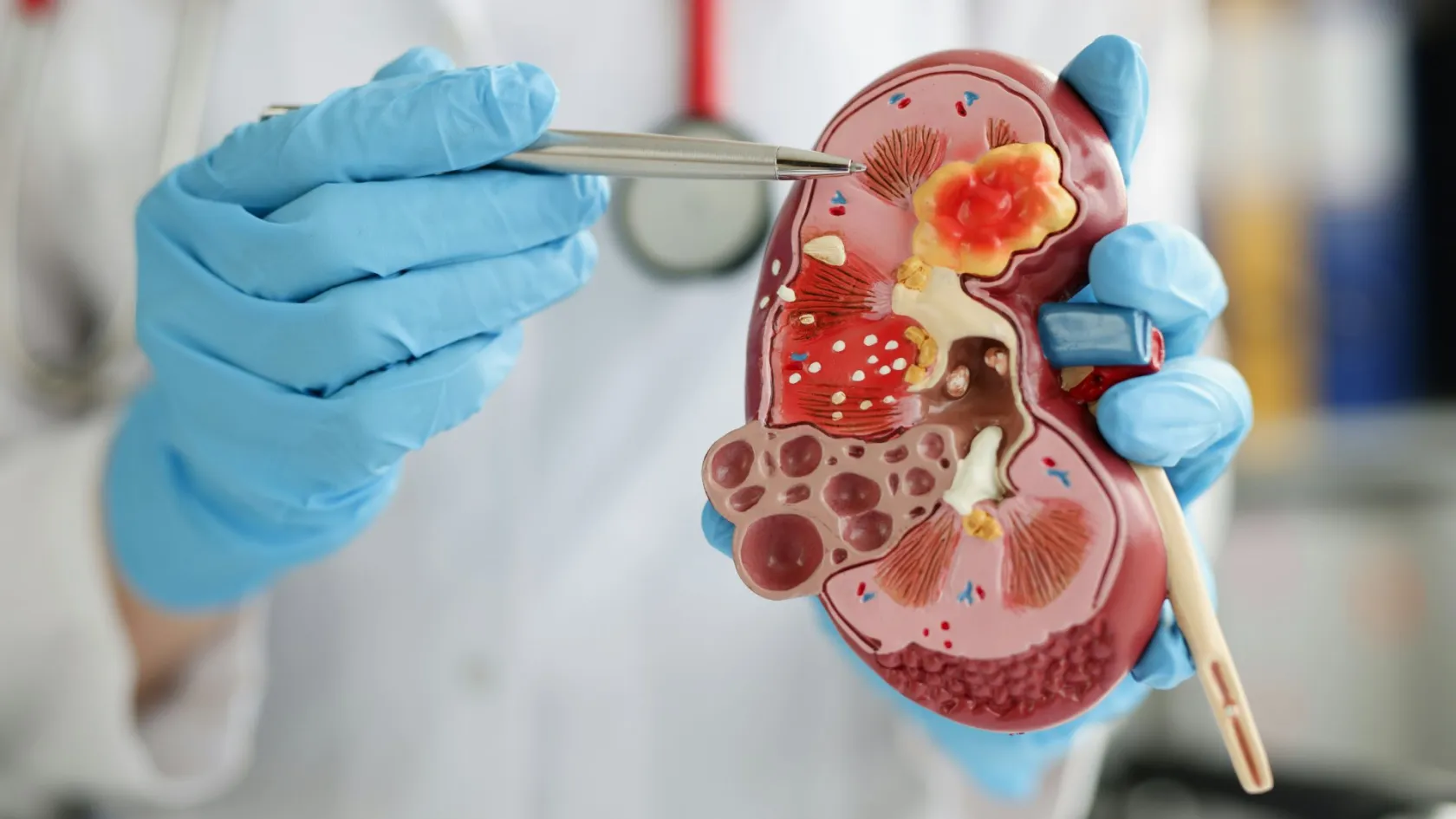
Kidney Cancer - Renal Cancer Surgery
A share of small kidney tumours removed by surgeons were never cancer, and a needle would have found that out in half an hour. This is what to ask before anybody operates.
About This Department
Two facts govern this operation and neither appears on most hospital pages. A meaningful share of small kidney tumours removed by surgeons turn out not to have been cancer at all. And the kidney you keep matters more to your next thirty years than the tumour was ever likely to. Everything below follows from those two sentences, including the uncomfortable part, which is that the only randomised trial testing the second one came out the wrong way round.
Free consultation
Send the scan images themselves, not only the report
Surgeons judge kidney tumours on what they look like across the contrast phases of a CT or MRI, so a written report describing a mass loses most of the information a surgeon needs. Send the actual images, the size in millimetres, where the tumour sits within the kidney, your creatinine and estimated filtration rate, and a note of diabetes, blood pressure and any kidney problem in the family. Say whether it was found by accident on a scan for something else, because that changes the picture more than people expect. What comes back is an opinion on whether part of the kidney can be kept, whether a needle biopsy should come first, and whether watching is reasonable. The review costs nothing and carries no obligation. Do send the images. A report alone rarely settles the question that matters.
How yours was probably found
Most kidney cancers today are discovered by accident, when somebody scans an abdomen for gallstones, back pain or a car accident, and there on the film is a lump in a kidney that was causing no trouble whatsoever. The classic textbook presentation of blood in the urine, a lump in the side and pain together has become genuinely uncommon, and when it does appear it usually means a tumour that has grown considerably. Accidental discovery explains why these tumours turn up small, and finding them small is why the next question becomes so awkward.
What a scan cannot tell you
Scans describe a mass in impressive detail and still not tell you what it is. Contrast enhancement, shape, fat content and growth pattern all narrow the field, and yet a substantial minority of solid kidney tumours under four centimetres turn out on final pathology to be something that was never going to harm anybody, which is a sentence no imaging report has ever been able to prevent. Oncocytomas and certain fat-poor angiomyolipomas are the common culprits, and radiology cannot reliably separate them from cancer, which is how a proportion of people come to have a kidney operation for a benign lump. No scandal attaches to that, since surgeons were acting on the best information available. The situation is, however, avoidable in a way most patients never hear about, and the next section is about the thirty minute procedure that avoids it. It is not a new procedure. It is simply one that many units still treat as optional.
The needle nobody offers
Kidney tumours can be biopsied through the skin with a needle, under local anaesthetic, guided by ultrasound or CT. It takes half an hour, and in most other cancers this would be so obvious that nobody would discuss it, and in kidney cancer it remains optional in many units for historical reasons that no longer hold.
What a needle first actually changed
A single-centre cohort followed 231 patients with kidney tumours under five centimetres treated either by surgical removal or by burning or freezing the tumour through the skin. Without routine biopsy beforehand, benign tumours were being treated in 15 percent of the ablation group and 18 percent of the surgical group. Where routine pre-procedural biopsy was introduced, the number of benign tumours treated in the ablation cohort fell to zero. Complications occurred in 9 percent after ablation against 30 percent after surgery, filtration rate fell by 5.9 against 12.1, and survival and recurrence were statistically similar. The authors conclude that biopsy decreases intervention for benign tumours and should be performed routinely. This was a single centre and the groups were not randomised, so the comparison between ablation and surgery deserves caution, while the biopsy finding is straightforward arithmetic. Fewer benign tumours were treated. Nobody argues with that direction of travel.
Old objections to biopsy were that it might spread tumour along the needle track and that the result would be unreliable. Track seeding turned out to be vanishingly rare with modern technique, and reliability improved once pathologists began seeing enough of these specimens to be good at reading them.
When it can reasonably be skipped
Biopsy does not suit everyone, since a tumour that is obviously cancerous on imaging, a large mass, a young patient who would have surgery whatever the result, and a lesion that is genuinely difficult to reach are all reasons to skip it. What should not happen is having a kidney operation without anybody having raised the possibility.
Put the question directly. Would a biopsy change the plan here, and if not, why not. A clear no is a perfectly good reply and you have lost nothing by asking for it.
Why the kidney is worth keeping
Removing an entire kidney to deal with a three centimetre tumour is a bad trade, and the reasoning behind that has become the central principle of modern kidney cancer surgery. Nobody notices kidney function until it has gone, and reduced filtration drives cardiovascular disease, complicates every future illness and every future drug, and cannot be replaced by anything short of dialysis or a transplant.
Removing only the tumour and leaving the rest of the kidney behind is called partial nephrectomy, and it does exactly what the principle predicts.
What each operation did to kidney function
A European randomised trial assigned 541 patients with a tumour of five centimetres or less and a normal kidney on the other side either to removal of the whole kidney or to removal of the tumour alone. Followed for a median of 6.7 years, moderate impairment of filtration was reached by 85.7 percent of those who lost the whole kidney against 64.7 percent of those who kept part of it, a difference of 21 percentage points. Advanced kidney disease was reached by 10.0 against 6.3 percent, a gap that did not reach significance. Actual kidney failure occurred in 1.5 and 1.6 percent, which is to say identically. The benefit sits at the moderate end of the scale rather than at the end where dialysis lives, which is a distinction that matters when weighing a harder operation. Moderate impairment means a label on a blood test. Dialysis means a life. The trial moved the first and barely touched the second.
So far the principle holds, in that keeping kidney keeps filtration exactly as everyone expected.
And then the same trial said something else
In the survival analysis of that same trial, over a median of 9.3 years, the patients who kept part of their kidney did worse. Overall survival was lower after partial nephrectomy than after removing the whole kidney, with a hazard ratio of 1.50 and a confidence interval running from 1.03 to 2.16. The authors state plainly that the benefit to filtration did not translate into better survival in this population. Nobody in the field believes partial nephrectomy shortens life. The trial recruited slowly across eleven years and closed early without reaching its target, and the deaths driving that result were largely not from kidney cancer at all. Guidelines worldwide still recommend keeping kidney where it is technically feasible, and the large observational evidence supports them. This appears on the page anyway because the strongest argument against a recommendation belongs in front of the person receiving it. A surgeon who has never heard of that trial is not the surgeon you want. One who knows it, explains why it is unlikely to apply to your case, and still recommends keeping your kidney is doing the job properly. Aim for that conversation.
Four things that can be done
Tumour size, position and your own health decide between these more than preference does.
This table scrolls sideways on a narrow screen. Swipe or drag to see every column.
| Option | What it involves, and where it fits |
|---|---|
| Partial nephrectomy | The tumour and a rim of normal tissue come out, the rest of the kidney stays. Standard for tumours up to about seven centimetres where the position allows it, and essential where you have one kidney, tumours in both, or existing kidney disease. Technically harder than removing the whole thing. |
| Radical nephrectomy | The whole kidney comes out, with the fat around it and sometimes the adrenal gland. Right for large tumours, central ones wrapped around the vessels, and any situation where preserving kidney would compromise removing the cancer. Simpler, quicker and safer as an operation. |
| Ablation | A needle passed through the skin freezes or burns the tumour, generally without a general anaesthetic. Suits small tumours away from the collecting system, older patients and those unfit for surgery. Fewer complications, more residual and recurrent tumour, and it needs closer imaging afterwards. |
| Active surveillance | Scans at intervals, with treatment only if the tumour grows or changes. A serious option for small masses in older patients or those with competing illnesses, and it stops being reasonable if you cannot get reliable imaging where you live. |
How slowly these tumours actually move
Surveillance deserves more than the line it usually gets, because these tumours are slower than people assume.
How fast small kidney tumours actually grow
A multi-institution registry followed patients who chose surveillance for small kidney masses and analysed 2,542 imaging measurements from 571 people. Median age at enrolment was 70.9 years and the median tumour was 1.8 centimetres across. Researchers tested whether growth accelerated with age, using cutoffs at 65, 70, 75 and 80 years. Age was not associated with growth rate as a continuous variable, and the authors conclude that surveillance is a safe and durable option for ageing patients with these tumours.
What limits this for an international patient is not the medicine. What limits it is whether somebody at home will scan the same tumour the same way every six to twelve months for as long as it takes.
The operation and the clamp
Surgeons perform both operations through keyholes in the great majority of units now, robotically or laparoscopically, with an open approach reserved for very large tumours and for disease reaching into the great vein. Two to four hours either way.
Reaching the kidney
Ports go through the abdomen or the flank, the bowel and its lining are swept aside, and the kidney is exposed within the envelope of fat that surrounds it. Ultrasound on the kidney surface finds tumours that sit deep and cannot be seen from outside.
Controlling the blood supply
The renal artery is isolated first, and in a partial nephrectomy it may then be clamped, which stops the bleeding and buys a clear view while the tumour is cut out, at the cost of starving the kidney of oxygen for as long as the clamp stays on. The next panel is about whether that trade is worth making.
Taking the tumour
Out comes the tumour with a thin margin of normal kidney around it. Kidney cancers grow inside a capsule, so a rim of a few millimetres suffices here rather than the centimetres demanded elsewhere in the body, and why so much kidney can be preserved.
Rebuilding the kidney
Any opened blood vessels and any breach of the urine collecting system are sewn closed, after which the defect itself is repaired and the clamp released. Bleeding and urine leak are the two complications specific to this step, and both are much less common than they were.
Clamping or not, across 10,154 patients
A systematic review and meta-analysis pooled thirty-nine studies, four of them randomised, comparing partial nephrectomy performed with the artery clamped against operating with the blood running. Working without the clamp produced a smaller fall in filtration, a mean difference of 4 mL per minute, and a smaller percentage loss. It was also associated with lower odds of a positive surgical margin and of postoperative complications. Clamping produced less blood loss, by a mean of 48 mL. The transfusion difference did not reach significance. The reviewers note that most of the underlying data is observational and that heterogeneity between studies was substantial, which places this somewhere between a strong signal and a settled question. Four randomised trials sit inside it. Thirty-five do not. Treat the direction as reliable and the exact millilitres as an estimate.
What that difference is worth to you
Four millilitres per minute of filtration is a modest gain for most people and a meaningful one for somebody who is already close to a threshold. That covers the whole argument. It explains why surgeons who mostly operate on healthy kidneys and surgeons who mostly operate on impaired ones settle into different habits, without either of them being wrong.
Find out what your surgeon plans to do and why, and if a clamp is planned, roughly how long they expect it to stay on.
When it has grown into the vein
Kidney cancer has an unusual habit of growing along the vein draining the kidney and up into the great vein that returns blood to the heart. It can reach the liver, the diaphragm, occasionally the heart itself.
That sounds terminal and frequently is not.
Why it is less hopeless than it sounds
Extending along a vein is not the same as spreading through the bloodstream, and provided the tumour has not seeded elsewhere, removing the kidney together with the column of tumour inside the vein offers a genuine chance of cure. This becomes a serious undertaking, open rather than keyhole, involving vascular surgeons and sometimes cardiac bypass where the tumour reaches the heart, and it belongs in a unit that does several a year rather than one a decade.
Where a report mentions tumour thrombus, find out how high it reaches and how many operations at that level the team has performed, because those two answers matter more here than anywhere else on this page and because the volume question is one the surgeons themselves regard as legitimate. Level matters. Numbers matter more.
Treatment after surgery
For decades nothing given after kidney cancer surgery improved anything, and patients were simply watched. That changed with immunotherapy, and men and women whose pathology shows a raised risk of recurrence are now offered a year of a drug that blocks a brake on the immune system.
The drug works, and it costs something other than money.
What a year of adjuvant immunotherapy costs in side effects
Safety data were pooled from four phase 3 trials of adjuvant pembrolizumab, one of them in kidney cancer after nephrectomy, covering 4,125 patients treated for around eleven months with either the drug or a placebo. Treatment-related side effects occurred in 78.6 percent on the drug against 58.7 percent on placebo, and severe ones in 16.3 against 3.5 percent. Immune-mediated effects, meaning the immune system attacking healthy tissue such as the thyroid, the adrenal glands or the pituitary, occurred in 36.2 percent against 8.4 percent, severe in 8.6 against 1.1 percent. Systemic steroids were needed by 35.2 percent of those affected. These figures come from four trials pooled together across three different cancers, so they describe the drug and not kidney cancer specifically. The pattern holds across all four. That consistency gives the figures their weight.
Reading those numbers against your own risk
Roughly one patient in three on this treatment has their immune system turn on some healthy organ, and a proportion of those effects are permanent, particularly thyroid and adrenal ones. That price makes sense where the risk of recurrence is genuinely high and a poor one where it is not, which makes the pathology report the document that decides it, and not a general preference for doing something.
Establish what your recurrence risk actually is before agreeing to a year of anything.
Living with what is left
Losing one kidney does not turn a healthy person into a kidney patient. The remaining kidney enlarges and takes on more work across the following months, so that most people settle at somewhere around 70 to 80 percent of their previous filtration rather than the half that arithmetic would suggest. Nothing about daily life changes for the great majority.
The margin for error, and where it narrows
The margin for error narrows, and that is where the advice belongs.
This table scrolls sideways on a narrow screen. Swipe or drag to see every column.
| What to watch | Why it matters now |
|---|---|
| Blood pressure | Matters more than it did, because high pressure damages the kidney you have left and there is no spare. This is the single most useful thing to get right. |
| Anti-inflammatory painkillers | Regular use is the commonest avoidable cause of decline. An occasional tablet for a headache sits in a different category from daily use for a bad back. |
| Contrast and prescriptions | Scan contrast and several common drug classes need a dose or a decision that accounts for reduced filtration, which means telling every doctor you see. |
| Diabetes | Where you have it, control matters roughly twice as much as it did before, because both conditions damage the same structures. |
| Contact sports | There is a real if small argument against them with one kidney, and it deserves a conversation, not an assumption in either direction. |
Drinking extra water does not protect a kidney. The belief persists widely and remains simply untrue, and the energy is better spent on blood pressure.
Recovery
Keyhole kidney surgery recovers faster than most abdominal operations, and patients are frequently surprised by how ordinary the first fortnight turns out to be, particularly those who arrived expecting something comparable to the abdominal cancer operations described elsewhere on this site.
- Eating and walking the same day or the next, with most people home after two to four nights.
- Shoulder tip pain from the gas used to inflate the abdomen is common, alarming and gone within days.
- Blood in the urine can appear in the first fortnight after a partial nephrectomy and generally settles on its own, though it should be reported every time rather than watched, because the same appearance can be the first sign of the delayed bleeding described below.
- Desk work at two weeks, heavy lifting at six, and nothing much in between that requires planning.
- A blood test at around six weeks establishes where your filtration has settled, and it is the number your future care is built on.
The two things to recognise at home
Two complications specific to partial nephrectomy are worth recognising. Delayed bleeding announces itself as sudden pain with visible blood in the urine, most often in the second or third week, while urine leak produces persistent drainage or pain in the flank. Both respond to treatment and both need reporting immediately rather than at the next appointment.
How long you stay
Ten to fourteen days for keyhole surgery of either kind, and sixteen to twenty-one where the tumour extends into the vein or the approach is open, with the difference coming from the operation rather than from any difference in how quickly people feel well. The delayed bleeding risk after a partial nephrectomy is the reason the shorter figure is not shorter still.
Assessment runs two to three days, in which the imaging is reviewed here and not accepted on a report, kidney function is measured, and a split function scan is added where the other kidney is questionable. A needle biopsy, where it is indicated, happens in this window and its result takes two to four days. Hospital stay runs two to four nights for keyhole surgery and five to eight for open surgery with vein involvement. Then a further week nearby, covering the wound review, the pathology discussion, a blood test to confirm the kidney is settling where it should, and the conversation about whether adjuvant treatment is indicated at all. That last discussion is the one people are least prepared for, since it arrives when the operation already feels finished.
When you are cleared to fly
Around ten days after keyhole surgery and two to three weeks after an open operation, once wounds are dry, the urine is clear and the kidney blood tests have stopped moving in the wrong direction, which is a different thing from being normal and is the condition that actually gets checked. Where adjuvant immunotherapy is recommended, settle before you leave whether it will be given here or at home, since it runs for a year and starting it late is worse than spending an extra day arranging it properly. Do that at the assessment stage. Not on the ward, the afternoon before your flight.
What drives the cost
Partial and radical nephrectomy are different operations with different price behaviour, which surprises people who assume removing less costs less. Seven things move the figure.
- Partial against radical, since keeping kidney takes longer, needs more instruments and carries a higher complication rate.
- Robotic, laparoscopic or open, with console time and single-use robotic instruments the largest single variable.
- Whether the tumour reaches the vein, which changes this from a urological operation into a joint vascular one.
- Needle biopsy beforehand, and the pathology on it.
- Intraoperative ultrasound, fluorescence imaging and haemostatic materials used on the cut kidney surface.
- Length of stay, which is longer after partial nephrectomy for reasons of bleeding risk rather than illness.
- The pathology on the whole specimen, including the markers that determine whether adjuvant treatment is offered.
The item that dwarfs the operation
For the patients who need it, a year of adjuvant immunotherapy is larger than everything else on this page put together. This never counts as a surgical cost and never appears on a surgical quotation, so finding out afterwards that it was never included in anybody's arithmetic is a common and entirely avoidable shock. Raise it at the assessment stage, before the operation, whether or not anybody has yet said you are likely to need it.
Packages here ordinarily cover the transfers, the assessment, the operating fees, the stated hospital nights, an interpreter, accommodation and the appointments before you fly. Outside them sit the flights, insurance, extra nights, the treatment of a complication, and any adjuvant therapy.
Five questions to ask before you accept a figure
Does the figure assume a partial or a radical nephrectomy, and what changes if the surgeon has to convert during the operation. Is the needle biopsy and its pathology included. What happens financially if bleeding requires a return to theatre or an embolisation. Are the follow-up blood tests before departure inside the figure. And has anybody quoted the adjuvant treatment, or is it assumed to be somebody else's problem.
Nothing here means anything until a urologist has looked at your actual images. That review costs nothing.
Once you are home
Kidney cancer needs longer follow-up than people expect, because it can recur late and occasionally does so more than a decade after an operation everybody had stopped thinking about. Expect scans of the chest and abdomen at intervals set by your stage and grade, along with blood tests for kidney function, running for at least five years and frequently a good deal longer where the pathology puts you in a higher risk category.
Five documents should travel home with you, in English, because the doctor arranging all of that was not in the operating theatre.
- The operative note, stating whether the kidney was removed whole or in part, and whether the artery was clamped and for how long.
- The full pathology, with subtype, grade, size, stage, margin status and whether there was sarcomatoid change.
- Your recurrence risk category and the surveillance schedule built from it, with the actual scan intervals written out.
- The kidney function baseline, meaning the filtration rate before and after, which every future doctor will need.
- A written list of the drugs and doses that now need adjusting, so that a doctor treating you for something unrelated does not have to work it out.
Get in touch here for sudden flank pain, visible blood in the urine after the first fortnight, fever, a wound that opens, or a filtration rate that keeps falling rather than settling at a new level, since the difference between a kidney finding its feet and a kidney deteriorating is a trend across three blood tests rather than any single result. Also get in touch about anything odd during adjuvant immunotherapy, particularly fatigue, thirst, dizziness or bowel changes, because immune side effects are far easier to manage early and are frequently dismissed by people who do not know you are on the drug. Carry a card or a note on your phone saying you have one kidney, or part of one. Nothing else you can do for yourself matters as much in an emergency department anywhere in the world, because the first decisions made about a person who cannot speak for themselves are drug doses and contrast, and both of those depend on how much kidney there is.
Frequently asked questions about kidney cancer surgery
Should I have a biopsy before the operation?
Is it better to remove part of the kidney or all of it?
Can a small kidney tumour just be watched?
What does clamping the blood supply do?
Will I need treatment after the surgery?
How long do I stay, and how will I feel with one kidney?
References
- Scosyrev E, Messing EM, Sylvester R, Campbell S, Van Poppel H. Renal function after nephron-sparing surgery versus radical nephrectomy, results from EORTC randomized trial 30904. European Urology. 2014;65(2):372-377.
- Lourenco P, Bilbey N, Gong B, Bahrabadi A, Halkier B. Percutaneous ablation versus nephrectomy for small renal masses, clinical outcomes in a single-center cohort. CardioVascular and Interventional Radiology. 2018;41(12):1892-1900.
- Alam R, Yerrapragada A, Wlajnitz T, et al. Evaluation of growth rates for small renal masses in elderly patients undergoing active surveillance. European Urology Open Science. 2023;50:78-84.
- Dębiński P, Karwacki J, Nowak Ł, et al. Off-clamp versus on-clamp partial nephrectomy, an updated systematic review, meta-analysis and meta-regression. Journal of Clinical Medicine. 2026;15(7):2792.
- Luke JJ, Long GV, Robert C, et al. Safety of pembrolizumab as adjuvant therapy in a pooled analysis of phase 3 clinical trials of melanoma, non-small cell lung cancer, and renal cell carcinoma. European Journal of Cancer. 2024;207:114146.
Editor's note
Written by the Biruni Hospital medical editorial team. Reviewed by Prof. Dr. Mustafa Teoman YANMAZ, Medical Oncology.
Medically reviewed by

Prof. Dr. Mustafa Teoman YANMAZ
Medical Oncology
Related Treatments
View All-
Bilateral Mastectomy
Whether you carry a BRCA mutation, have cancer in one breast or in both, bilateral mastectomy removes both breasts in one operation, and how much it helps depends on which of those three paths brought you to it.
-

Breast Conserving - Lumpectomy Surgery
Keeping the breast has never been the less thorough choice, and the largest recent studies now point the other way. This page explains who can have breast conserving surgery, what the margin report decides, and how long a woman traveling for it needs to stay.
-
Cytoreductive - Tumor Reduction Surgery
Patients cleared of every visible deposit lived 30 months in one gastric series. Those left with anything at all lived 7.3 months, however little remained.
-
Debulking - Ovarian Cancer Tumor Reduction
Two women with the same diagnosis on the same morning can get operations that share almost nothing. What decides it is who measured the disease first.
-
Debulking Surgery
Surgeons removed a median of 57 lymph nodes from women already cleared of visible disease. It bought no extra months, and tripled deaths within 60 days.