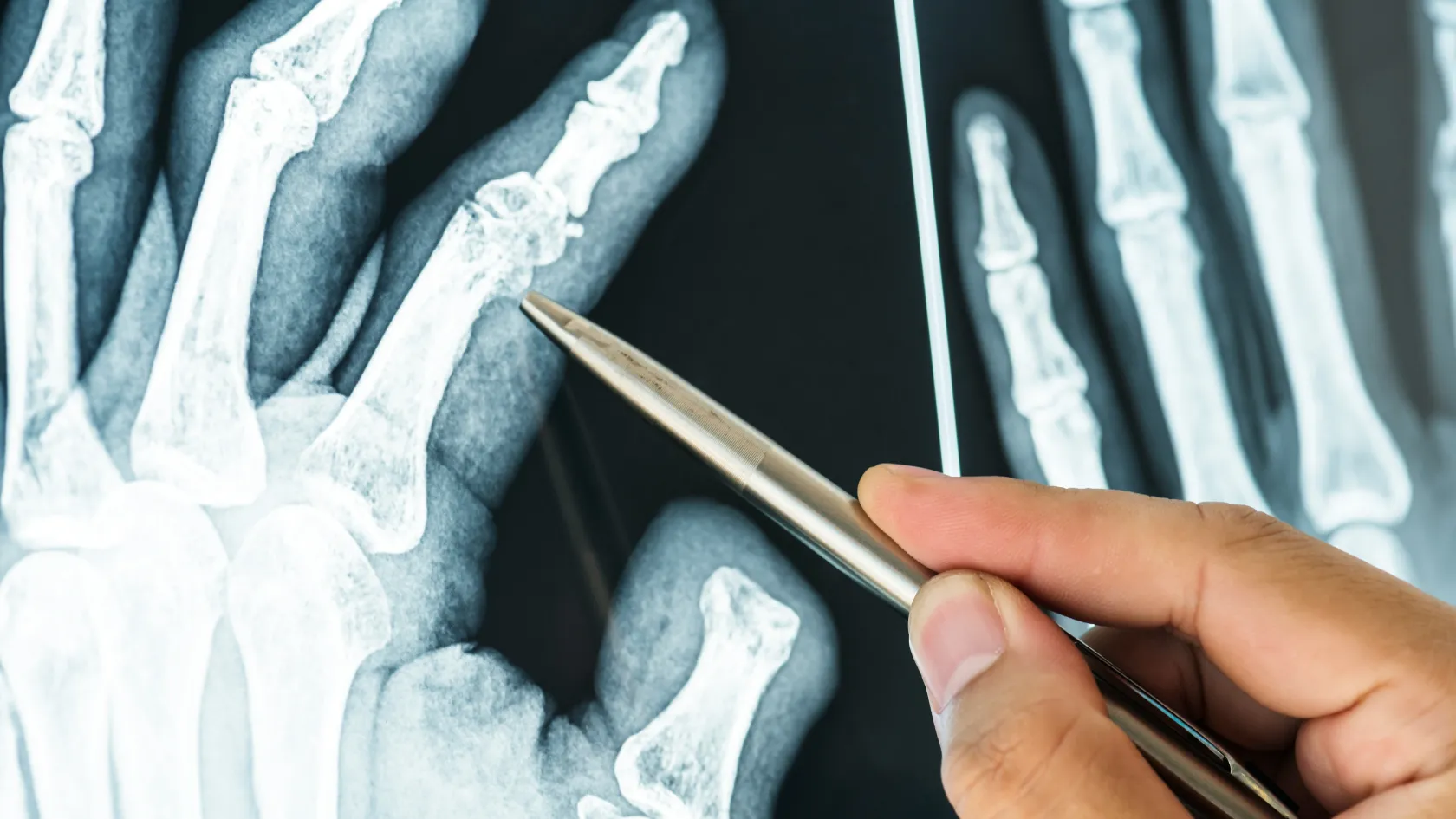
Two people with the same worn joint on an X-ray can live very different lives, so joint replacement for arthritis is timed by what the pain takes from your day, after exercise, weight management and medicines have had a fair trial.
About This Department
Orthopedics
Arthritis decides the timing by what it takes from your day. The X-ray only confirms it.
In a randomized trial of knee osteoarthritis, replacement followed by exercise therapy improved a 100-point knee score by 32.5 points at one year, against 16.0 points for exercise therapy alone.
82.3%
Knee replacements still in place at 25 years in registry data
57.9%
Hip replacements still in place at 25 years in registry data
About 14 days
Published total stay in Turkey for one joint
Free
Review of your X-rays before you book
Free consultation
The review costs nothing and carries no obligation. Send recent standing X-rays of the painful joint, a list of your medicines and the treatments you have tried, and an orthopedic surgeon will tell you whether replacement is the right step now, which implant fits, and how long to plan for. A coordinator replies in your own language.
Arthritis has worn a joint to the point where pain wakes you at night, walking distance keeps shrinking, and tablets, injections and exercise no longer hold it back. Joint replacement removes the damaged joint surfaces and replaces them with metal, plastic or ceramic parts, and it is done most often for the hip and knee, followed by the shoulder, the ankle and the small joints of the hand. Below you will find how to tell when arthritis is ready for surgery, what a randomized trial found when it compared knee replacement with a full program of non-surgical care, which joints can be replaced and what the alternatives are, how rheumatoid arthritis changes the plan, what to expect for pain relief and implant lifespan, how long to stay in Istanbul, and the follow-up at home.
When arthritis is ready for a new joint
X-rays alone do not decide.
Two people with the same picture of worn cartilage can live very different lives, one still walking the dog every morning and the other unable to manage the stairs, so surgeons weigh what the joint stops you doing alongside what the images show. The usual point of decision comes when pain is present most days and at night, the joint has stiffened or bent out of line, and at least three to six months of exercise therapy, weight loss where it applies, pain medicines and perhaps an injection have been tried properly without enough relief. Waiting too long has costs as well, because muscles waste, the joint stiffens further and the heart and lungs lose fitness, and patients who reach surgery very disabled finish lower than those who come earlier, even though they gain more from where they started. The decision is yours to make with the surgeon, weighing how much the joint takes from your day against the risks of an operation, and no X-ray score or age limit makes it for you.
1
Exercise therapy
Twelve weeks or more.
2
Weight
Each kilogram lost takes load off the hip and knee.
3
Medicines and injections
Pain medicines as tolerated, and a steroid injection for a flare.
Signs it may be time
Pain most days and at night, walking or stairs limited, a joint that is stiff or out of line, X-rays showing advanced damage, and a proper trial of exercise, weight management and medicines that no longer helps enough.
Talk to us first
Pain mainly from the back or nerves, mild changes on X-ray, an active infection anywhere in the body, uncontrolled diabetes, recent heart problems, or a goal of heavy impact sport after surgery.
Surgery or exercise first, the Danish knee trial
One trial from Denmark, published in the New England Journal of Medicine in 2015, assigned 100 patients by chance. All had moderate to severe knee osteoarthritis and were already eligible for replacement, and half had the operation followed by twelve weeks of non-surgical care while the other half had the twelve weeks alone, a program built from five parts.
Supervised exercise.
Education about osteoarthritis.
Diet advice for weight loss.
Insoles.
Pain medicines.
This table scrolls sideways on a narrow screen. Swipe or drag to see every column.
Twelve-month results of the Danish knee replacement trial
Measure
Replacement plus non-surgical care
Non-surgical care alone
Improvement on a 100-point knee score
32.5 points
16.0 points
Serious adverse events
24
6
Crossed over to surgery within a year
Not applicable
13 of 50 patients, 26 percent
Surgery gave twice the improvement but brought more complications. Three quarters of the non-surgical group managed the year without an operation.
Who might reasonably try exercise first
Moderate pain that still allows walking and sleep, no fixed deformity, and the time and support to follow a twelve-week program before deciding.
Exercise first is a real choice.
Which joints can be replaced
Hips and knees make up most replacements, but the choice and its alternatives change from joint to joint.
Partial or total knee
When arthritis is limited to one side of the knee and the ligaments are intact, a partial replacement keeps more of your own knee and recovers faster, at the cost of a higher revision rate over 25 years.
This table scrolls sideways on a narrow screen. Swipe or drag to see every column.
Joint replacement and the main alternatives by joint
Joint
Replacement options
Main alternative
Hip
Total hip replacement, cemented or uncemented
Exercise therapy and medicines
Knee
Total knee replacement, or partial replacement when only one compartment is worn
Exercise therapy, bracing, and in younger patients an osteotomy that shifts load
Shoulder
Anatomic total shoulder, or reverse shoulder when the rotator cuff is torn
Physiotherapy and injections
Ankle
Total ankle replacement
Ankle fusion
Elbow
Total elbow replacement, mostly for rheumatoid arthritis
Clearing out the joint in milder cases
Thumb base and fingers
Small joint implants in selected patients
Trapeziectomy or fusion
Ankle replacement or fusion
In a British trial of 303 patients aged 50 to 85, published in 2022, both operations improved walking and standing at one year with no clear winner overall. Replacement brought more wound healing problems, while fusion brought more blood clots and a 7 percent rate of bones that failed to join with symptoms.
Rheumatoid and other inflammatory arthritis
Inflammatory arthritis affects several joints at once, softens bone and, through its medicines, raises the risk of infection. Planning differs.
1
Medicines
The rheumatologist and surgeon agree which medicines pause before surgery and when they restart. Steroids are never stopped suddenly.
2
The neck
X-rays of the neck before anesthesia, because rheumatoid disease can loosen the top of the spine.
3
The order
Lower limb joints before upper limb joints, since crutches load the wrists, elbows and shoulders.
Tell the team before travel
Every medicine you take with its dose, including injections given weekly or monthly, the date of the last dose, and any infection in the past year.
Bring the full medicine list.
What to expect from a new joint
Pain relief is the main reason to have a joint replaced, and it works for most. Not for everyone. A review of prospective studies found an unfavorable long-term pain outcome in 9 percent or more of patients after hip replacement and around 20 percent after knee replacement.
Implants last.
Two Lancet reviews of national registry data published in 2019 found that 82.3 percent of total knee replacements and 57.9 percent of total hip replacements were still in place 25 years after surgery, while partial knee replacements reached 69.8 percent at 25 years. Younger and more active patients wear implants faster, so an implant fitted at fifty is more likely to need revising during a lifetime than one fitted at seventy-five.
Getting ready for surgery
1
Exercise before surgery
Strength work for the thigh and hip muscles, started weeks before the operation, shortens the time on crutches afterward.
2
Weight and blood sugar
Weight loss where possible and good diabetes control lower wound and infection risk.
3
Teeth, skin and urine
Treat infections first.
4
Medicines
Blood thinners and arthritis medicines are paused or bridged on the surgeon's written plan.
5
Home
A raised toilet seat, a firm chair with arms, loose rugs taken up, and someone at home to help with shopping, cooking and laundry for the first two weeks.
Risks and how they are managed
Blood clots
Clot prevention medicine, early walking and compression on long journeys.
Infection
Antibiotics around surgery, clean wound care and treating other infections first. A deep infection needs another operation.
Stiffness
Most common after knee replacement. Early physiotherapy prevents most of it.
Dislocation
Mainly after hip and shoulder replacement, in the first weeks. Precautions taught before discharge.
Wear and loosening
The reason most implants eventually need revising, years or decades later.
The recovery
Walking starts the next day.
After a hip or knee replacement you stand with a physiotherapist on the day of surgery or the day after, walk with a frame or crutches on the ward, and climb stairs before going home, then move to a stick over the next few weeks as the leg strengthens. A knee is slower and more painful in the early weeks than a hip, because bending has to be regained against swelling, and daily exercises at home over the first three months decide how far it will bend in the end. Shoulder replacements spend several weeks in a sling, ankle replacements spend weeks in a boot with limited weight through the foot, while desk work returns within six weeks and driving between four and eight weeks, depending on the joint and the side. Swelling around a new knee can last three to six months. Sleep suffers in the first weeks, and pain medicines taken before exercise sessions make the work easier, so the team writes a schedule for them before you leave.
The knee needs patience.
How long to stay in Istanbul
Plan for two weeks.
Published packages for knee replacement in Istanbul list three or four nights in hospital and those for hip replacement three to five nights, and clinics advise fourteen days in Turkey in total for a single joint. That leaves time for the stitches or clips to be checked, for physiotherapy sessions after discharge and for a safe flight, with a walk every hour and the clot prevention plan your surgeon writes. Two joints in one trip take longer.
What decides the cost
The joint, one side or both, a total or a partial implant, the implant brand, nights in hospital, physiotherapy sessions and any extra tests set most of the figure.
Published Istanbul packages list the operation, anesthesia, the hospital stay with nursing, laboratory tests, medicines during admission, initial rehabilitation and transfers. Hotel nights near the hospital and physiotherapy after discharge sit outside several of them. A quote you can compare names the joint, the implant, the nights and the therapy sessions, and that figure comes only from an orthopedic surgeon reading your X-rays.
The review costs nothing.
Arranging the trip
One WhatsApp message starts it. From then on a single coordinator handles your case, from the first X-ray review to the day you board the plane home, and answers on that number long after. Staff speak English, Arabic, French, Russian, Serbian, Romanian and Spanish, and an interpreter covers anything else. A relative or friend can sleep in your room on the companion bed for the whole admission, while the international office reserves a hotel for the nights before and after, mails the invitation letter you need for a medical visa ten days ahead and sends a car to the airport. The kitchen prepares halal, vegetarian and diabetic menus, there is a prayer room in the building, and you can ask for a female doctor in that first message.
Once you are back home
Your local physiotherapist continues the program written in Istanbul. X-rays at six weeks and one year, then every few years, follow the implant, with the coordinator passing them to the surgeon.
Fever, a red or draining wound, a swollen painful calf, sudden breathlessness, or a joint that suddenly gives way. Each needs a doctor the same day.
Joint replacement for arthritis FAQ
When is the right time for a joint replacement?
When pain is present most days and at night, daily life is limited, and a proper trial of exercise, weight management and medicines no longer helps enough.
Is knee replacement better than exercise therapy?
In a randomized trial, replacement plus exercise therapy improved a knee score by 32.5 points against 16.0 for exercise therapy alone, with more complications, and 74 percent of the exercise group managed a year without surgery.
How long does a joint replacement last?
In registry data, 82.3 percent of knee replacements and 57.9 percent of hip replacements were still in place at 25 years.
Can rheumatoid arthritis patients have joint replacement?
Yes. The rheumatologist and surgeon plan medicine pauses, check the neck before anesthesia and decide the order of operations.
How long should I stay in Istanbul?
About two weeks for one joint, including three to five nights in hospital.
Can a family member stay with me?
Yes. A relative can sleep in your room on the companion bed, and a nearby hotel can be booked for anyone else traveling with you.
References
Skou ST, Roos EM, Laursen MB, et al. A randomized, controlled trial of total knee replacement. N Engl J Med. 2015;373(17):1597-1606.
Evans JT, Walker RW, Evans JP, Blom AW, Sayers A, Whitehouse MR. How long does a knee replacement last? A systematic review and meta-analysis of case series and national registry reports with more than 15 years of follow-up. Lancet. 2019;393(10172):655-663.
Evans JT, Evans JP, Walker RW, Blom AW, Whitehouse MR, Sayers A. How long does a hip replacement last? A systematic review and meta-analysis of case series and national registry reports with more than 15 years of follow-up. Lancet. 2019;393(10172):647-654.
Beswick AD, Wylde V, Gooberman-Hill R, Blom A, Dieppe P. What proportion of patients report long-term pain after total hip or knee replacement for osteoarthritis? A systematic review of prospective studies in unselected patients. BMJ Open. 2012;2(1):e000435.
Goldberg AJ, Chowdhury K, Bordea E, et al. Total ankle replacement versus arthrodesis for end-stage ankle osteoarthritis. A randomized controlled trial. Ann Intern Med. 2022;175(12):1648-1657.
Editor's note
Written by the Biruni Hospital medical editorial team. Reviewed by Assoc. Prof. Dr. Suat BATAR, Orthopedics and Traumatology.