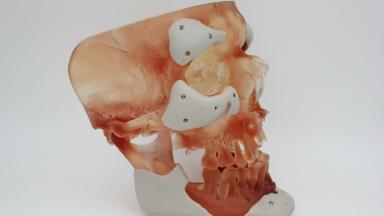
When arthritis or deformity has worn out the big toe, ankle, hindfoot, wrist or a finger joint, joint fusion surgery heals the bones into one so the joint stops moving and stops hurting, and healing that bone, helped by stopping smoking, decides the result.
About This Department
Orthopedics
A fused joint stops moving and stops hurting. Healing the bone is the whole job.
A review of 277 big toe fusions with modern fixation found a 95.7 percent union rate, while active smokers in a matched ankle fusion study had 3.75 times the risk of a fusion that failed to heal.
95.7%
Union rate in a review of 277 big toe fusions
3.75 times
Risk of nonunion for active smokers after ankle fusion
1 to 2 weeks
Usual stay in Istanbul after a foot or ankle fusion
Free
Review of your X-rays before you book
Free consultation
The review costs nothing and carries no obligation. Send standing X-rays of the painful joint, any CT or MRI and earlier operation notes, and an orthopedic surgeon will tell you whether fusion or replacement suits you, which joints are involved, and how long to plan for. A coordinator replies in your own language.
Arthritis, an old fracture or a deformity has left a joint that hurts with every step or every grip, and injections, braces and shoes have stopped helping. Joint fusion surgery, called arthrodesis, removes the worn cartilage and holds the bones together with screws, plates or a nail until they heal into one solid bone, so the painful joint no longer moves and no longer hurts. Below you will find which joints are fused and why, how fusion compares with joint replacement, the healing rates published for the big toe and the ankle, why smoking matters so much, how the operation is done, what happens to the neighboring joints, the recovery, how long to stay in Istanbul, and the follow-up at home.
What joint fusion does
Fusion trades motion for comfort.
A joint hurts when worn cartilage lets bone rub on bone, and when two bones grow together into one, nothing rubs anymore. The trade works best in joints whose motion the body can spare or make up for elsewhere, such as the big toe, the ankle and the joints of the hindfoot, the wrist, the base of the thumb and the small finger joints, and it works least well in the hip and knee, where replacement has largely taken its place. Fusion lasts. Once the bone has healed there is nothing to wear out or loosen, so it suits younger, heavier and more active patients and those who do hard physical work, and surgeons still choose it when a joint replacement has failed and cannot be redone. Deformity can be corrected at the same time, so a foot that has collapsed inward or a toe that has drifted sideways ends up straight as well as painless, and the corrected position holds for good once the bone has united.
This table scrolls sideways on a narrow screen. Swipe or drag to see every column.
Joints commonly fused and what is given up
Joint
Common reason
Motion given up
Big toe
Hallux rigidus, severe bunion, failed earlier surgery
Bending of the big toe, high heels become difficult
Ankle
Arthritis after fracture or instability
Up and down motion at the ankle, partly taken over by nearby joints
Hindfoot, subtalar or triple fusion
Flatfoot collapse, arthritis, deformity
Side to side motion, walking on uneven ground is harder
Midfoot
Arthritis, Charcot foot, old Lisfranc injury
Little noticeable motion
Wrist
Advanced arthritis, failed earlier surgery
Bending of the wrist, forearm rotation stays
Thumb and finger joints
Arthritis, instability, rheumatoid deformity
Bending of that one joint
1
Examination
The surgeon finds which joint hurts, how it moves and how the leg or hand is aligned.
2
Standing X-rays and CT
Weight-bearing films show the true wear, and CT shows the neighboring joints.
3
Test injection
Numbing one joint with local anesthetic confirms that it is the source of the pain before it is fused.
Fusion does three things well.
Lasting pain relief in a worn joint.
Correction of deformity in the same operation.
Stability for heavy use.
Spinal fusion follows the same principle and is covered on our spine pages.
Fusion or joint replacement
Replacement keeps motion but can wear out.
At the ankle the two have been compared directly. A British trial of 303 patients aged 50 to 85, published in 2022, found that both improved walking and standing at one year with no clear winner, with more wound problems and nerve injuries after replacement and more blood clots and failed fusions after fusion, where 7 percent of patients had a bone that did not join and caused symptoms. At the big toe, fusion remains the standard operation for advanced arthritis, and at the wrist and the small joints of the hand, fusion gives the most reliable pain relief for heavy use.
Signs it may be time
Severe arthritis in a joint you can spare the motion of, heavy work or high body weight, deformity that needs correcting at the same time, a failed earlier replacement, or poor bone and soft tissue for an implant.
Talk to us first
Arthritis in the joints right next to the one being fused, which will take extra load, smoking that cannot be stopped, poorly controlled diabetes, or a job or sport that depends on the motion you would lose.
How often fusions heal
Most fusions heal. Seven UK studies of big toe fusion with modern screws, plates or staples, covering 277 feet, together found a 95.7 percent union rate at a mean of 83.5 days, with complications in 5.8 percent. Another review of 898 big toe fusions in patients allowed to walk within two weeks of surgery in a protective shoe found that 6.35 percent failed to fuse, so early walking on the heel does not ruin the result.
The bone has to grow across the gap.
Several things slow that growth.
Smoking and nicotine in any form.
Diabetes, especially when poorly controlled.
Poor blood supply or earlier infection in the area.
Steroid tablets and some arthritis medicines.
Smoking and fusion
In a matched study of ankle fusions, active smokers had 3.75 times the risk of nonunion, and in patients with no other risk factor the risk was 16 times higher than in non-smokers. Stopping before surgery and staying stopped until the bone has healed matters more here than in almost any other operation.
1
Six weeks
X-rays show early bridging bone.
2
Twelve weeks
Most foot and ankle fusions have united, and a CT settles any doubt.
3
Full weight
Allowed once the surgeon sees solid bone.
How a fusion is done
On a phone, slide the table sideways to read every column.
Ways to hold a fusion
Fixation
Where it is used
Removed later
Compression screws
Ankle, hindfoot, big toe
Rarely
Plates
Big toe, midfoot, wrist
Sometimes, if they rub
Staples
Midfoot, big toe, small joints
Rarely
Intramedullary nail
Combined ankle and hindfoot fusion
Rarely
Wires or headless screws
Finger and thumb joints
Wires at six weeks
1
Preparing the surfaces
The remaining cartilage is removed down to bleeding bone, through an open incision or, at the ankle and some foot joints, through an arthroscope.
2
Setting the position
The joint is fixed in the position that works best for walking or gripping, which the surgeon plans on X-rays beforehand.
3
Holding it still
Screws, a plate, staples or an intramedullary nail hold the bones firmly together.
4
Adding graft where needed
Bone graft fills gaps after deformity correction or a failed earlier operation.
The joints next door
A fused joint passes its work to its neighbors.
After an ankle fusion, the joints below and in front of it move more to make up for the lost motion.
The subtalar joint under the ankle.
The talonavicular joint in the middle of the foot.
The small midfoot joints.
Over many years some of them develop arthritis of their own. Surgeons check them with X-rays and sometimes CT before fusing, and when they are already worn, an ankle replacement comes into the discussion.
Risks and how they are managed
Nonunion
The bones fail to join, and pain continues at the fusion site months after surgery. Revision with fresh bone graft and stronger fixation fixes most, provided smoking has stopped.
Malunion
A fusion set in a poor position, corrected with an osteotomy.
Wound problems and infection
More common in smokers and diabetics. Dressings, antibiotics and careful skin handling.
Blood clots
Clot prevention medicine while the leg is in a cast and off weight.
Prominent hardware
Screws or plates that rub are removed once the fusion is solid.
The recovery
Protection decides the result.
After a big toe fusion, most patients walk on the heel in a stiff-soled shoe within days and return to normal shoes at six to eight weeks. An ankle or hindfoot fusion is slower, with two weeks in a splint, then a cast or boot and no weight on the leg for six weeks or more, partial weight after that, and walking without aids by three months for many patients, while full comfort on uneven ground, hills and stairs can take a year. Wrist and finger fusions spend six to eight weeks in a cast or splint while the fingers and other joints keep moving. Crutches, a knee scooter or a wheelchair for the first weeks, a shower seat and help at home make the non-weight-bearing period manageable. Swelling in the foot lasts months. A compression stocking and raising the leg in the evenings help, and many people need a slightly wider shoe for the first year.
How long to stay in Istanbul
Published ankle fusion packages in Istanbul list hospital stays from one day to several nights and a seven-day stay in Turkey, with the operation itself taking two to three hours. Foot and ankle fusions call for one to two weeks so the wound is checked and the cast or boot fitted before the flight, and smaller toe, finger and thumb fusions for three to five days. Because the leg is off weight in a cast, the flight home needs an aisle seat, clot prevention and airline assistance booked in advance.
What decides the cost
The joint, the fixation and any graft, arthroscopic or open surgery, deformity correction, nights in hospital and imaging set most of the figure.
Published packages list surgery, surgeon fees, preoperative tests and consultations, and many add the hospital room, transfers, an interpreter, meals, imaging, implants, nursing, medicines and a companion's stay, so a quote you can compare names the joint, the fixation and what is included. That figure comes only from an orthopedic surgeon reading your X-rays and CT. The review costs nothing.
Arranging the trip
One WhatsApp message with your X-rays starts the review, and the coordinator who answers stays with you through surgery and after you fly home. English, Arabic, French, Russian, Serbian, Romanian and Spanish are spoken, with an interpreter for other languages. A companion sleeps in your room on the companion bed, the international office books a hotel, sends the visa invitation letter ten days before travel and arranges transfers, and halal, vegetarian and diabetic meals, a prayer room and a female physician on request are available.
Once you are back home
X-rays at six weeks and three months show the fusion healing, and a CT scan settles any doubt before full weight is allowed. A local physiotherapist takes over the walking program.
A swollen, painful calf, sudden breathlessness, a wound that opens or drains, fever, or new pain and movement at the fusion site. Each needs a doctor the same day.
Joint fusion surgery FAQ
Will I be able to walk normally after an ankle fusion?
Most patients walk without a limp on flat ground once the fusion has healed, though hills and uneven ground feel different.
How often does a fusion fail to heal?
In big toe fusion reviews, about 4 to 6 percent did not heal. Smokers carry several times the risk.
Is fusion better than joint replacement?
At the ankle, a trial found similar results at one year, with different complications. Fusion lasts once healed, while replacement keeps motion.
How long before I can put weight on my foot?
Within days on the heel after a big toe fusion, and after six weeks or more after an ankle or hindfoot fusion.
Can a fusion be reversed?
Rarely. In selected cases an ankle fusion can be converted to a replacement, but fusion is best treated as permanent.
Can a family member stay with me?
Yes. A relative or friend sleeps in your room on the companion bed for the whole stay, and a nearby hotel can be booked for anyone else traveling with you.
References
Goldberg AJ, Chowdhury K, Bordea E, et al. Total ankle replacement versus arthrodesis for end-stage ankle osteoarthritis. A randomized controlled trial. Ann Intern Med. 2022;175(12):1648-1657.
Kang YS, Bridgen A. First metatarsophalangeal joint arthrodesis/fusion. A systematic review of modern fixation techniques. J Foot Ankle Res. 2022;15(1):30.
Crowell A, Van JC, Meyr AJ. Early weight-bearing after arthrodesis of the first metatarsal-phalangeal joint. A systematic review of the incidence of non-union. J Foot Ankle Surg. 2018;57(6):1200-1203.
Cobb TK, Gabrielsen TA, Campbell DC, Wallrichs SL, Ilstrup DM. Cigarette smoking and nonunion after ankle arthrodesis. Foot Ankle Int. 1994;15(2):64-67.
Editor's note
Written by the Biruni Hospital medical editorial team. Reviewed by Assistant Professor Şafak SAYAR, Orthopedics and Traumatology.