Skip to content
Datscan
Nuclear Medicine

Datscan

About This Department

 
Nuclear Medicine

A DaTscan shows whether the brain's dopamine nerve endings are intact. When the diagnosis between Parkinson disease and a harmless tremor is uncertain, that answer changes treatment.

Parkinson disease, and related conditions such as multiple system atrophy and progressive supranuclear palsy, destroy the dopamine nerve endings in a deep part of the brain called the striatum. Essential tremor, drug-induced parkinsonism and many other causes of shaking do not. A DaTscan, a SPECT scan with a tracer that binds to those nerve endings, tells the two groups apart. In patients whose diagnosis was uncertain, clinicians at the first visit had overcalled Parkinson disease, while the scan was 97 percent specific. Send us the neurologist's notes and a list of your medicines, and a nuclear medicine physician will confirm whether the scan will answer your question.

95 to 97%
Sensitivity for parkinsonism against essential tremor
90.4%
Specificity for Lewy body dementia against Alzheimer disease
Half a day
Injection, a three to six hour wait and a 30 minute scan
Free
Nuclear medicine review of your file
Free consultation

What the scan shows

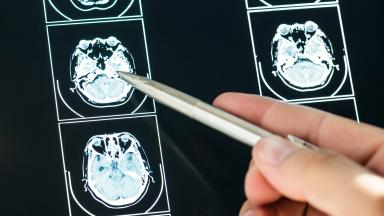
Dopamine nerve cells in the midbrain send fibers to the striatum, two comma-shaped structures deep in each half of the brain. The fibers carry a pump, the dopamine transporter, that recycles dopamine released into the gap between nerve cells for reuse. The DaTscan tracer, ioflupane labeled with iodine-123, binds to it. On a healthy scan the striatum shows as two bright commas. In Parkinson disease and its relatives the tail of the comma fades first, more on one side in the majority, leaving a full stop.

When is a DaTscan useful?

  1. Tremor of uncertain cause, to separate Parkinson disease from essential tremor.
  2. Parkinsonism in someone taking medicines that can cause it, such as some antipsychotics or anti-sickness drugs, to see whether an underlying Parkinson disease is present.
  3. Early or atypical symptoms, where the examination is not yet conclusive.
  4. Dementia with visual hallucinations or fluctuating alertness, to separate dementia with Lewy bodies from Alzheimer disease.
What a normal or abnormal result means

An abnormal scan confirms loss of dopamine nerve endings. It supports Parkinson disease or one of the related degenerative conditions, and in a patient with dementia it points toward Lewy body disease. It does not by itself say which of these conditions is present.

A normal scan argues strongly against degenerative parkinsonism. Essential tremor, drug-induced parkinsonism, dystonic tremor, parkinsonism from small strokes in many cases, and functional movement disorders leave the scan normal in nearly all cases. For the patient, a normal scan can mean stopping Parkinson medicines that were never going to help.

This table scrolls sideways on a narrow screen. Swipe or drag to see every column.

Accuracy in the main studies
Question Study Result
Parkinsonism against essential tremor Six centers, 158 patients with parkinsonism, 27 with essential tremor, Movement Disorders 2000 Sensitivity 95 to 97 percent, specificity 93 to 100 percent
Uncertain cases followed for three years 99 patients, Movement Disorders 2009 Scan specificity 97 percent. Clinical diagnosis at the first visit specificity 46 percent
Lewy body dementia against other dementias 326 patients, Lancet Neurology 2007 Sensitivity 77.7 percent, specificity 90.4 percent
DaTscan had a significant impact on clinical management, diagnosis and confidence of diagnosis in patients with clinically uncertain parkinsonian syndromes.
Randomized study of 273 patients, Journal of Neurology, Neurosurgery and Psychiatry, 2012
Thyroid protection
An hour before the injection you take a tablet, potassium iodide or perchlorate, that stops the thyroid taking up the iodine in the tracer.
Injection and wait
A small injection into an arm vein, then three to six hours of waiting while the tracer reaches the brain. You may leave the department, eat and drink.
The scan
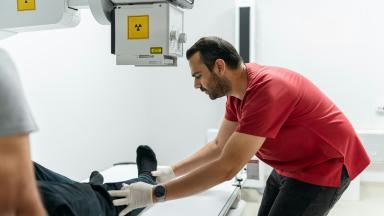
You lie on your back with your head in a rest while the SPECT camera turns around it for 30 to 45 minutes. Keeping still matters, and a mild sedative can be arranged for people with severe tremor.

What the scan cannot tell you

A DaTscan cannot separate Parkinson disease from multiple system atrophy or progressive supranuclear palsy, since all three damage the same nerve endings. The examination, time, and sometimes MRI or other scans decide between them. Nor can the scan predict how fast the disease will progress or which medicine will work best. It turns abnormal only once a large share of the nerve endings has been lost, and a normal scan in someone with very early, mild symptoms gets repeated a year or two later if doubt persists, and in research studies a small group of people first thought to have Parkinson disease, whose scans were normal, turned out over time to have another condition altogether.

How accurate is a DaTscan?

Accurate enough to overrule a first impression.

Against the clinical examination

In the first multicenter study, readers who saw only the images classed 95 to 97 percent of patients with a clinical diagnosis of parkinsonism as abnormal, and 93 to 100 percent of those with essential tremor as normal. Readers agreed with each other almost always.

A European study then followed 99 patients whose diagnosis was uncertain at the start for three years, with video recordings reviewed by blinded experts at the end as the reference. At the first visit, the treating clinicians had diagnosed degenerative parkinsonism in many patients who turned out not to have it, a specificity of 46 percent. The scan at the first visit had a specificity of 97 percent, and a sensitivity of 78 percent.

  • Some antidepressants and smoking-cessation medicines such as bupropion, and in high doses some other antidepressants.
  • Stimulants such as methylphenidate, amphetamines and modafinil, and cocaine.
  • Some appetite suppressants and cold remedies. Levodopa and most other Parkinson medicines do not need to be stopped.
What the scan changes

In a randomized study at 19 university hospitals in Europe and the United States, 273 patients with uncertain parkinsonism received a DaTscan or no scan. Those who were scanned had their diagnosis changed and their treatment adjusted more frequently, at 12 weeks and at one year, and their doctors were more confident of the diagnosis.

Quality of life and use of health services did not differ over the year. The scan helps doctors reach the right diagnosis sooner, and its benefit to patients lies in the decisions that follow.

Lewy body dementia

In a phase III study of 326 patients with dementia, an abnormal scan identified probable dementia with Lewy bodies with a sensitivity of 77.7 percent and excluded other dementias, mainly Alzheimer disease, with a specificity of 90.4 percent. The distinction matters, because people with Lewy body dementia can react badly to some antipsychotic medicines, and their fluctuations and hallucinations need a different approach.

How do I prepare, and how is the result read?

Medicines matter most.

Preparation

Bring a full list of medicines, including those bought without a prescription. The team tells you which to pause and for how long, several days for most, and which to continue. Eat as you would any day. Parkinson medicines continue unless the team says otherwise. Tell the team of any pregnancy, breastfeeding, kidney or liver disease and allergies to iodine.

Reading the result

  1. Normal. Both commas intact. Degenerative parkinsonism is very unlikely.
  2. Abnormal, one side more than the other. The typical pattern of Parkinson disease, with loss starting at the back of the striatum.
  3. Abnormal on both sides and throughout. Seen in more advanced disease and in some atypical parkinsonian conditions.

Measuring as well as looking

Visual reading is the standard. Software that compares uptake in each part of the striatum with a database of healthy people of the same age adds a number, which helps in borderline scans and when comparing two scans over time. The 2020 European and American joint guideline sets out how both should be done and reported.

Safety

Pregnancy and breastfeeding
The scan is avoided in pregnancy. Breastfeeding should be interrupted for several days after the injection, and the team gives exact advice. The radiation dose is similar to that of a CT scan of the abdomen.

The scan day, hour by hour

Morning
Arrival, a brief check of medicines, the thyroid tablet and, an hour later, the injection.
Midday
Free time, with lunch and a walk if you wish, while the tracer settles. Drinking plenty helps clear it.
Afternoon
The scan, then home or to the hotel. The report follows in one to two working days.
The diagnostic accuracy is sufficiently high for this technique to be clinically useful in distinguishing dementia with Lewy bodies from Alzheimer's disease.
Phase III study of 326 patients, Lancet Neurology, 2007
Beyond the DaTscan
PET scans of the dopamine system, with fluorodopa or newer transporter tracers, give sharper images and are used in some centers. Availability decides between them. A DaTscan remains the most widely available and most studied test for this question, with twenty-five years of data behind its readings.

Days, cost and the trip

The length of stay is short.

One day covers the scan, and a second day allows a consultation with a neurologist and the report in hand. The radiation dose is low, and flying the next day is fine.

Price follows the parts.

Cost covers the tracer, which is ordered for each patient, the thyroid tablet, the scan and the specialist report. A neurology consultation and quantification are separate items. Your own figure follows the free review of your file.

One coordinator handles your visit. The team works in seven languages, with interpreters for the rest. Ten days before travel, an invitation letter naming the hospital and the physician goes out, and the international patients office books the transfer and a hotel for you and a companion, who is welcome during the long wait. Halal, vegetarian and diabetic meals come on request, a prayer room is on site, and a request for a female doctor is passed to the department and met wherever the rota allows. Back home, the coordinator stays reachable on the same WhatsApp number, and the images go to your neurologist in a standard format together with the written report, the quantification figures if they were measured, and a note of the medicines you paused, so that anyone reading the scan later, or comparing it with a repeat scan in a year or two, knows exactly the conditions under which it was taken and can trust the comparison.

DaTscan FAQ

What does a DaTscan show?
Whether the dopamine nerve endings in the striatum are intact. Loss of these endings points to Parkinson disease or a related degenerative condition.
Can a DaTscan diagnose Parkinson disease?
It confirms or rules out loss of dopamine nerve endings. It cannot separate Parkinson disease from multiple system atrophy or progressive supranuclear palsy, which the neurologist distinguishes.
Can a DaTscan tell essential tremor from Parkinson disease?
Yes. Essential tremor leaves the scan normal, and in the first multicenter study the scan separated the two with 93 to 100 percent specificity.
Do I need to stop my medicines?
Levodopa and most Parkinson medicines continue. Some antidepressants, stimulants and cold remedies interfere and are paused on the team's advice.
How long does the scan take?
Plan half a day. The wait between injection and scan is three to six hours, and the scan takes 30 to 45 minutes.
Can my family come with me?
Yes. A companion is welcome during the wait, and the international patients office arranges a hotel.

References

  1. Benamer TS, Patterson J, Grosset DG, et al. Accurate differentiation of parkinsonism and essential tremor using visual assessment of [123I]-FP-CIT SPECT imaging. Movement Disorders. 2000;15(3):503-510.
  2. Marshall VL, Reininger CB, Marquardt M, et al. Parkinson's disease is overdiagnosed clinically at baseline in diagnostically uncertain cases: a 3-year European multicenter study with repeat [123I]FP-CIT SPECT. Movement Disorders. 2009;24(4):500-508.
  3. Kupsch AR, Bajaj N, Weiland F, et al. Impact of DaTscan SPECT imaging on clinical management, diagnosis, confidence of diagnosis, quality of life, health resource use and safety in patients with clinically uncertain parkinsonian syndromes. Journal of Neurology, Neurosurgery and Psychiatry. 2012;83(6):620-628.
  4. McKeith I, O'Brien J, Walker Z, et al. Sensitivity and specificity of dopamine transporter imaging with 123I-FP-CIT SPECT in dementia with Lewy bodies: a phase III, multicentre study. Lancet Neurology. 2007;6(4):305-313.
  5. Morbelli S, Esposito G, Arbizu J, et al. EANM practice guideline/SNMMI procedure standard for dopaminergic imaging in Parkinsonian syndromes 1.0. European Journal of Nuclear Medicine and Molecular Imaging. 2020;47(8):1885-1912.

Editor's note

Written by the Biruni Hospital medical editorial team. Reviewed by Specialist Dr. Sedat OFLUOĞLU, Nuclear Medicine.

Related Treatments

View All