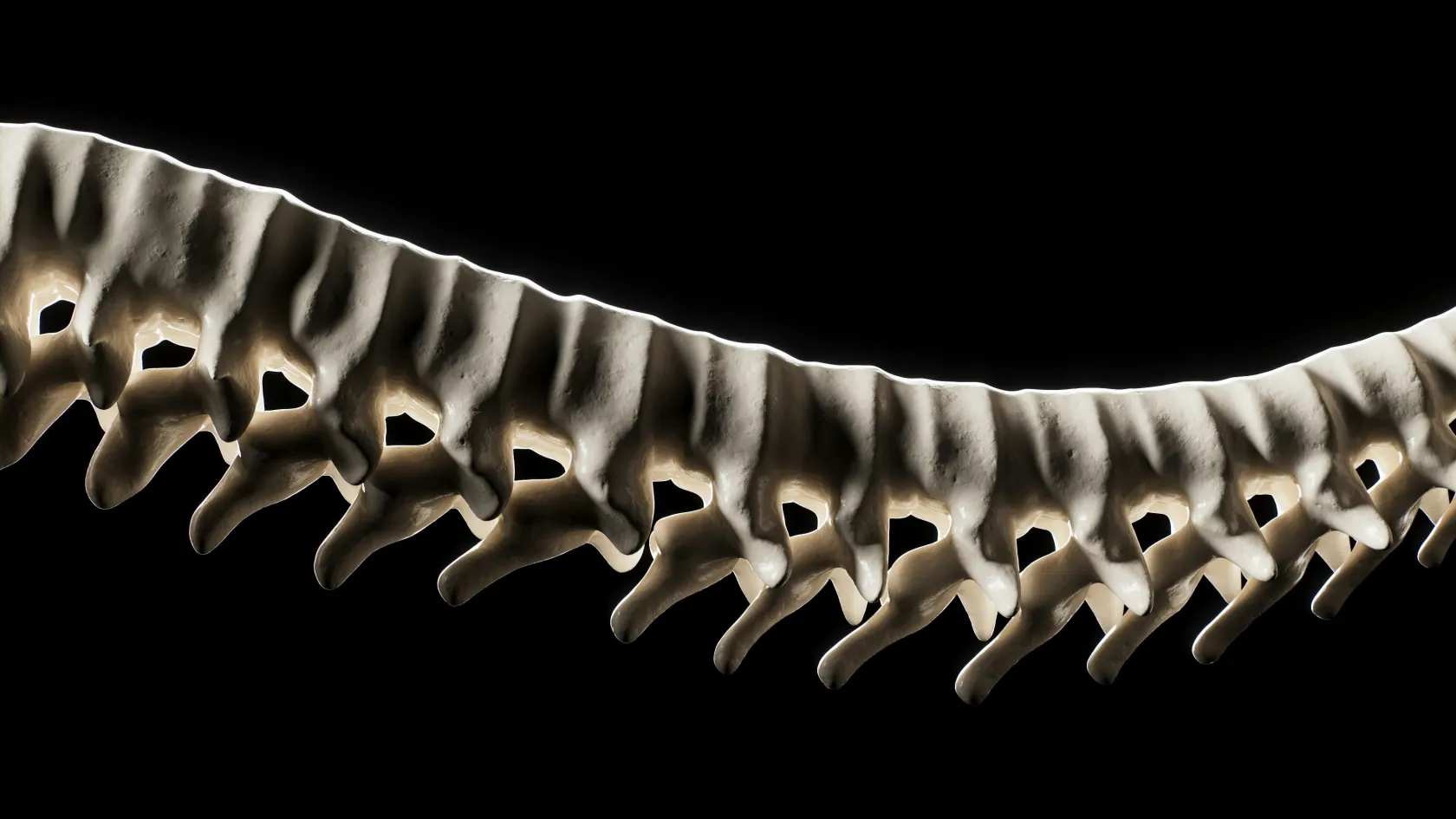
A fusion locks two vertebrae together, and the discs above and below then work harder with every turn and nod of the head. The idea behind a disc replacement is to spare those neighbors by keeping the treated level in motion.
What the trials show
Large randomized trials compared single-level disc replacement with fusion and followed patients for seven years or more. Both relieved arm pain. The disc replacement groups needed fewer repeat operations.
The Prestige Cervical Disc maintains improved clinical outcomes and segmental motion after implantation at 7-year follow-up.
Prestige trial at seven years, 2014
Who is a candidate
Four features.
- Arm pain or weakness from a soft disc herniation or modest spurs at one or two levels.
- A neck that still moves at that level on bending X-rays.
- Healthy facet joints, the small joints at the back of the neck.
- Good bone density and no instability.
When we recommend fusion instead
Severe arthritis in the facet joints, a level that no longer moves, instability or a slipped vertebra, osteoporosis, thick bony bars or a calcified ligament behind the vertebrae, infection or a tumor, and more than two levels. A disc replacement in these necks either fails to relieve the pain or stiffens anyway.
Single-level results at seven years
The Prestige trial randomized 541 patients with one painful level.
This table scrolls sideways on a narrow screen. Swipe or drag to see every column.
Prestige disc against fusion, single level, seven years
| Outcome |
Disc replacement |
Fusion |
| Improvement in neck disability score |
37.5 points |
31.9 points |
| Neurological status maintained or improved |
88.2 percent |
79.7 percent |
| Further surgery at the operated level |
4.8 percent |
13.7 percent |
| Surgery at a neighboring level |
4.6 percent |
11.9 percent |
| Working |
73.9 percent |
73.1 percent |
The ProDisc-C trial
Janssen and colleagues randomized 209 patients to the ProDisc-C disc or fusion and followed 92 percent for seven years. Pain relief and function matched, and neurological status held or improved in 88 and 89 percent. Secondary surgery reached 7 percent after disc replacement and 18 percent after fusion, with no difference in device problems.
This table scrolls sideways on a narrow screen. Swipe or drag to see every column.
ProDisc-C against fusion, seven years
| Outcome |
ProDisc-C |
Fusion |
| Patients needing secondary surgery |
7 of 103 |
19 of 106 |
| Secondary procedures in total |
7 |
30 |
| Neurological status maintained or improved |
88 percent |
89 percent |
Patients treated with ProDisc-C had a lower probability of subsequent surgery, suggesting that total disc arthroplasty provides durable results and has the potential to slow the rate of adjacent-level disease.
ProDisc-C trial, 209 patients, Journal of Bone and Joint Surgery, 2015
The operation step by step
1
Approach
Under general anesthesia, a three-centimeter incision in a skin crease at the front of the neck.
2
Removing the disc
Under the microscope, the surgeon removes the whole disc and any spur pressing on the nerve or cord.
3
Sizing
X-ray guides the choice of implant size and position at the center of the vertebrae.
4
Placing the disc
The implant goes in, the surgeon checks it on X-ray, and the incision closes with dissolving stitches.
Bone growth around the implant
This table scrolls sideways on a narrow screen. Swipe or drag to see every column.
Heterotopic ossification after cervical disc replacement, pooled from 38 studies
| Follow-up |
Any new bone |
Severe new bone |
| One to two years |
38.0 percent |
10.9 percent |
| Two to five years |
52.6 percent |
22.2 percent |
| Five to ten years |
53.6 percent |
47.5 percent |
Follow-up time was positively associated with the prevalence of severe HO (P < .01), and the 1-month growth of mean follow-up went with 0.63% increase of severe HO.
Meta-analysis of 38 studies, Medicine, 2017
Recovery week by week
1
Same day
Walking within hours.
2
Days one to two
Home, no rigid collar in most cases, and gentle neck movement encouraged from the start.
3
Two weeks
Desk work and driving.
4
Six weeks to three months
Sport and lifting, once an X-ray confirms the disc sits well.
What the new bone means
Severe new bone can slowly bridge the disc and stiffen the level, turning a replacement into something close to a fusion over the years. Anti-inflammatory tablets for two weeks after surgery reduce it, and pain relief holds either way.
Ossification at the neighboring level
Fusion leaves its own mark next door. In ten-year follow-up of the Bryan disc trial, high-grade ossification at the level above appeared in 68.2 percent after fusion with a plate and 11.1 percent after disc replacement, though it did not change pain or function scores.
Risks
Statistical evaluation of ALOD findings in patients from each surgical group found a significantly higher rate of high-grade ALOD in patients who underwent cervical arthrodesis with plate fixation compared with cervical arthroplasty (68.2% vs. 11.1%, P=0.0003).
Bryan disc trial, 10-year follow-up, Clinical Spine Surgery, 2020
Call the team the same day
Swelling in the neck with difficulty breathing, worsening difficulty swallowing, new weakness in an arm or leg, fever, or a wound that leaks.
Risks of the operation
The front-of-neck approach carries the same risks as a fusion. A sore throat and mild swallowing discomfort for a few weeks, a hoarse voice that settles in most cases, and rarely bleeding, infection or injury to the gullet. The disc itself can move out of place or wear, which the trials found rare at seven years, and severe new bone can stiffen the level.
Disc replacement or fusion
How we decide
We look at your age, the number of levels, the facet joints on CT, the motion on bending X-rays and the bone density. For a younger patient with a soft disc at one or two levels and healthy joints, we recommend a disc replacement. For arthritis, instability, three or more levels or poor bone, we recommend fusion, and we explain the reasons in writing either way.
Recovery and the stay in Istanbul
One night in hospital, then five to seven days in Istanbul for the wound check and an X-ray before you fly, with no collar needed for the flight. A companion can sleep in your room, coordinators speaking English, Arabic, French, Russian, Serbian, Romanian and Spanish arrange the hotel and transfers, and follow-up after you return home runs through them with X-rays at six weeks, one year and every few years after, each reviewed by our surgeon. The cost depends on the number of levels and the implant, and the estimate after the free review lists them. For that review, send these.
- A neck MRI under six months old.
- Neck X-rays, including bending forward and back.
- A CT if you have one, to judge the facet joints and any calcified ligament.
- A short note of your symptoms, the treatments tried and any osteoporosis.
Cervical disc replacement FAQ
Is disc replacement better than fusion?
For suitable patients, trials found equal or better relief and fewer repeat operations at seven years. For arthritic, unstable or multilevel necks, fusion fits better.
How long does an artificial cervical disc last?
Trials have followed implants for seven to ten years with low failure rates. Some stiffen as bone grows around them, which does not undo the pain relief.
Can two levels be replaced?
Yes, when both levels meet the criteria. Three or more levels go to fusion.
Will I need a collar?
Rarely. Gentle neck movement from the first day helps the disc keep its motion.
Can I have an MRI after a disc replacement?
Yes. Modern discs are MRI safe, though the metal blurs the image at that level.
References
- Mummaneni PV, Burkus JK, Haid RW, Traynelis VC, Zdeblick TA. Clinical and radiographic analysis of cervical disc arthroplasty compared with allograft fusion: a randomized controlled clinical trial. Journal of Neurosurgery: Spine. 2007;6(3):198-209.
- Burkus JK, Traynelis VC, Haid RW, Mummaneni PV. Clinical and radiographic analysis of an artificial cervical disc: 7-year follow-up from the Prestige prospective randomized controlled clinical trial. Journal of Neurosurgery: Spine. 2014;21(4):516-528.
- Janssen ME, Zigler JE, Spivak JM, et al. ProDisc-C total disc replacement versus anterior cervical discectomy and fusion for single-level symptomatic cervical disc disease: seven-year follow-up of the prospective randomized U.S. Food and Drug Administration investigational device exemption study. Journal of Bone and Joint Surgery (American Volume). 2015;97(21):1738-1747.
- Kong L, Ma Q, Meng F, et al. The prevalence of heterotopic ossification among patients after cervical artificial disc replacement: a systematic review and meta-analysis. Medicine. 2017;96(24):e7163.
- Boody BS, Lee EN, Sasso WR, et al. Functional outcomes associated with adjacent-level ossification disease 10 years after cervical disc arthroplasty or ACDF. Clinical Spine Surgery. 2020;33(9):E420-E425.