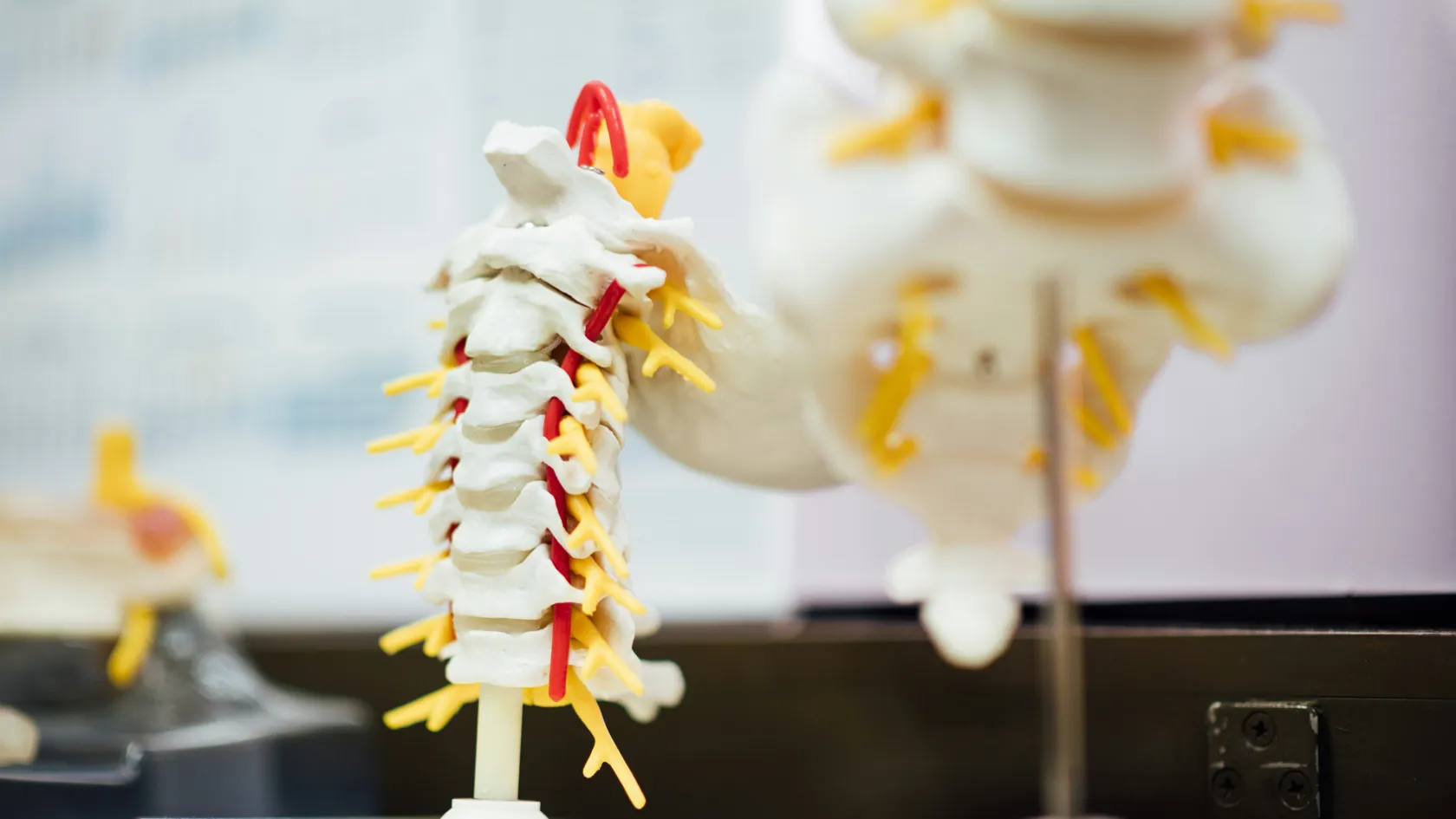
Most herniated discs in the neck settle with physiotherapy, so this page starts with the signs that cannot wait and the point at which surgery helps more than waiting. It then compares fusion, artificial disc replacement and surgery from the back of the neck, and sets out the hospital nights, the flight home and the return to work.
About This Department
Orthopedics
Most herniated neck discs settle without an operation. Surgery is for the arm pain, numbness or weakness that does not.
A cervical disc herniation happens when the soft center of a disc in the neck pushes out and presses on a nerve root or on the spinal cord. The result is pain that runs from the neck into the shoulder and arm, often with tingling or weakness in the hand. Surgery removes the part of the disc that presses on the nerve, and then either fuses the two vertebrae, fits an artificial disc, or opens the nerve's exit from behind without touching the disc space. This page explains which symptoms cannot wait, when an operation beats physiotherapy, how the three operations compare, and what to send for a free review of your MRI.
93%
Rated better 5 to 8 years after fusion plus physiotherapy, against 62% with physiotherapy alone
55%
Lower odds of surgery at the next level with a disc replacement than with fusion
Each nerve root leaving the neck supplies its own strip of the arm, so the pattern of pain points to the level. The MRI has to match.
If the MRI and the arm symptoms do not match, surgery is unlikely to help.
In the middle of the canal, a herniation can press on the spinal cord instead, which changes the urgency, as the next section explains. For a herniation off to one side, the table below shows how the level usually maps onto the arm, and the surgeon checks each of these on examination before reading the scan.
This table scrolls sideways on a narrow screen. Swipe or drag to see every column.
Common levels of cervical disc herniation and the nerve they affect
Disc level
Nerve root
Where pain and numbness go
Weakness to look for
C4 to C5
C5
Shoulder and outer upper arm
Lifting the arm to the side
C5 to C6
C6
Outer forearm, thumb and index finger
Bending the elbow, raising the wrist
C6 to C7
C7
Back of the arm and middle finger
Straightening the elbow
C7 to T1
C8
Inner forearm, ring and little finger
Grip and fine finger movements
C5 to C6 and C6 to C7 are hit most.
Signs that cannot wait
A disc that presses on the spinal cord itself causes a different picture, called myelopathy, and it needs a specialist within days, in the country where you are.
Clumsy hands, dropping things, trouble with buttons or writing
Unsteady walking or a feeling of walking on cotton wool
Numbness or weakness in both arms, or in the legs
New trouble controlling the bladder or bowels
Arm weakness that gets worse from one week to the next
Spinal cord damage recovers less well the longer pressure lasts, so these signs move the decision from months to days.
Physiotherapy first, and when surgery is advised
Most arm pain from a herniated disc eases. Time, simple painkillers and structured physiotherapy do most of the work, and the herniation itself can shrink on later scans.
Structured physiotherapy comes before surgery for most patients without weakness or spinal cord signs.
In a Swedish randomized trial, 63 patients with cervical radiculopathy were assigned to fusion surgery plus physiotherapy or to the same physiotherapy alone and followed for up to eight years. Both groups improved. Neither got worse. Surgery brought relief faster in the first year, and the gap narrowed by two years, which led the authors to advise trying physiotherapy first. Then the picture shifted. By five to eight years, the surgical group reported less neck pain and disability. Arm pain no longer differed. Arm pain, in other words, settles with or without an operation, and the lasting benefit of surgery shows mostly in the neck. That trial also found that patients whose arm pain had lasted less than 12 months gained more from surgery than those who waited longer.
On a phone, slide this table sideways to read all of its columns.
Patients rating themselves better or much better, Swedish randomized trial
Time after treatment
Fusion plus physiotherapy
Physiotherapy alone
12 months
87%
62%
2 years
81%
69%
5 to 8 years
93%
62%
Surgery is advised when disabling arm pain persists despite several weeks of proper non-surgical care, when weakness is present or progressing, or when myelopathy is found. Neck pain alone rarely justifies it.
Three operations for one problem
All three take pressure off the nerve. They differ in how they reach it, what they leave behind in the neck, and which kind of herniation each one handles best, so the MRI and the X-ray of the joints decide between them more than any preference of the patient or the surgeon.
Fusion or disc replacement
Anterior cervical discectomy and fusion
Through a short crease incision at the front of the neck, the surgeon moves the windpipe and gullet gently aside, removes the disc and any bone spurs, and fits a small cage that lets the two vertebrae grow together. This operation, known as ACDF, is the most common one for cervical disc herniation.
Fusion remains the choice for advanced arthritis, instability or large bone spurs at the level.
Cervical disc replacement
Disc replacement uses the same front approach but fits a moving artificial disc instead of a cage, and it suits a soft herniation at one or two levels with healthy joints at the back of the spine. A level-matched analysis of 16 long-term randomized and regulatory trials, with a mean follow-up of seven years, found 55 percent lower odds of surgery at a neighboring level after a one-level disc replacement than after a one-level fusion, and lower odds of any repeat operation. A separate analysis of 13 studies and 18,473 patients that excluded industry-funded research found more wear at neighboring levels after fusion but no difference in revision rates, neck pain or disability. Both operations work well for the arm. In a Michigan registry of 2,760 patients, two-year outcomes were similar, and disc replacement patients averaged one night in hospital against 1.3 after fusion. Those patients were three years younger on average, which reflects how surgeons choose candidates for a moving disc rather than any effect of the implant itself.
Surgery from the back of the neck
Posterior foraminotomy widens the opening where the nerve leaves the spine, through a small incision at the back of the neck, and removes the piece of disc pressing on it without fusion or implant. Nothing is left behind. It works for a herniation that sits to the side. Five randomized trials with 568 patients found no difference from front fusion in good outcomes, complications, repeat surgery or satisfaction. In the Dutch FACET trial of 265 patients, arm pain fell by a similar amount after either approach over two years.
Drag sideways on a narrow screen to see the whole table.
Operations for cervical disc herniation compared
Point
Fusion, ACDF
Disc replacement
Posterior foraminotomy
Approach
Front of the neck
Front of the neck
Back of the neck
Movement at the level
Lost
Kept
Kept
Best suited to
Central or side herniation, arthritis
Soft herniation, healthy facet joints
Side herniation only
Main trade-off
Wear at neighboring levels
Not for arthritic or unstable levels
More neck muscle pain early on
Risks to discuss before you agree
Serious complications are uncommon after one-level surgery.
Stopping smoking before the operation is the single change that most helps a fusion heal.
The front approach passes close to the gullet, the windpipe and the nerve to the voice box, which explains the most common complaints after surgery. Most patients notice nothing worse than a sore throat for a few days, and the surgeon goes through each risk again at the consultation, for your level and your approach, before you sign the consent form. The rarer ones are listed below. Read them.
Scroll the table left and right on a small screen to see each column.
Risks after surgery for cervical disc herniation
Risk
How often
What it means
Sore throat and difficulty swallowing
Common after a front approach
Settles over days to weeks
Hoarse voice
Uncommon
Fades in most patients as the nerve recovers
Bleeding into the neck
Rare
Treated as an emergency, seen within 24 hours in most cases, so patients are watched overnight
Spinal cord or nerve root injury, spinal fluid leak, infection
Rare
Discussed with the surgeon for your level and approach
Fusion that fails to heal
Uncommon, more often in smokers
Can need a second operation
Ask the surgeon for the numbers in their own practice.
The stay, the flight and returning to work
Published packages in Turkey list one to three nights in hospital, and many single-level patients go home after one. Plan seven to ten days in Istanbul. That covers the assessment, the operation, a wound check and an X-ray before the flight.
Day of surgery, walking within hours and soft food in the evening
Next morning, an X-ray of the implant and, for most one-level operations, discharge
Days five to seven, a wound check with the surgeon
Weeks two to four, desk work and short drives once turning the head is comfortable
Weeks six to twelve, gradual return to lifting and sport as the surgeon advises
After a front approach, the sore throat settles over a few weeks. Heavy lifting waits for the follow-up X-ray. Driving waits until you can turn your head fully to check over your shoulder. You leave with a written discharge report for your doctor at home. Your coordinator stays on WhatsApp once you are back home, answers questions from your physiotherapist or family doctor during the months of recovery, and works in English, Arabic, French, Russian, Serbian, Romanian or Spanish. Interpreting in other languages is arranged on request. One companion sleeps in the patient room for the admission, and the international patients office arranges the hotel nights before and after it, airport transfers and transport to every appointment, including the wound check. Halal, vegetarian and diabetic meals are cooked in the hospital kitchen, a prayer room is on site, a female surgeon can be requested and is assigned wherever the rota allows, and the visa invitation letter is sent ten days before travel.
Call straight away for new swelling in the neck, difficulty breathing or swallowing saliva, fever, or new weakness in an arm or leg.
What a quote should cover
Cost depends on the operation, the number of levels and the implant. An artificial disc costs more than a cage. Each extra level adds an implant and theater time. Published packages in this market include the surgeon and theater, general anesthesia, the implant, tests before surgery, one to seven hospital nights, airport transfers and an interpreter, and some add an X-ray or CT after surgery. Extra hotel nights and physiotherapy at home sit outside most of them. Read the exclusions.
Only a surgeon who has read your MRI can say which operation fits, and that review costs nothing.
Cervical disc herniation surgery FAQ
Can a herniated disc in the neck heal without surgery?
In most people the arm pain eases over weeks to months with physiotherapy and pain relief, and the herniation can shrink. Surgery is kept for pain that persists, weakness, or pressure on the spinal cord.
Is disc replacement better than fusion?
For a suitable one-level herniation, long-term trials show fewer operations at neighboring levels after disc replacement, while independent studies show similar pain and disability scores. Fusion stays the choice when the joints at the back of the spine are worn.
How long after neck disc surgery can I fly?
Seven to ten days after a one-level operation, once the wound check and the X-ray are done.
When can I go back to work?
Desk work after two to four weeks, and physical work after six to twelve weeks depending on the operation and the surgeon's review.
What should I send for a free review?
Send these.
The MRI images of the neck and the report
Any X-ray or CT, and nerve conduction tests if done
Where the pain and numbness go, and how long they have lasted
A list of medications
A spine surgeon replies with whether surgery is advised, which operation, and the expected stay, at no charge and with no obligation to travel.
References
Engquist M, Lofgren H, Oberg B, et al. Surgery versus nonsurgical treatment of cervical radiculopathy: a prospective, randomized study comparing surgery plus physiotherapy with physiotherapy alone with a 2-year follow-up. Spine. 2013;38(20):1715-1722.
Engquist M, Lofgren H, Oberg B, et al. A 5- to 8-year randomized study on the treatment of cervical radiculopathy: anterior cervical decompression and fusion plus physiotherapy versus physiotherapy alone. J Neurosurg Spine. 2017;26(1):19-27.
Engquist M, Lofgren H, Oberg B, et al. Factors affecting the outcome of surgical versus nonsurgical treatment of cervical radiculopathy: a randomized, controlled study. Spine. 2015;40(20):1553-1563.
Sulman M, Guppy HM, Castillo JA, et al. Long-term reoperation risk after cervical disc arthroplasty versus fusion: a level-matched meta-analysis of FDA investigational device exemption studies and international randomized trials. Neurosurg Focus. 2026;61(1):E4.
Issa TZ, Song J, Maayan O, et al. Clinical outcomes are similar following anterior cervical discectomy and fusion versus cervical disc arthroplasty: a systematic review and meta-analysis of studies without industry influence. Clin Spine Surg. 2026. doi:10.1097/BSD.0000000000002141
Miller AK, Zakko P, Park DK, et al. Cervical disc arthroplasty versus anterior cervical discectomy and fusion: an analysis of the Michigan Spine Surgery Improvement Collaborative database. Spine J. 2024;24(5):791-799.
Tome JOD, de Souza RC, de Oliveira WH, et al. Anterior cervical discectomy and fusion versus posterior cervical foraminotomy for cervical radiculopathy: a systematic review and meta-analysis of randomized controlled trials. Clin Spine Surg. 2026. doi:10.1097/BSD.0000000000002136
Broekema AEH, Simoes de Souza NF, Groen RJM, et al. Cost-effectiveness of posterior versus anterior surgery for cervical radiculopathy: results from a multicentre randomised non-inferiority trial (FACET). Eur Spine J. 2024;33(8):3087-3098.
Lombardo G, Washington T, Anderson P, Kindo B. Retropharyngeal hematoma following anterior cervical spine surgery: a narrative review. J Spine Surg. 2026;12(8):137.
Editor's note
Written by the Biruni Hospital medical editorial team. Reviewed by Assistant Professor Şafak SAYAR, Orthopedics and Traumatology.