Plastic Surgery
Breast reconstruction rebuilds the breast after mastectomy, with an implant or with tissue from your own body. Each route has its own trade-off, and radiation therapy changes which one works better.
Reconstruction can happen at the time of the mastectomy or months to years later. Implants mean a shorter operation and recovery. Tissue from your own body, taken in most women from the lower abdomen, means a longer operation. The result is a softer, warmer breast that ages with you. In the largest prospective study, from 11 North American centers, women with tissue reconstructions were more satisfied with their breasts two years later and had more complications along the way. Implants failed more frequently, especially after radiation. Send us your pathology, treatment plan and photographs, and a plastic surgeon working with your breast cancer team will tell you which options fit and how many trips each would need.
2,343
Women followed for two years in the multicenter outcomes study
7.1% vs 1.3%
Reconstruction failure at two years, implants against DIEP flaps
7 to 14 days
In Istanbul, depending on the technique
Free
Plastic surgeon's review of your file
Free consultation
Five techniques account for almost all reconstructions. Choosing between them depends on body shape, cancer treatment, the other breast and personal priorities.
Implant or your own tissue?
No single answer fits everyone.
Implants
How implant reconstruction works
Most implant reconstructions start with a tissue expander, a deflated implant placed under the skin and in some women under the chest muscle. Over the following weeks the surgeon adds saline through a port under the skin until the pocket is the right size, and a permanent silicone implant replaces the expander in a second, shorter operation. Healthy mastectomy skin and a small to moderate breast allow a permanent implant straight away.
Implant reconstruction avoids a second surgical site and gets you home sooner. The breast feels firmer and rounder than a natural one, has no sensation, and does not change with weight. Implants have a limited lifespan, and further surgery down the line is expected.
Immediate or delayed
In this multicenter analysis, procedure choice and other patient variables were significant predictors of 1-year complications in breast reconstruction.
Mastectomy Reconstruction Outcomes Consortium, Annals of Surgery, 2018
An implant reconstruction, step by step
1
At the mastectomy
The breast surgeon removes the breast tissue, and the plastic surgeon places the expander or implant through the same incision.
2
The filling visits
Every one to two weeks, saline is injected into the expander in the clinic, a few minutes each time. International patients can have it done by a local surgeon.
3
The exchange
Three to six months later, or after radiation and a recovery interval, the expander is replaced with a permanent implant in a day-case operation.
Your own tissue
Flap reconstruction
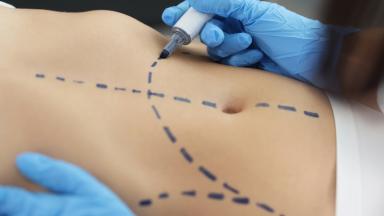
A flap moves skin and fat, sometimes with muscle, from one part of the body to the chest. In a DIEP flap, the commonest today, tissue from the lower abdomen is detached with its artery and vein and reconnected to vessels in the chest under a microscope, sparing the abdominal muscle. The patient gains a tummy tuck, with a long low scar across the abdomen.
A tissue breast feels soft and warm, moves naturally and changes with weight. The operation takes longer, needs a microsurgery team and a longer stay, and carries the risk of the flap losing its blood supply in the first days, and the flap is therefore checked hourly at first.
Who suits a flap
- Women with enough lower abdominal tissue for the size of breast they want.
- Women who have had radiation, or will need it.
- Women who prefer to avoid implants and future implant surgery.
- Those fit for a long operation, without heavy smoking or severe vascular disease.
Significant differences were noted across reconstructive procedure types for overall and reoperative complications, which is critically important information for women and surgeons making breast reconstruction decisions.
Two-year outcomes, JAMA Surgery, 2018
This table scrolls sideways on a narrow screen. Swipe or drag to see every column.
Two years after reconstruction, 2,343 women
| Technique |
Reconstruction failure |
| Expander or direct implant |
7.1 percent |
| DIEP flap |
1.3 percent |
| Free TRAM flap |
2.1 percent |
| Pedicled TRAM flap |
1.2 percent |
| Latissimus dorsi flap |
2.8 percent |
- Older age and higher body mass index.
- Reconstruction of both breasts at once.
- Radiation therapy, especially with implants.
- Smoking, which harms both implant pockets and flaps.
At 2 years, patients who underwent autologous reconstruction were more satisfied with their breasts and had greater psychosocial well-being and sexual well-being than did those who underwent implant reconstruction.
Patient-reported outcomes, JAMA Surgery, 2018
Complications against satisfaction
The same consortium followed 2,343 women for two years. Complications of some kind occurred in 32.9 percent, and 19.3 percent had an unplanned return to the operating room within those two years. Every type of flap carried close to twice the odds of a complication compared with expander-implant reconstruction, and most flaps higher odds of a reoperation. Implants failed and had to be removed more frequently.
Satisfaction told the other side. Among 2,013 women questioned two years after immediate reconstruction, those with tissue reconstructions scored higher on satisfaction with their breasts, on psychosocial well-being and on sexual well-being, even after allowing for differences in age and health before surgery. A flap asks more of you at the start. It gives a more satisfying breast in the long run for many women.
Radiation therapy
Autologous reconstruction appears to yield superior patient-reported satisfaction and lower risk of complications than implant-based approaches among patients receiving postmastectomy radiotherapy.
Study of 2,247 women, Journal of the National Cancer Institute, 2018
This table scrolls sideways on a narrow screen. Swipe or drag to see every column.
Complications at two years, by radiation and technique
| Group |
At least one breast complication |
| Radiation, implant reconstruction |
38.9 percent |
| Radiation, tissue reconstruction |
25.6 percent |
| No radiation, implant reconstruction |
21.8 percent |
| No radiation, tissue reconstruction |
28.3 percent |
- Whether radiation after mastectomy is likely, from the tumor size, lymph nodes and margins.
- If it is, whether to place an expander now and finish after radiation, or to delay the flap until six to twelve months after radiation.
- How the timing fits with chemotherapy, which should not be delayed by a complication.
Implant-associated lymphoma
Breast implants are associated with increased risk of breast-ALCL, but the absolute risk remains small.
Dutch national registry study, JAMA Oncology, 2018
A rare lymphoma of the capsule around breast implants, called breast implant-associated anaplastic large-cell lymphoma, is linked mainly to textured implants. In the Netherlands, the number of women with implants needed to cause one case before age 75 was estimated at 6,920. Most reconstructions now use smooth implants, and new swelling or a lump around an implant years later should be checked with ultrasound.
How many days in Istanbul, and what decides the cost?
Recovery
Recovery depends on the technique.
After implant reconstruction, most women go home in a day or two, with drains for one to two weeks, and resume light activity in two to three weeks. After a DIEP flap, the first days are spent in a warm room with regular flap checks, walking begins on day one or two, and the abdomen feels tight for several weeks. Desk work returns after four to six weeks.
Reconstruction is a series of steps. Months later, once the breast has settled, a second smaller operation refines its shape, adjusts the other breast for symmetry if wished, and builds a nipple. The areola is recreated by tattoo. Fat grafting can soften contour irregularities at any stage.
Days, cost and the trip
Plan seven to ten days for implant reconstruction and ten to fourteen days for a DIEP flap, including the planning visit and the first wound check. Expander fillings can continue with a surgeon at home. The refinement stage months later is a shorter second trip. The long flight after a flap needs the same care as after any major operation, with walking, fluids and blood-thinning injections if advised.
Cost depends on the technique, whether one or both breasts are reconstructed, whether reconstruction is done with the mastectomy, the implant or expander, the hospital nights and the later refinement stage. Your own figure follows the free review of your file.
Your coordinator stays with you across every stage, which matters in an operation done in steps. We send the visa invitation letter ten days ahead, a driver collects you at the airport, and a hotel near the hospital houses you and a companion. The team works in seven languages, interpreters cover the rest, and halal, vegetarian and diabetic meals, the prayer room and a female surgeon or doctor on request when the schedule allows are all part of the stay. Back home, the plastic surgeon stays in touch through the same WhatsApp line, coordinates expander fillings with your local team, and plans the next stage with you, taking into account the dates of chemotherapy, radiation and hormone treatment set by your oncologist at home, so that no step of the reconstruction ever delays the cancer care that comes first, and so that each trip to Istanbul is booked for the moment when the breast, the scars and the rest of your treatment are all ready for it.
Breast reconstruction FAQ
Should I choose an implant or my own tissue?
It depends on your body, your cancer treatment and your priorities. Tissue reconstructions gave higher satisfaction at two years and failed less, while implants meant a shorter operation and fewer early complications.
Can I have reconstruction if I need radiation?
Yes. After radiation, tissue reconstruction had fewer complications than implants, 25.6 against 38.9 percent, and higher satisfaction.
Can reconstruction be done at the same time as the mastectomy?
Yes, in many women. It can also be done months or years later.
Will the new breast have feeling?
Sensation is reduced or absent in most reconstructed breasts. Some return in tissue flaps over time.
How many trips to Istanbul will I need?
Often two, one for the main reconstruction and a shorter one months later for refinement and the nipple. Expander fillings can continue at home.
Can my family come with me?
Yes. A companion stays at the hotel we arrange and can visit throughout.
References
- Wilkins EG, Hamill JB, Kim HM, et al. Complications in Postmastectomy Breast Reconstruction: One-year Outcomes of the Mastectomy Reconstruction Outcomes Consortium (MROC) Study. Annals of Surgery. 2018;267(1):164-170.
- Bennett KG, Qi J, Kim HM, et al. Comparison of 2-Year Complication Rates Among Common Techniques for Postmastectomy Breast Reconstruction. JAMA Surgery. 2018;153(10):901-908.
- Santosa KB, Qi J, Kim HM, et al. Long-term Patient-Reported Outcomes in Postmastectomy Breast Reconstruction. JAMA Surgery. 2018;153(10):891-899.
- Jagsi R, Momoh AO, Qi J, et al. Impact of Radiotherapy on Complications and Patient-Reported Outcomes After Breast Reconstruction. Journal of the National Cancer Institute. 2018;110(2):157-165.
- de Boer M, van Leeuwen FE, Hauptmann M, et al. Breast Implants and the Risk of Anaplastic Large-Cell Lymphoma in the Breast. JAMA Oncology. 2018;4(3):335-341.