
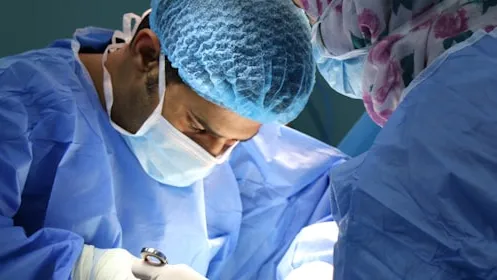
Organ Transplant Center
Kidney and liver transplantation at the Organ Transplant Center in Istanbul: who can donate under Turkish law, donor protection, costs and a free file review.
Let us call you
Send us your contact information and we will call you as soon as possible.
About This Center
There is no legal way to buy a kidney or a liver, in Turkey or almost anywhere else, and there is no waiting list here that an international patient can join for a deceased donor's organ. What Turkish law does permit is this: you travel to Istanbul together with your own living donor, usually a relative, and the Organ Transplant Center at Biruni Hospital performs the transplant within that pair once the legally required review has approved it. Nobody can find, provide or arrange a donor for you. If that corrects the picture you arrived with, the rest of this page explains the law, the medicine and the money in the order a family actually needs them.
Free consultation
Have your file and your donor's file read together
Reading the two files costs nothing and commits you to nothing. Describe the recipient's diagnosis and dialysis history and attach recent laboratory results, then name the donor, the family relationship between you, and the civil documents you hold that prove it. A transplant surgeon replies in writing with a medical and legal opinion on whether the pair is workable, and with the tests and papers still needed, before either of you pays for a flight.
The law that shapes every transplant journey to Turkey
Turkey has regulated organ transplantation by statute since 1979, and the framework rests on two pillars that every reader of this page will pass through. Living donation is lawful within families, defined more generously than most people assume. Trading in organs is a crime, prosecuted as one, and a hospital's transplant license depends on staying far away from anything that resembles it.
Who can be your donor under Turkish law?
A living donor must normally be a relative within the fourth degree of kinship, by blood or by marriage. Parents and children are first degree. Siblings, grandparents and grandchildren are second, aunts, uncles, nieces and nephews third, and first cousins fourth, together with the corresponding relatives of your husband or wife. A spouse is accepted as a related donor as well, provided the marriage has lasted at least two years. Seen from the patient's side, the circle is wide: most families contain several legally eligible people, and the real question becomes which of them is medically suitable and genuinely willing.
Kinship is proven with civil records, never with a signed statement. Population registry extracts or the equivalent documents from your own country establish the family tree, and for use in Turkey they generally need certified translation and an apostille. Assembling these papers takes longer than families expect, which is why the file review names the exact documents at the start of the process rather than after you have landed.
Blood group and crossmatch testing then decide whether the legally eligible relative is also a biologically workable one. The review weighs both questions together, because a pair that passes one test and fails the other cannot proceed.
The ethics commission for unrelated donors
Donation from someone outside the fourth degree, a close friend for example, is not automatically excluded, but the case moves in front of an ethics commission convened under the health authorities. The commission interviews donor and recipient, examines how long and how genuinely they have known each other, and looks above all for one thing: any sign that money, debt or pressure stands behind the offer. Approval is a real decision. Cases are refused, and a refusal there ends the matter for that pair in Turkey.
The international standard behind this scrutiny carries this city's name. The Declaration of Istanbul, drafted at a summit held here in 2008 and updated in 2018, is the framework transplant medicine uses worldwide against organ trafficking and transplant tourism, and this center works inside it.
The Declaration's central principle, restated in its 2018 edition, is that an organ must be a gift: donation has to be free and unpaid, trafficking and transplant tourism violate the rights of donors and recipients alike, and the poor and vulnerable must never become a source of organs for those able to pay.
A rule that turns some inquiries away is the same rule that makes the accepted ones safe, for the donor above all.
What cannot happen at this center
Some of what hospitals are asked for from abroad sits outside the law, and saying so on the public page spares serious families weeks of confusion. The deceased-donor waiting list is closed to transplant travel: organs recovered in Turkey are allocated through the national coordination system to patients registered within it, and an international patient cannot fly in to join that queue. Nor can any hospital supply the other half of a living pair. No donor can be found, provided or arranged, at any price, through any intermediary, and a clinic anywhere that offers this service is describing a crime. Buying or selling an organ is prosecuted in Turkey, as it is nearly everywhere, and the exposure falls on the patient as well as the broker.
You come with your donor, or the transplant does not happen. Every other answer on this page builds on that sentence.
Why transplant instead of staying on dialysis?
Dialysis keeps a person alive. It does not make the two options equal, and the strongest evidence on the question is large, old and one-directional. A landmark study in the New England Journal of Medicine followed 228,552 American dialysis patients and found that those who received a first kidney transplant had a long-term risk of death 68 percent lower than comparable patients still waiting on dialysis, with projected remaining life roughly doubling from about ten years to about twenty (Wolfe et al., 1999). Transplantation, where a donor exists, is a survival decision rather than a comfort upgrade.
For a family that already contains a willing relative, the finding has a practical edge. A transplant performed before dialysis ever starts, called a preemptive transplant, is possible and frequently preferable once kidney function approaches the threshold, and a workable living-donor pair gains nothing by drifting on dialysis for years while the heart and blood vessels absorb the damage. Living-donor kidneys also tend to begin working sooner and to last longer than deceased-donor organs, a quiet advantage of the very pathway the law prescribes for patients from abroad.
The donor is our patient too
Half of every living-donor transplant is an operation on a healthy person, and how a program treats that fact is the test of its ethics. The donor is assessed on their own account. Fitness is examined as though no recipient existed, voluntariness is explored in conversations held without the recipient in the room, and where the two files pull in different directions, the team's duty runs to the donor first.
Some donors are declined. High blood pressure, diabetes, reduced kidney function, unfavorable anatomy, or a liver lobe that would leave too little reserve behind are all reasons an eager relative is told no, and that refusal is protection rather than obstruction. A donor is also free to withdraw at any point up to the operation, without giving a reason, and the team guards that exit instead of closing it.
For the carefully screened donor who does proceed, the long-term evidence is reassuring. A follow-up study of 3,698 living kidney donors, some traced for more than thirty years, found survival and the risk of kidney failure similar to the general population, with preserved kidney function in most (Ibrahim et al., 2009). Screening exists to keep every donor inside that statistic.
Kidney and liver transplantation at Biruni Hospital
Two programs run at the Organ Transplant Center: kidney transplantation and living-donor liver transplantation, performed by the transplant surgeons of the General Surgery department inside a university hospital of more than 600 beds, with intensive care on site and the kidney and liver specialties of a university hospital behind both operating teams. Bone marrow and stem cell transplantation is a different discipline with its own unit at Biruni, the Bone Marrow Transplant Center, and is not covered on this page. Organ transplantation as a wider field also spans heart, lung and pancreas; the programs described here are kidney and liver.
Kidney transplantation
Candidates are patients with end-stage kidney disease, established on dialysis or approaching it. The operation places the donor kidney low in the abdomen and connects its vessels and ureter, usually leaving your own kidneys where they are; the donor's kidney is removed in a separate, shorter operation. As a typical pattern the recipient spends one to two weeks in the hospital and the donor a few days. Neither flies straight home. Both stay in Istanbul for outpatient checks, with drug levels and kidney function measured until the team sets a flight date, and that monitored period is counted in weeks, not days.
Living-donor liver transplantation
A living liver donor gives a lobe, not the whole organ, and the liver's capacity to regenerate is what makes the operation possible: over the following weeks and months, the donor's remaining liver and the transplanted lobe both grow back toward full working size. This is larger surgery than kidney donation on both sides of the pair. The donor's operation is itself major abdominal surgery, which is why the independent donor assessment weighs it so seriously, and the recipient should plan for several weeks in Istanbul, with a longer hospital stay and closer early monitoring than a kidney recipient needs. Urgency also works differently across borders: home systems allocate deceased-donor livers to the sickest first through scores such as MELD, whereas a living-donor pair arrives together, on a date planned around the recipient's condition and the donor's readiness.
Immunosuppression, and the handover to your doctor at home
The transplant is an event; immunosuppression is the rest of your life. The drugs that stop your immune system from rejecting the organ are taken every day, indefinitely, and they have two faces that both deserve stating. Kept at the right blood level, they protect the graft. The same suppression makes infections easier to catch and harder to shake, which is why the first months are dense with blood tests, why doses change repeatedly at the start, and why a fever after transplant means calling a doctor the same day rather than waiting it out.
Going home is organized, not assumed.
Before your flight, the team prepares a written protocol for the nephrologist or liver specialist who will follow you: every drug with its dose and target level, the laboratory schedule for the months ahead, and the findings that should trigger a same-day local review. Results can be forwarded to Istanbul for remote reading. Your doctor can also reach the transplant team with questions. Daily care back home, though, belongs with a physician who can examine you, and the handover is built so that it does.
What the file review needs, and what a transplant costs
Everything begins remotely, with two files read side by side. The recipient's file carries the medical story: the diagnosis behind the kidney or liver failure, the dialysis history with its start date and current schedule if dialysis has begun, laboratory results from recent months, abdominal imaging, a cardiac workup if one exists, and the full medication list. The donor's file is shorter and legally heavier: age, the exact family relationship and the civil documents available to prove it, a basic health history, and the blood group if known.
The written reply addresses whether the pair looks plausible on medical and legal grounds, the tests still to be done at home, the documents to prepare, translate and apostille, the expected total time in Istanbul for each of you, and an itemized quote. Some pairs are told no at this stage, over blood groups, over a donor's health, over kinship papers that cannot be assembled, and hearing that before anyone has bought a ticket is the review's entire purpose.
A transplant quote pays for two patients at once. It has to carry the evaluation battery for recipient and donor, the two operations, the recipient's intensive care and ward days, the donor's shorter admission, and the first supply of immunosuppressive drugs with the blood-level monitoring that tunes them. Package listings on medical travel aggregators place kidney transplantation in Turkey at roughly 20,000 to 35,000 US dollars and living-donor liver transplantation at roughly 40,000 to 75,000, spans that show the market's shape rather than any hospital's own pricing. Biruni Hospital's figure for your case arrives itemized, in writing, as part of the reply to the file review.
Interpreter support, airport transfer and help with accommodation extend to the donor and accompanying family as well as the patient, which matters more in transplant than in most surgery, because the law itself guarantees you will not be traveling alone.
Common questions from patients and donors
Can Biruni Hospital find an organ donor for me?
My donor is my cousin. Does Turkish law accept that?
How long do my donor and I need to stay in Istanbul?
If your donor changes their mind in Istanbul
Managing immunosuppression after you fly home
The cost of a kidney or liver transplant in Turkey
References
- Wolfe RA, Ashby VB, Milford EL, et al. Comparison of mortality in all patients on dialysis, patients on dialysis awaiting transplantation, and recipients of a first cadaveric transplant. New England Journal of Medicine. 1999;341(23):1725-1730.
- Ibrahim HN, Foley R, Tan L, et al. Long-term consequences of kidney donation. New England Journal of Medicine. 2009;360(5):459-469.
- The Declaration of Istanbul on Organ Trafficking and Transplant Tourism (2018 Edition). Transplantation. 2019;103(2):218-219.
Editor's note
Written by the Biruni Hospital medical editorial team. Reviewed by Specialist Dr. Vedat Ertunç, Cardiology.
Medically reviewed by
Specialist Dr. Vedat Ertunç
Cardiology
Areas of Specialization
Our multidisciplinary team covers the following areas within this center.
- Liver Transplantation
- Kidney Transplantation
- Pancreas Transplantation
- Living Donor Evaluation
- Post-Transplant Follow-Up
Other Medical Centers
View All
Breast Health & Breast Cancer Center
Most people arrive having already decided which operation they want. The operation is rarely the first decision and never the one that decides most.
CAR-T Cell Therapy Center
CAR-T cell therapy in Istanbul for leukemia, lymphoma and myeloma. Eligibility, the five stage process, honest cost figures and how long you stay at Biruni.
Cellular Immunotherapy Center
Two entirely different industries use the words cell therapy. One has a regulator behind it. Four questions tell you which one you are talking to.
Check Up & Longevity Center
Biruni Hospital's Check-Up and Preventive Medicine Center in Istanbul plans risk based health screening by age, sex and history, with a free remote intake.

Children’s Health Center
The Children's Health and Diseases Center in Istanbul unites pediatric subspecialists at Biruni Hospital, with a free remote review of your child's file.