
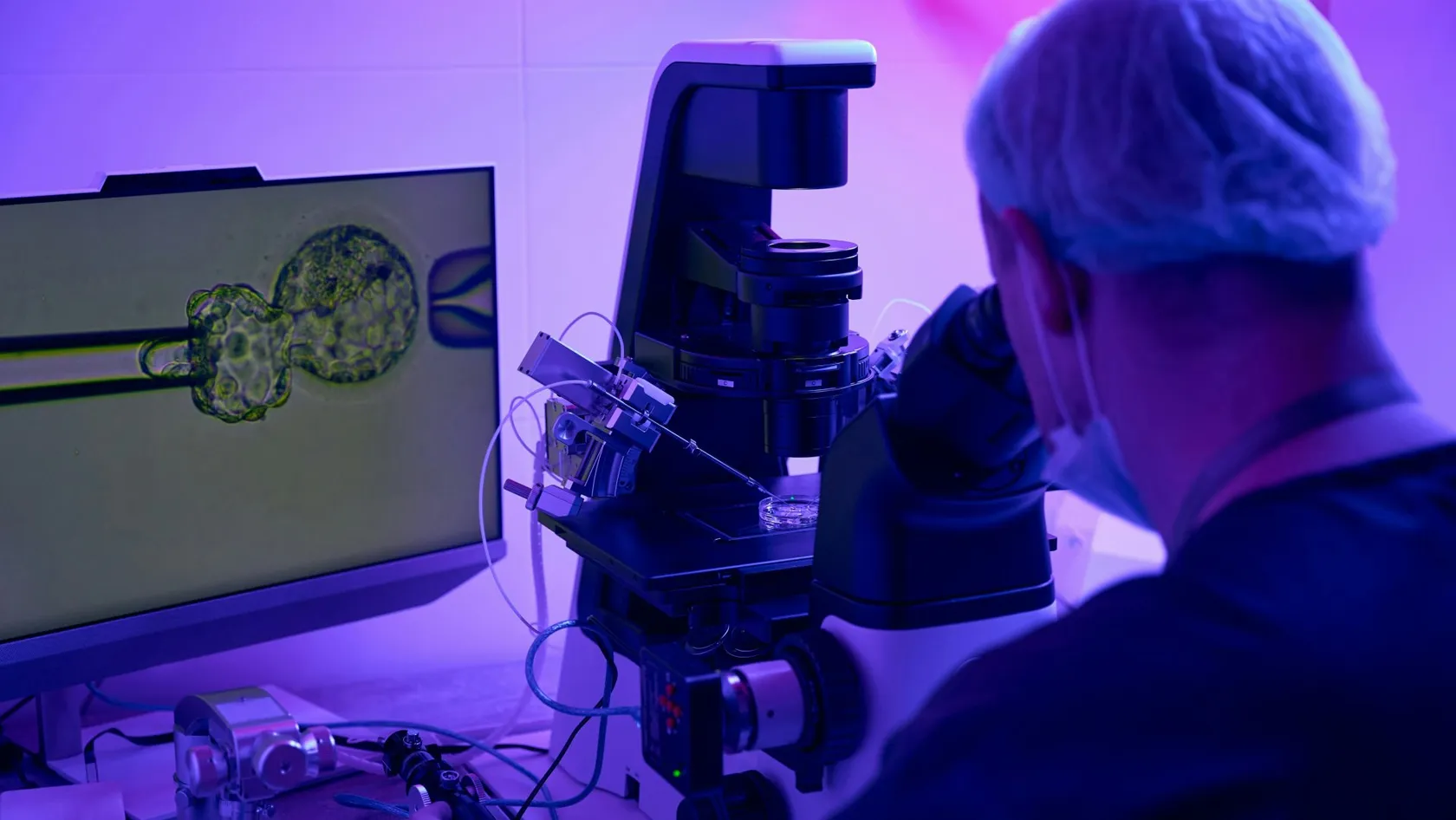
IVF & Reproductive Medicine Center
Biruni Hospital's IVF Center explains Turkish IVF law first, then the cycle, honest age numbers, one-trip or two-trip planning and costs. Free file review.
Let us call you
Send us your contact information and we will call you as soon as possible.
About This Center
The IVF Center at Biruni Hospital in Istanbul treats married couples using their own eggs and their own sperm, because that is the group Turkish law permits, and it says so at the top of this page instead of in the small print. If you are comparing countries for fertility treatment, the rules below decide whether flying here makes sense at all, so they come before the medicine. After them, this page covers the treatments the centre performs, how a cycle runs across four to six weeks, what age honestly does to the numbers, the risks, the one-trip and two-trip ways of planning treatment from abroad, and what a cycle costs.
Free consultation
Have your fertility file read before you book anything
The review costs nothing and carries no obligation. Send your AMH and hormone results with the dates they were taken, the most recent semen analysis report, any tubal imaging report, and the records of previous IVF cycles if you have them, and a reproductive medicine specialist will reply with a written opinion on whether a cycle in Istanbul is realistic for you, which protocol would be proposed, and how the trip could be arranged.
The rules come first: who Turkish law allows us to treat
Turkish assisted-reproduction regulation permits IVF for married heterosexual couples using their own eggs and their own sperm, and no licensed centre in the country may work outside that frame. Egg donation, sperm donation, embryo donation and surrogacy are all prohibited in Turkey. Most pages selling fertility treatment abroad leave this until you ask. We put it first, because a couple who discovers it after landing has wasted a flight, a hotel booking and several weeks of hope.
So the direct version: if your plan requires donor eggs or donor sperm, Turkey is not your destination, and a centre that tells you this before you travel is treating you honestly. What Turkish law does allow, it regulates closely, and that regulation works in your favour. Licensed IVF centres are inspected by the Ministry of Health at regular intervals, embryo transfer numbers are capped by law, and preimplantation genetic testing is available for medical indications while sex selection for non-medical reasons is banned.
The document to prepare before you book flights
An apostilled marriage certificate is required at registration. Obtain the apostille from the issuing authority in your home country, have the certificate translated, and carry both with you, because treatment cannot begin without them and arranging an apostille from Istanbul is slow. Couples married in countries outside the apostille convention should ask the international patients office about consular legalisation instead. This single sheet of paper delays more IVF trips than any medical finding.
| Question | Position under Turkish regulation |
|---|---|
| Who can be treated | Married heterosexual couples using their own eggs and sperm. An apostilled marriage certificate is checked at registration. |
| Donor eggs, sperm or embryos | Prohibited. No licensed centre in Turkey may offer donation of any gamete or embryo. |
| Surrogacy | Prohibited. |
| Genetic testing of embryos | Permitted for medical indications, for example a known inherited disease or repeated implantation failure. Sex selection for non-medical reasons is banned. |
| Embryos per transfer | Under 35: one embryo in the first and second cycles, two from the third. Age 35 and over: up to two. |
| Embryo storage | Up to 10 years, with the couple's written confirmation renewed every year. |
| Egg freezing | Permitted for medical indications: before cancer treatment, diminished ovarian reserve, or a family history of premature ovarian failure. |
| Oversight | Licensed IVF centres are inspected by the Ministry of Health at regular intervals. |
Which fertility treatments does the IVF Center perform?
Four methods cover almost every couple the law allows us to treat. Conventional IVF places prepared sperm with each egg in the laboratory and lets fertilisation happen on its own. ICSI, intracytoplasmic sperm injection, injects a single selected sperm directly into the egg and is the answer when sperm count, movement or shape would make conventional fertilisation unreliable. Natural cycle and minimal-stimulation IVF work with the one egg a natural month produces, or with a low dose of medication, for women who respond poorly to full stimulation or who want to avoid high-dose hormones. GIFT, gamete intrafallopian transfer, places eggs and sperm into the fallopian tube so that fertilisation happens inside the body, and remains available for the small group of couples who need or request it.
Every treatment starts the same way, with a full fertility assessment of both partners. For the woman this means a pelvic ultrasound, hormone testing and infectious disease screening; for the man, a semen analysis and the same screening. Couples who already have frozen eggs or frozen embryos from an earlier cycle can use them here, which matters for anyone continuing treatment begun elsewhere.
How does an IVF cycle run, week by week?
A complete cycle spans about four to six weeks from the first baseline scan to the pregnancy test. The steps below are the fresh-transfer version; the two-trip variant is described further down.
Both partners are assessed: ultrasound, hormone profile, semen analysis and infectious screening. The stimulation protocol and medication dose are chosen to fit your ovarian reserve, your age and any previous cycle records.
Daily hormone injections run for roughly 10 to 12 days while blood tests and ultrasound scans track how the follicles respond, so the dose can be adjusted and the trigger timed to the day.
Eggs are collected through the vagina with a fine needle guided by ultrasound. You sleep through it under sedation, the procedure takes around 20 to 30 minutes, and you go back to the hotel the same day. The sperm sample is given the same morning.
The laboratory fertilises the eggs by conventional IVF or ICSI and watches the embryos develop for three to five days. You are told each day how many are progressing.
The chosen embryo is placed in the uterus through a soft catheter. No anaesthesia is needed and it feels like a smear test. Progesterone support starts around the transfer and continues into early pregnancy. Spare good-quality embryos are frozen.
A blood test 10 to 14 days after the transfer gives the answer. If it is positive, an ultrasound at 6 to 8 weeks confirms the heartbeat, in Istanbul or with your own gynaecologist at home.
What are the real chances at my age?
A study of 156,947 women treated in the United Kingdom, published in JAMA in 2015, put numbers on what every fertility specialist knows: in women under 40 using their own eggs, the live-birth rate of a first complete cycle was 32.3 percent, and after six cycles the adjusted cumulative rate reached 68.4 percent. At ages 40 to 42 the first cycle gave 12.3 percent, reaching 31.5 percent over six cycles. Above 42, every individual cycle carried a live-birth rate below 4 percent.
Those figures shape how this centre counsels. Turkish law sets no statutory upper age for treatment, but with donation prohibited every cycle here uses your own eggs, so the biology cannot be outsourced. Realistic treatment with own eggs centres on the early and mid 40s at most clinics, and the honest framing is not an age cut-off. It is that the review of your AMH, your antral follicle count and your history will say what a cycle can plausibly achieve for you, before you spend anything on travel. We would rather send a hard number by WhatsApp than sell a flight.
Two consequences follow. A couple in their early 30s with two years of unexplained infertility has time to think; a woman of 41 does not, and delaying a decision by a year measurably lowers the odds. And no clinic anywhere can quote you a personal success rate before seeing your file, which is why this page quotes registry data and not marketing figures.
Do we need ICSI, or is it an extra we can skip?
ICSI exists for male-factor infertility, and there it is decisive: a few viable sperm are enough to fertilise every mature egg. Many clinics worldwide now use it in nearly all cycles regardless of the diagnosis, and couples pay for it as a default.
The evidence does not support that habit. An analysis of 275,825 first treatment cycles in the UK national registry, published in the Journal of Translational Medicine in 2024, found that when infertility was due to female factors alone, ICSI was associated with slightly lower odds of a live birth than conventional IVF, and in unexplained infertility it made no significant difference. In plain terms, for couples without a sperm problem ICSI adds cost and adds nothing to the outcome. At this centre the semen analysis decides the method, and the written plan you receive after a file review states which method is proposed and why, so the line item is explained before you agree to it.
Why is only one embryo transferred? We would be happy with twins
Couples say this often, and it deserves a straight answer: twins are a complication risk, not a bonus. In the Latin American assisted-reproduction registry covering 106,918 cycles, transferring two selected embryos raised the delivery rate by about six percentage points over transferring one, and multiplied twin births twelve-fold. Among those twins, 58.1 percent were born preterm against 14.3 percent of singletons, and perinatal mortality was more than twice as high. A twin pregnancy also carries higher risks for the mother, from pre-eclampsia to caesarean delivery and haemorrhage.
Turkish regulation takes the decision out of the sales conversation. Women under 35 receive one embryo in the first and second cycles and up to two from the third; women aged 35 and over receive up to two. This mirrors what European and North American fertility societies recommend, and because spare embryos are frozen for later transfers, a single-embryo policy costs very little in the chance of an eventual healthy baby. It changes when you conceive far more than whether.
Freezing embryos and eggs: what the ten-year rule means for you
Embryos frozen here can be stored for up to 10 years under Turkish regulation, provided the couple renews written consent every year. For an international couple this yearly confirmation is a piece of administration worth taking seriously: the international patients office will contact you when it falls due, and keeping your e-mail and phone details current with the centre is what protects your embryos.
Frozen embryos are also the key to treating from abroad in two short trips instead of one long one, which the travel section below explains. Egg freezing follows a narrower rule: it is permitted for medical indications, meaning a cancer treatment ahead of you, diminished ovarian reserve, or a family history of premature ovarian failure, and a gynaecologist's documentation of the indication is part of the file. Elective egg freezing without a medical indication is not offered in Turkey.
What can go wrong during a cycle?
IVF is a safe treatment by any surgical standard, and honesty about its few real risks is what makes the rest of this page worth believing.
How long must we stay in Istanbul? One trip or two
A fresh cycle done entirely in Istanbul keeps you here for roughly three to four weeks, from the baseline scan through stimulation, collection, the culture days and the transfer. The fixed part is the middle: between egg collection and embryo transfer you must be in Istanbul, because those days belong to the laboratory and to you.
Starting the first monitoring days at home
The early days of stimulation need only routine scans and blood tests, and these can sometimes be done by your own gynaecologist at home to an agreed schedule, with results sent over WhatsApp, so that you fly to Istanbul in the second week of injections instead of the first. Whether this fits your case depends on your protocol and on what your local doctor is willing to do, and it is settled during the file review, not improvised after booking.
Splitting the treatment with a frozen transfer
Freezing all embryos converts one long stay into two short ones. Trip one covers stimulation and egg collection, around 10 to 14 days in Istanbul; the embryos are frozen; trip two, in a later month, covers preparing the uterine lining and the transfer, around 5 to 7 days, with the lining checks before departure often done at home. Couples with jobs and children to arrange around frequently find two planned absences easier than one open-ended one, and for high responders the freeze-all route is also the safer one, as the risk section explains.
Flying home, the test, and who follows up
Flying after an embryo transfer has not been shown to reduce the chance of implantation, and couples routinely fly home within a day or two of it. Bed rest is not part of modern IVF. The pregnancy blood test follows 10 to 14 days after transfer at any laboratory near your home, the result goes to the coordinator over WhatsApp, and the team tells you what it means and what to do about the progesterone. A positive test is followed by the 6 to 8 week scan, done here or by your own gynaecologist, after which your care hands over to your own gynaecologist, with a written summary of the whole cycle for your records once you are back home.
If the cycle fails, what then?
A negative test after all of this is heavy, and it is also common: the registry numbers above mean most first cycles in most age groups do not end in a live birth, in good centres and bad ones alike. Nothing on this page will soften that morning. What a serious centre owes you instead is a clear reading of whether it was bad luck or something fixable.
The review of a failed cycle, ours or one you had elsewhere, reads three things. How the ovaries responded to the dose, because too few or too many eggs points to a protocol change. What the laboratory saw, meaning fertilisation rate and embryo quality day by day, because that can shift the method or raise the genetic testing question. And the transfer conditions, from lining thickness to how the catheter passed, because an anatomical problem found there is often treatable before the next attempt. Only after those three does anyone here recommend another cycle, and if the file says another cycle with your own eggs is unlikely to end differently, you will be told that too.
What does IVF cost in Turkey, and what moves the price?
Public medical tourism aggregators quote a complete IVF or ICSI cycle in Turkey at around 2,500 to 4,500 euros, with medication included in many packages. The same sites quote 15,000 to 25,000 dollars for a cycle in the United States and 5,000 to 8,000 pounds in the United Kingdom. All three are indicative figures from public listings, nothing firmer. Their use is calibration: they tell you whether a written quote you are holding sits inside the normal range for the country.
Five things move the price of an individual cycle. ICSI, where the semen analysis genuinely calls for it. Preimplantation genetic testing, priced per embryo tested and used only on medical indication. Freezing spare embryos and the yearly storage fee that follows. The medication dose, which is the quietest variable: it rises with age and with diminished ovarian reserve, so two couples on the same package can face different pharmacy bills. And the number of monitoring scans and blood tests your protocol needs, which also decides how much of the monitoring can happen at home. A quote that does not itemise these five is not comparable with one that does, whatever the headline number says.
Three situations where the answer is do not travel
Some files come back from review with the advice to stay home, and that answer is free too.
What a remote file review can settle before you spend anything
Most of the decisions in an IVF cycle can be made from documents, which is why the first step is a file and not a flight. Send, by WhatsApp or e-mail: your AMH result and hormone tests with the dates they were taken, since ovarian reserve values age quickly; the most recent semen analysis report; the tubal imaging report, usually called an HSG, if you have one; and for any previous cycle, the stimulation protocol and dose, the number of eggs collected, the fertilisation result and what became of the embryos. Photographs of the reports are fine, in any language.
What comes back is a written opinion from a reproductive medicine specialist: whether treatment here is realistic for you, the proposed protocol and method with the reasoning, the one-trip or two-trip plan that fits your dates, the documents to prepare, and the cost picture for your specific case. What a remote review cannot do is examine you, so the baseline ultrasound on arrival can still change details of the plan, and the opinion will say which parts are firm and which are provisional.
Questions couples ask before travelling for IVF
What documents do we need for IVF treatment in Turkey?
How many trips to Istanbul does an IVF cycle take?
Can we fly home soon after the embryo transfer?
Can we use donor eggs or donor sperm for IVF in Turkey?
How many embryos will be transferred?
What does IVF cost in Turkey compared with other countries?
References
- Smith ADAC, Tilling K, Nelson SM, Lawlor DA. Live-birth rate associated with repeat in vitro fertilization treatment cycles. JAMA. 2015;314(24):2654-2662.
- Paffoni A, Vitagliano A, Corti L, Somigliana E, Vigano P. Intracytoplasmic sperm injection versus conventional in vitro insemination in couples with non-male infertility factor in the 'real-world' setting: analysis of the HFEA registry. Journal of Translational Medicine. 2024;22(1):687.
- Zegers-Hochschild F, Crosby JA, Musri C, et al. Assisted reproductive technologies in Latin America: the Latin American Registry, 2019. Reproductive BioMedicine Online. 2022;45(2):235-245.
- Practice Committee of the American Society for Reproductive Medicine. Prevention and treatment of moderate and severe ovarian hyperstimulation syndrome: a guideline. Fertility and Sterility. 2016;106(7):1634-1647.
- Cao M, Lin Q, Liu Z, et al. Optimized personalized management approach for moderate/severe OHSS: development and prospective validation of an OHSS risk assessment index. Human Reproduction. 2024;39(10):2320-2330.
- ESHRE Ovarian Stimulation Guideline Group, Ata B, Bosch E, et al. ESHRE guideline: ovarian stimulation for IVF/ICSI: an update in 2025. Human Reproduction. 2026;41(4):498-514.
Editor's note
Written by the Biruni Hospital medical editorial team. Reviewed by Assoc. Prof. Yağmur MİNARECİ, Gynecology and Obstetrics.
Medically reviewed by

Assoc. Prof. Yağmur MİNARECİ
Gynecology and Obstetrics
Areas of Specialization
Our multidisciplinary team covers the following areas within this center.
- In Vitro Fertilization (IVF)
- Intracytoplasmic Sperm Injection (ICSI)
- Preimplantation Genetic Testing (PGT)
- Egg Freezing & Embryo Cryopreservation
- Donor Egg & Sperm Programs
- Recurrent Pregnancy Loss Management
Other Medical Centers
View All
Breast Health & Breast Cancer Center
Most people arrive having already decided which operation they want. The operation is rarely the first decision and never the one that decides most.
CAR-T Cell Therapy Center
CAR-T cell therapy in Istanbul for leukemia, lymphoma and myeloma. Eligibility, the five stage process, honest cost figures and how long you stay at Biruni.
Cellular Immunotherapy Center
Two entirely different industries use the words cell therapy. One has a regulator behind it. Four questions tell you which one you are talking to.

Check Up & Longevity Center
Biruni Hospital's Check-Up and Preventive Medicine Center in Istanbul plans risk based health screening by age, sex and history, with a free remote intake.

Children’s Health Center
The Children's Health and Diseases Center in Istanbul unites pediatric subspecialists at Biruni Hospital, with a free remote review of your child's file.