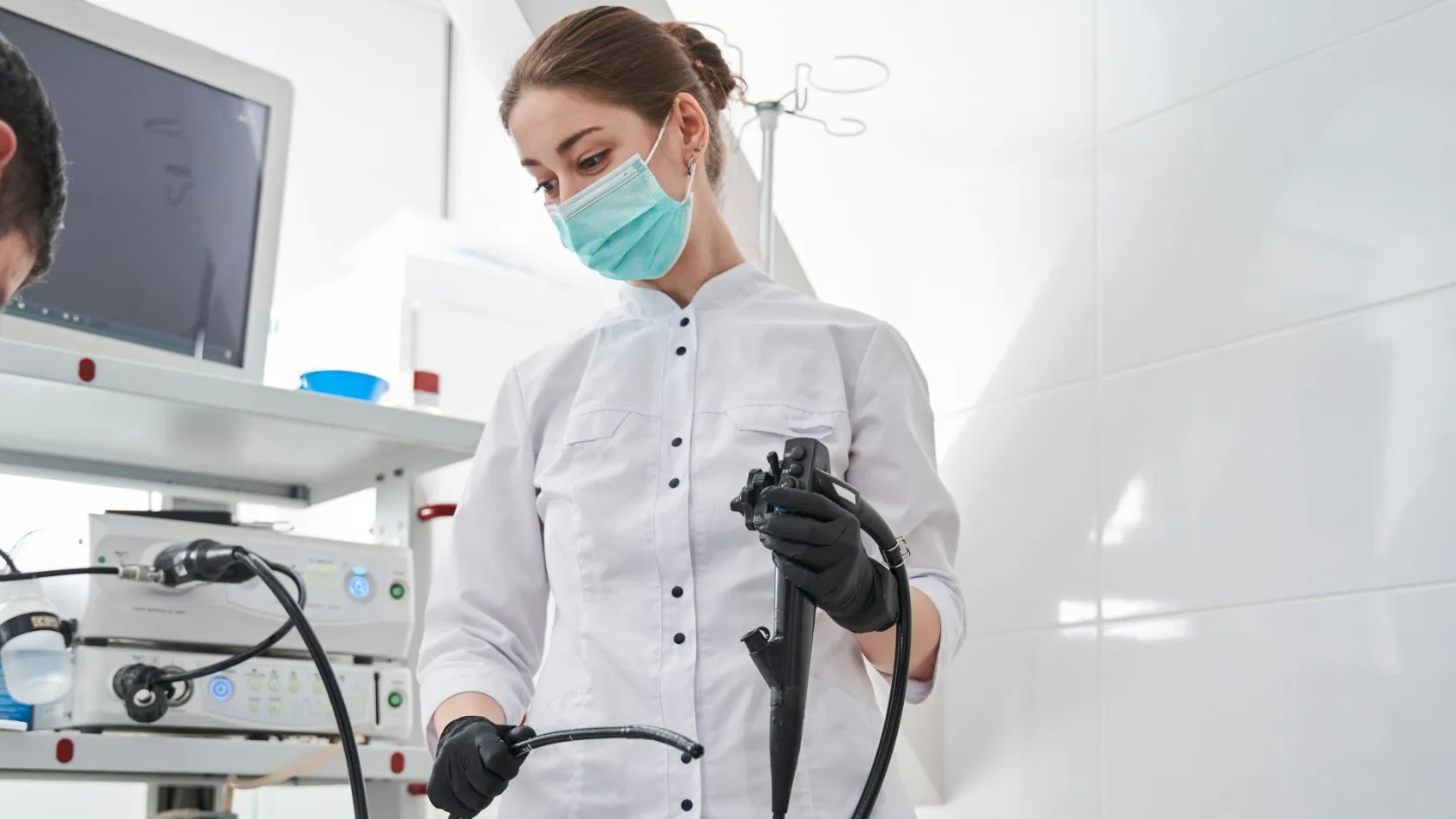
The Gastroenterology and Advanced Endoscopy Center at Biruni Hospital in Istanbul explains gastroscopy, colonoscopy, ERCP and EUS for traveling patients.
Let us call you
Send us your contact information and we will call you as soon as possible.
About This Center
A colonoscopy takes under an hour. Deciding to have one in another country takes most people far longer, because the questions that matter to a traveler, how bowel preparation works in a hotel room, what sedation means for your flight, when biopsy results will actually reach you, are the ones clinic pages rarely answer. The Gastroenterology and Advanced Endoscopy Center at Biruni Hospital in Istanbul diagnoses and treats diseases of the esophagus, stomach, intestines, liver, pancreas and bile ducts, and this page covers both halves of the decision: the medicine itself, and the trip that has to be built around it.
Free consultation
Find out first whether you need an endoscopy at all
The remote file review is free and commits you to nothing. Send any earlier endoscopy or colonoscopy reports with photos if you have them, pathology results, imaging such as ultrasound, CT or MRCP, recent blood tests including liver values, and your complete medication list with any blood thinners named. A gastroenterologist replies in writing with the procedure your case actually calls for, the days to plan in Istanbul and what must be settled before you fly.
What the Gastroenterology and Advanced Endoscopy Center treats
The center is built around the Gastroenterology department of Biruni Hospital, a university hospital in Istanbul, and it covers the digestive system end to end: swallowing disorders, reflux and its complications, stomach and duodenal disease, celiac disease, inflammatory bowel disease, bleeding from anywhere in the gut, chronic liver disease, and disorders of the pancreas and bile ducts. Gastroenterology surgery, general surgery, anesthesiology, pathology and interventional radiology work in the same building, which shapes how cases are handled when a finding needs more than a camera.
Children are seen separately. Pediatric gastroenterology belongs to the hospital's Children's Health center, so a family traveling with a child is directed there rather than through this adult pathway.
Diagnostic endoscopy
Gastroscopy examines the esophagus, stomach and duodenum through a thin flexible camera passed through the mouth, and it answers most upper digestive questions in one sitting: whether reflux has damaged the esophagus, whether gastritis or an ulcer explains the pain, whether the small biopsies that diagnose celiac disease should be taken. Helicobacter pylori, the stomach bacterium behind most ulcers and much chronic gastritis, is tested for during the same examination. The Maastricht VI consensus, the current international standard for this infection, recommends eradicating the bacterium when it is found and then, a step many patients never hear about, confirming with a follow-up test after therapy that treatment actually worked (1). That confirmation test can be done back home, and the written plan you leave with says when and how.
Colonoscopy inspects the large bowel and is the standard investigation for rectal bleeding, unexplained anemia, a lasting change in bowel habit, assessment of inflammatory bowel disease, and colorectal cancer screening. Polyps found on the way are removed in the same session. Capsule endoscopy, a swallowed camera the size of a large pill, covers the small bowel that neither instrument reaches, most often in obscure bleeding.
Therapeutic endoscopy
Treatment through an endoscope now reaches conditions that once demanded open surgery. Achalasia is the clearest example: the muscle at the bottom of the esophagus fails to relax, food will not pass, and for decades the fix was an operation through the abdomen. Peroral endoscopic myotomy, POEM, cuts that muscle from inside the esophagus with no external incision, and a randomized trial in the New England Journal of Medicine found it noninferior to laparoscopic Heller myotomy, the surgical standard, at two years (2).
The center's therapeutic work runs along the same line. ERCP clears bile duct stones, relieves obstructive jaundice and opens strictures. Endoscopic ultrasound, EUS, places an ultrasound probe on the tip of the endoscope directly beside the pancreas and bile ducts and takes fine-needle samples from tissue no external scan can reach safely. Endoscopic resection, known technically as EMR and ESD, lifts large polyps and some early tumors off the bowel or stomach wall and removes them whole, sparing the organ they grew in.
Beyond the endoscope
Roughly half of gastroenterology never involves a camera. Persistently elevated liver enzymes are worked up to a named cause. Fatty liver disease and chronic hepatitis B and C are staged with noninvasive stiffness measurement of the liver, which in many patients has replaced the needle biopsy, and then managed with modern antiviral and metabolic treatment. Inflammatory bowel disease is treated medically, with escalation planned rather than improvised. Pancreatic and biliary disease is managed jointly with the surgical and interventional radiology teams, and when a tumor is found anywhere in the digestive tract, the hospital's oncology infrastructure takes the case up without a transfer to another institution.
Having an endoscopy as a traveler, from fasting to the flight rule
Endoscopies at the center are planned under sedation with anesthesiology support, the standard of care for comfortable, safe examination. You are asleep or deeply drowsy, you feel nothing, and most patients keep no memory of the procedure. Sedation is also the part of the day that constrains a traveler most, so it is worth understanding before the ticket is bought. For the rest of that day you do not fly, you do not drive, and you should not sign anything that matters. Having someone walk you back to the hotel is sensible, and if you are traveling alone, say so in advance so the escort can be arranged. After an uncomplicated diagnostic procedure, flying the next day is usually acceptable.
Preparation differs by procedure. For a gastroscopy the stomach must be empty, which in typical practice means no food for six to eight hours beforehand, with exact fluid rules stated in your plan. Colonoscopy asks more of you. The evening before, in your hotel room, you drink a prescribed laxative solution in divided doses and spend several hours making repeated trips to the bathroom while the bowel empties to clear fluid. Nobody enjoys it, it is not painful, and it decides the quality of the examination: a poorly prepared bowel hides exactly the small polyps the colonoscopy exists to find. Book a room with its own bathroom, keep the evening free, and stay on the clear liquids you are given. The international patient office helps with accommodation near the hospital and airport transfer, so the practical side of that evening is arranged rather than left to you.
One detail matters more to travelers than almost any other, and it rarely appears in writing: gastroscopy and colonoscopy can be combined in a single session under one sedation. One fasting, one preparation, one recovery, both ends of the digestive tract examined in one appointment. When symptoms justify both examinations, this is how the center plans them for a visiting patient.
Blood thinners need a plan, not a pause you improvise. Aspirin usually continues, but anticoagulants such as warfarin or the newer oral agents may have to be stopped or adjusted before biopsies or polyp removal can be done safely, and that decision is made together with the doctor who prescribed them, days before travel. Some diabetes medicines also need adjusting around fasting and bowel preparation. This is a routine conversation. It just has to happen early, which is why the medication list belongs in your very first message.
Colonoscopy quality, screening, and who should not wait for a trip
Not all colonoscopies are equal, and the difference can be measured. The measure is the adenoma detection rate: the share of a colonoscopist's screening examinations in which at least one precancerous polyp is found. In a large study published in the New England Journal of Medicine, every 1 percent increase in a colonoscopist's adenoma detection rate was associated with a 3 percent lower risk of a cancer appearing in the interval between examinations (3). A missed polyp is a future cancer, and detection rate is the single most useful quality question a patient can ask of any endoscopy unit, in Istanbul or anywhere else. Ask it here too.
Screening colonoscopy travels well. From the age your national guideline names, commonly somewhere between 45 and 50, a screening colonoscopy is a legitimate add-on to a trip you were making anyway, and because polyps are removed during the same examination, screening and prevention happen in one sitting.
Honesty runs the other way as well. Bleeding, unintended weight loss, difficulty swallowing, persistent vomiting or a newly discovered anemia are alarm symptoms, and they deserve prompt evaluation where you live, not a place in a travel itinerary weeks away. Equally, reflux that is well controlled on standard medication and causes no warning signs does not need an endoscopy abroad; it usually needs no endoscopy at all. Part of what the free file review does is tell you which of these groups you are in before any money is spent.
ERCP, endoscopic ultrasound and the honest risks of advanced endoscopy
ERCP is not a look around. It is a treatment delivered through an endoscope into the bile and pancreatic ducts, and it is done because something has to be fixed: a stone blocking the bile duct, jaundice from an obstruction, a narrowed duct that needs a stent. When the indication is real, ERCP spares the patient an operation. It also carries the most serious complication profile in routine endoscopy, and a center that does not say so plainly is not being straight with you.
Post-ERCP pancreatitis
Inflammation of the pancreas after the procedure is the defining risk of ERCP. A systematic review of randomized controlled trials in Gastrointestinal Endoscopy found it in about 9.7 percent of patients (4). Most cases are mild and settle with fluids and monitoring over a few hospital days; severe cases need intensive care. This risk is the reason ERCP belongs in a hospital that can manage its own complications: Biruni Hospital is a university hospital of more than 600 beds with intensive care on site, so a patient who develops pancreatitis is treated where the procedure happened, by the team that did it.
Bleeding after polyp or tumor removal
Removing tissue leaves a wound on the bowel or stomach wall, and a small share of patients bleed from it, occasionally days later. Most bleeding is controlled endoscopically. Because delayed bleeding is possible, the flying date after a large resection is set with a safety margin rather than the day after.
Perforation
A tear through the wall of the gut is rare in diagnostic work and somewhat less rare in advanced resection. Small perforations are often closed through the endoscope during the same procedure; larger ones need surgery, which is available in the same building without transfer.
Sedation reactions
Breathing and circulation can dip under sedation, which is why sedation is given with anesthesiology monitoring throughout, and why your heart and lung history belongs in the file review.
Endoscopic ultrasound sits at the other end of the risk spectrum, close to a diagnostic procedure, and it answers questions nothing else answers as well: what a cyst or mass in the pancreas actually is, whether a bile duct is harboring a small stone that MRCP missed, how deep an early tumor goes before a resection is attempted. Fine-needle sampling through the EUS scope brings back tissue for the pathologists without an operation. For early tumors and large flat polyps, endoscopic resection then does what surgery once did, removing the lesion whole from inside while the organ stays where it is. Which technique fits which lesion is a judgment made on the images and the pathology, case by case, and it is exactly the judgment the free file review gives you in writing.
When a finding changes the trip, and how pathology timing works
Endoscopy is a search. Sometimes it finds things, and a traveler deserves to know in advance what happens then.
Removing ordinary polyps during the same colonoscopy is standard practice worldwide, and it is agreed with you before the sedation, not assumed. Beyond that, the rule at the center is simple: nothing outside the plan you approved is done without a conversation. A very large polyp, a lesion that looks like an early tumor, a stone seen in the bile duct on imaging, each of these is documented, explained to you, and treated only after you have agreed to the new plan. Sometimes that means an extra procedure later the same week, an ERCP added to a diagnostic visit, or an endoscopic resection scheduled two days after the colonoscopy that found the lesion. Sometimes it means going home to think, with the complete file in your hands, and returning when you decide. Both are respectable answers, and the choice stays yours.
Pathology has its own clock. Biopsies and removed polyps are processed, stained and read by pathologists over several days, so a patient who flies home two days after a colonoscopy will often travel before the tissue result exists. The pathway is designed around this rather than embarrassed by it: before your procedure you agree how the written pathology report reaches you, and you then receive it remotely, together with an explanation in plain language of what it shows and what, if anything, should follow. Interpreter support covers this handover in your own language, the same as every other step of the visit. What you should not do is fly home assuming that no news is good news. Agree the handover first; it takes two minutes.
What endoscopy costs in Istanbul
Published third-party figures give a starting point. On the medical travel platform Bookimed, a bare colonoscopy in Turkey is listed from about $150 to $200, while a full package at an Istanbul hospital, covering the procedure with anesthesia, consultations and a translator, is listed around $1,200, rising to roughly $1,500 when biopsy and polyp removal are included. ERCP in Istanbul is listed between $2,000 and $3,200, with a package example around $2,940 to $3,000 including a private room, an interpreter and transfers. Treat all of these as indicative aggregator figures, not quotes.
Published Istanbul ranges compiled from Bookimed listings, and the factors behind them
Procedure
Published range
What moves the figure
Colonoscopy
$150 to $200 bare; about $1,200 as a hospital package, near $1,500 with biopsy and polypectomy
Anesthesiologist-delivered sedation, number of biopsies sent to pathology, polyps removed, whether gastroscopy is combined
ERCP
$2,000 to $3,200; package example around $2,940 to $3,000 with room, interpreter and transfers
Stent placement, stone complexity, nights of private room observation after the procedure
Two forces set the final figure in any hospital. First, whether the procedure stays diagnostic or becomes therapeutic: removing polyps, placing a stent or resecting a lesion adds instruments, pathology work and observation time. Second, what surrounds the procedure: sedation with a dedicated anesthesiologist, the count of biopsy specimens each read separately by pathology, and hospital nights when observation after ERCP or a large resection is prudent. A price that looks low usually excludes several of these.
Biruni Hospital does not publish a flat list price for this reason. After the free file review you receive a written individual quote naming what it includes, so the number you compare is the number you would pay.
Questions travelers ask about endoscopy in Istanbul
How many days should I plan in Istanbul for a gastroscopy or colonoscopy?
Medical travel platforms such as Bookimed recommend 2 to 4 days for diagnostic endoscopy and 5 to 7 days when endoscopic treatment is planned, and those windows match how visits here are structured. Day one covers the consultation and preparation, day two the procedure, and the following day a review of the initial findings. Biopsy results take longer than that, so the handover of the written pathology report is agreed before the procedure instead of extending your stay.
Can I fly home on the day of my endoscopy?
No. Sedation is used for every endoscopy at the center, and for the rest of that day you should not fly, drive or make significant decisions. Having someone accompany you back to the hotel is sensible, and the team arranges an escort if you are traveling alone. After an uncomplicated diagnostic procedure, flying the next day is usually acceptable; after ERCP or a large endoscopic resection you stay longer for observation, and the timing appears in your written plan.
Can a gastroscopy and a colonoscopy be done in the same session?
Yes, and for a traveler it is usually the sensible arrangement. Both examinations are performed under one sedation in one appointment, the fasting and bowel preparation are combined, and a single recovery covers both. Whether both are actually indicated in your case is settled during the free file review, not on the day.
I take blood thinners. Can I still have an endoscopy abroad?
Usually yes, with planning. Aspirin can often continue, but anticoagulants such as warfarin or the newer oral agents may need to be paused or adjusted before biopsies or polyp removal, and that decision involves the doctor who prescribed them. Some diabetes medicines also need adjusting around the fasting and the bowel preparation. Name every medication in your first message, because this planning happens before you travel, not at the hospital door.
How do I get my biopsy results if I fly home before they are ready?
Tissue samples take several days to process and read, so a patient who flies home two days after a colonoscopy will often travel before the pathology is complete. The pathway is designed for exactly that: before the procedure you agree how the report reaches you, and you then receive the written pathology result remotely together with an explanation of what it means and what, if anything, should happen next.
My reflux is controlled with medication. Should I travel for an endoscopy?
Probably not. Reflux that responds well to standard medication and causes no warning signs rarely needs an endoscopy in another country, or any endoscopy at all. Difficulty swallowing, unintended weight loss, vomiting, bleeding or a new anemia change that answer completely, and those symptoms deserve prompt evaluation where you live rather than a wait for a trip. If you are unsure which group you belong to, send your history for the free review and ask.
What happens if a polyp is found during my colonoscopy?
Small and medium polyps are removed during the same colonoscopy, which is standard practice worldwide and is agreed with you in advance. The removed tissue goes to pathology, and the result shapes your follow-up interval. A very large polyp or a suspected early tumor is handled differently: it is documented, discussed with you, and treated only after you have agreed to the new plan, sometimes in a separate endoscopic resection session. Nothing beyond the plan you approved is done without that conversation.
References
Malfertheiner P, Megraud F, et al. Management of Helicobacter pylori infection: the Maastricht VI/Florence consensus report. Gut. 2022;71(9):1724-1762.
Werner YB, Hakanson B, et al. Endoscopic or Surgical Myotomy in Patients with Idiopathic Achalasia. New England Journal of Medicine. 2019;381(23):2219-2229.
Corley DA, Jensen CD, et al. Adenoma detection rate and risk of colorectal cancer and death. New England Journal of Medicine. 2014;370(13):1298-1306.
Kochar B, Akshintala VS, et al. Incidence, severity, and mortality of post-ERCP pancreatitis: a systematic review by using randomized, controlled trials. Gastrointestinal Endoscopy. 2015;81(1):143-149.
Editor's note
Written by the Biruni Hospital medical editorial team. Reviewed by Prof. Dr. Ali Hakan KAYA, Hematology.