
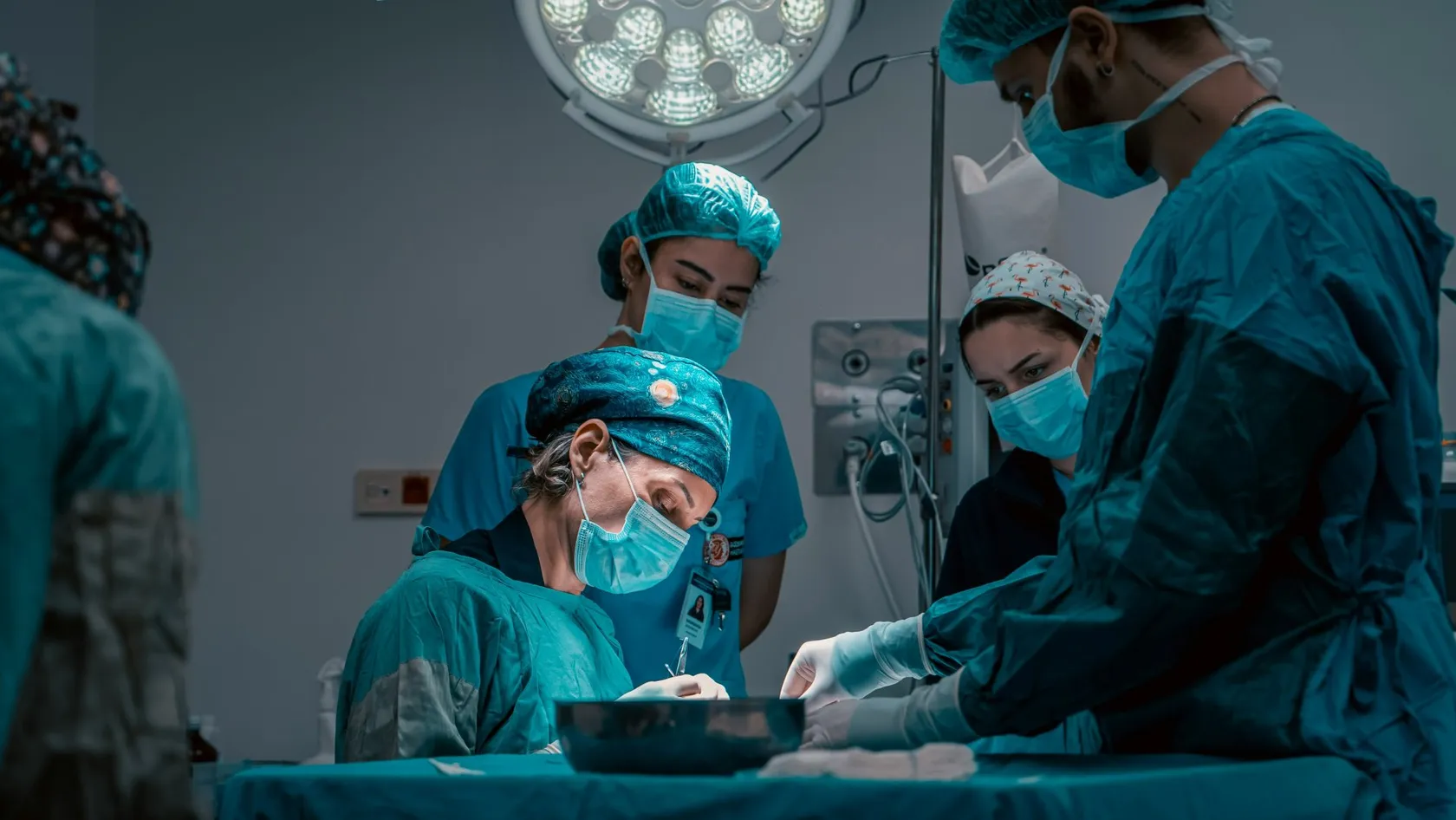
Cardiology & Cardiovascular Surgery Center
Biruni Hospital's Cardiology and Cardiovascular Surgery Center reviews your angiogram free, then plans bypass, valve or aneurysm surgery and the flight home.
Let us call you
Send us your contact information and we will call you as soon as possible.
About This Center
Most people who write to the Cardiology and Cardiovascular Surgery Center at Biruni Hospital in Istanbul have already been given a verdict at home, you need a bypass, or you need a new valve. This page explains how a cardiologist and a cardiovascular surgeon here test that verdict against your own angiogram before anyone books an operating theatre, what the surgery and the weeks around it involve, how the valve choice changes when you live far from an INR clinic, and when you will be cleared to fly home.
Free consultation
Have your angiogram read here before you agree to an operation
The review costs nothing and carries no obligation. Send your coronary angiogram as DICOM files, the echocardiography report with the ejection fraction, the catheterisation report and your current medication list, and a cardiologist and a cardiovascular surgeon will tell you in writing whether the operation you were offered is the one they would perform, and what it would involve here.
What the Cardiology and Cardiovascular Surgery Center treats
Biruni Hospital's Cardiology and Cardiovascular Surgery Center puts both heart specialties on one corridor: cardiologists, who diagnose and treat with medication and catheters, and cardiovascular surgeons, who operate. Between them the centre manages coronary artery disease, heart failure, rhythm disorders and hard-to-control hypertension, and performs adult cardiac surgery from bypass grafting through valve surgery to aortic aneurysm repair.
Diagnosis runs on site. ECG, echocardiography and stress testing answer the first questions, and coronary angiography runs on the hospital's Artis Icono Biplane and Artis Zee Pure imaging systems, which produce the catheter images every decision below depends on. The pictures the cardiologist records are the pictures the surgeon reads. Nothing is lost between departments, because there is nothing between the departments.
Told you need a bypass? The decision deserves as much scrutiny as the operation
A narrowing seen on a coronary angiogram can usually be treated in one of three ways: bypass surgery, a stent placed through a catheter, or medication alone. Which one is right depends on how many vessels are involved, where the narrowings sit, whether you have diabetes, and how well the heart muscle is still pumping. At this centre that judgement is never left to one specialist. A cardiologist and a cardiovascular surgeon review the same angiogram together, the working method the 2021 American revascularisation guideline formalises as the Heart Team and recommends exactly for patients whose best option is not obvious.
The caution has numbers behind it. In the ten-year follow-up of the SYNTAX trial, published in The Lancet in 2019, patients with three-vessel coronary disease lived longer after bypass than after stenting: 21 percent had died within ten years of surgery against 28 percent after stents, while for left main disease the two approaches were equivalent. Guidelines draw a similar line for people with diabetes and multivessel disease, in whom bypass generally gives the more durable result.
So a patient offered a stent for three-vessel disease, or offered open surgery for a single accessible narrowing, deserves a second pair of eyes before booking any travel. Sometimes the second reading confirms the first advice completely. That answer is worth having too, because you then fly, if you fly at all, without the quiet doubt.
What a remote review of your heart file can settle
Before you price flights, send the file. A cardiac case can be assessed from another country to a degree most patients do not expect, provided the material is the real material: the coronary angiogram as DICOM files on the disc or USB stick the catheter laboratory gave you, the echocardiography report with the ejection fraction written on it, the catheterisation report, and a list of every medication with doses. Photographs of paper reports are fine. A phone video of an angiogram playing on a screen is not, because compression destroys exactly the detail the decision rests on, so ask your hospital for the disc; every catheter laboratory can export one.
What comes back is a written answer to the question that actually matters: whether the operation you were recommended is the operation this Heart Team would perform, a different one, or none. An estimate of cost and length of stay comes with it, but the estimate is the smaller half of the reply.
Which heart operations are performed at the centre?
Coronary artery bypass grafting is the core open operation: a segment of artery or vein from your own body is joined in beyond the blocked stretch so blood reaches the muscle again. Heart valve surgery covers repair, where your own valve is preserved and reshaped, and replacement with a mechanical or a biological prosthesis, a choice the next section takes slowly because it deserves it. Pacemaker implantation, a short catheter-lab procedure, treats hearts that beat too slowly. Aortic aneurysm repair replaces or relines a swollen segment of the body's main artery, either as open surgery with a synthetic graft or as an endovascular procedure threaded up from the groin.
One of the hospital's operating theatres is a hybrid theatre, an operating room with an angiography system built over the table. Aneurysm surgery gains the most from it: a stent graft can be positioned under live imaging, checked, and converted to open repair in the same room in the rare case that becomes necessary, instead of moving an anaesthetised patient between floors.
Mechanical or biological valve: the choice reads differently when you live abroad
Every replacement valve is a compromise. A mechanical valve is built to outlast you, and in exchange demands lifelong warfarin with regular INR blood tests, keeping the blood thin enough that clots do not form on the valve yet thick enough that you do not bleed. A biological valve, made from treated animal tissue, needs no long-term warfarin in most patients, and in exchange it wears out: reintervention is commonly needed after ten to fifteen years, sooner in younger people whose metabolism degrades the tissue faster.
The 2020 American valve guideline frames the trade by age. A mechanical prosthesis is reasonable below about 50, a biological one above about 65, and between those ages the guideline explicitly hands the decision to the patient and the team together.
For someone flying home from Istanbul, one question outranks age: can you reliably get an INR test every few weeks where you live? Across the regions this centre's patients come from, the honest answer changes from one city to the next. A mechanical valve with erratic INR control is more dangerous than a biological valve with a planned second procedure, so the surgeons ask about your local follow-up options before recommending a prosthesis, and you should raise it yourself if nobody has. Pregnancy plans push the same direction, since warfarin can harm a developing baby. A few patients also mind the faint click a mechanical valve makes in a quiet room; most stop hearing it within months.
| What matters to you | Mechanical valve | Biological valve |
|---|---|---|
| Blood thinning | Warfarin for life, with INR testing roughly every two to four weeks once stable | Usually only for the first weeks to months, then none in most patients |
| What your home town must provide | A laboratory or clinic that can check INR dependably, for decades | A yearly echocardiogram to watch the valve age |
| How long it lasts | Designed to last a lifetime | Commonly ten to fifteen years before reintervention, less in younger patients |
| Guideline age steer (2020 ACC/AHA) | Reasonable below about age 50 | Reasonable above about age 65; shared decision between 50 and 65 |
| Planning a pregnancy | Warfarin complicates pregnancy and needs specialist management | No warfarin issue, which is why it is often preferred here |
From admission to the ward: how the days in hospital run
Preparation starts before you fly. Eating stops six to eight hours before the operation, and blood thinners such as aspirin, clopidogrel or warfarin are paused or adjusted in the days beforehand on a written schedule the team gives you, because arriving with the wrong drug still active in your blood is one of the few things that genuinely postpones cardiac surgery. Bring every medication box, or a clear photographed list.
The operation itself takes several hours. You wake in cardiac intensive care, where monitoring continues for 24 to 48 hours while drains, lines and the urinary catheter come out one by one. Sitting out of bed usually begins on the first day, and corridor walking within a day or two, because early mobilisation is what protects the lungs and the leg veins after heart surgery. In total, an open operation means five to ten days in hospital. Pacemaker implantation is far shorter, often one night.
What does recovery from heart surgery feel like, week by week?
Most patients feel weaker than they expected in the first two weeks and stronger than they expected by the sixth. Tiredness, poor sleep, low appetite and flat mood are all part of the normal arc, and full recovery from open heart surgery takes six to ten weeks. Two things in that stretch catch international patients off guard, so they get their own space here.
The irregular heartbeat on day two or three that is usually not an emergency
A racing, fluttering pulse a few days after cardiac surgery frightens every patient who was not warned about it, which is why you are being warned here. Postoperative atrial fibrillation follows 20 to 40 percent of cardiac operations, according to a 2019 review in Nature Reviews Cardiology, appearing most often on the second to fourth day and usually passing on its own or with rate-controlling medication before discharge. Unpleasant to feel, rarely dangerous when monitored. Watching for exactly this rhythm is one of the reasons the intensive care stay lasts 24 to 48 hours instead of ending at the ward door.
The breastbone sets the calendar
A sternum divided for surgery is wired back together and heals the way any broken bone heals, over two to three months. Until then, no lifting beyond roughly five kilograms, no pushing up from a chair on your arms, no driving until the surgeon agrees, and a folded towel hugged to the chest whenever you cough. Wound care is unglamorous and decisive. Redness, discharge or fever around the incision is a same-day message to a doctor, never something to watch for a week.
How long do you stay in Turkey, and when is the flight home safe?
Plan for three to four weeks in Turkey for open heart surgery: five to ten days in hospital, then the remainder nearby, within reach of the team, for wound review, a follow-up echocardiogram and the consultation that clears you to fly. Aviation medicine guidance used by airlines generally treats an uncomplicated sternotomy as compatible with air travel from around ten to fourteen days after surgery. Clearance here is individual rather than calendar-based, follows the echo and the wound check, and for most patients lands two to three weeks after discharge.
The flight itself is a management problem, and a small one. Walk the aisle every hour against clot risk, drink water, keep all medication and the discharge summary in your hand luggage, and let someone else lift the bag into the overhead locker, because that push is precisely what a healing sternum cannot give. Some airlines ask recent surgical patients for a fitness-to-fly form before boarding; the discharge documents you leave with contain everything the form needs. Most patients travel with a companion, and the coordinators will tell you how accommodation for the person coming with you is arranged.
Cardiac rehabilitation, and the handover to your doctor at home
Cardiac rehabilitation is the part of heart surgery most often skipped, and the evidence says it is the part least worth skipping. A 2021 Cochrane review pooling 85 randomised trials and 23,430 participants found that exercise-based rehabilitation after events such as bypass surgery reduced heart attacks by 28 percent within the first year and reduced cardiovascular deaths by about 40 percent across long-term follow-up. Rehabilitation begins on the ward here, with breathing exercises and graded walking, and you leave carrying a written programme to continue through the weeks at home.
The handover is documented, never assumed. Your discharge summary records the operation, the exact prosthesis if a valve was implanted, the medication plan, the INR target range where warfarin applies, and the echocardiogram schedule your own cardiologist should run. An INR checked at any laboratory near your home counts; patients send the result over WhatsApp and the team comments on dose changes together with the local doctor. Once you are back home, chest pain, new breathlessness, fever or a leaking wound goes to a nearby doctor first and to this team second, in that order, because in those situations hours matter more than familiarity.
Who should not fly to Istanbul for heart surgery?
Some patients should not board a plane for this, and saying so plainly is part of the service. A file review that ends with the advice to stay near home costs you nothing and can spare you a dangerous journey.
Between the clear yes and the clear no sits a wide middle band, which is exactly what the free file review exists to sort. Send the records and let the Heart Team place you honestly on that map.
What moves the cost of heart surgery in Turkey?
Three things move the price of cardiac surgery more than anything else: which operation it is, what gets implanted, and how long you stay. A bypass built from your own vessels involves no prosthesis. A valve replacement adds the valve, and mechanical and biological prostheses are priced differently. An endovascular aneurysm repair adds a stent graft sized to your anatomy, which can cost more than the rest of the admission combined. Extra days in intensive care, an added procedure such as a pacemaker, and the conditions you bring with you, diabetes or kidney disease among them, all widen an estimate, which is why a serious written quote follows the file review here instead of preceding it.
For scale, public medical tourism platforms quote roughly 10,000 to 25,000 US dollars for cardiac surgery in Turkey, against 40,000 to 200,000 dollars quoted for the United States and 30,000 to 50,000 pounds for the United Kingdom on the same sites. Treat those as indicative market ranges compiled by aggregator services: not clinical data, and not this hospital's prices. Your own estimate arrives with the Heart Team's written opinion, and it spells out what it covers.
Questions international patients ask about heart surgery in Turkey
How long do I need to stay in Turkey after open heart surgery?
When can I fly home after bypass or valve surgery?
There are few INR clinics where I live. Should I still choose a mechanical valve?
Can you tell me whether I need a bypass or a stent before I travel?
Is an irregular heartbeat a few days after heart surgery dangerous?
What does heart surgery cost in Turkey?
References
- Thuijs DJFM, Kappetein AP, Serruys PW, et al. Percutaneous coronary intervention versus coronary artery bypass grafting in patients with three-vessel or left main coronary artery disease: 10-year follow-up of the multicentre randomised controlled SYNTAX trial. Lancet. 2019;394(10206):1325-1334.
- Lawton JS, Tamis-Holland JE, Bangalore S, et al. 2021 ACC/AHA/SCAI Guideline for Coronary Artery Revascularization: A Report of the American College of Cardiology/American Heart Association Joint Committee on Clinical Practice Guidelines. Journal of the American College of Cardiology. 2022;79(2):e21-e129.
- Otto CM, Nishimura RA, Bonow RO, et al. 2020 ACC/AHA Guideline for the Management of Patients With Valvular Heart Disease: A Report of the American College of Cardiology/American Heart Association Joint Committee on Clinical Practice Guidelines. Circulation. 2021;143(5):e72-e227.
- Dobrev D, Aguilar M, Heijman J, Guichard JB, Nattel S. Postoperative atrial fibrillation: mechanisms, manifestations and management. Nature Reviews Cardiology. 2019;16(7):417-436.
- Dibben G, Faulkner J, Oldridge N, et al. Exercise-based cardiac rehabilitation for coronary heart disease. Cochrane Database of Systematic Reviews. 2021;11:CD001800.
Editor's note
Written by the Biruni Hospital medical editorial team. Reviewed by Op. Dr. Selda Atar Akal, Gynecology and Obstetrics.
Medically reviewed by
Op. Dr. Selda Atar Akal
Gynecology and Obstetrics
Areas of Specialization
Our multidisciplinary team covers the following areas within this center.
- Interventional Cardiology
- Electrophysiology & Arrhythmia
- Heart Failure & Transplant
- Structural Heart Disease
- Coronary Bypass Surgery
- Valve Repair & Replacement
Other Medical Centers
View All
Breast Health & Breast Cancer Center
Most people arrive having already decided which operation they want. The operation is rarely the first decision and never the one that decides most.
CAR-T Cell Therapy Center
CAR-T cell therapy in Istanbul for leukemia, lymphoma and myeloma. Eligibility, the five stage process, honest cost figures and how long you stay at Biruni.
Cellular Immunotherapy Center
Two entirely different industries use the words cell therapy. One has a regulator behind it. Four questions tell you which one you are talking to.

Check Up & Longevity Center
Biruni Hospital's Check-Up and Preventive Medicine Center in Istanbul plans risk based health screening by age, sex and history, with a free remote intake.

Children’s Health Center
The Children's Health and Diseases Center in Istanbul unites pediatric subspecialists at Biruni Hospital, with a free remote review of your child's file.