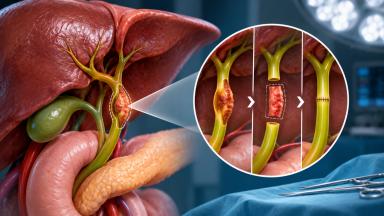
Total Thyroidectomy
Total thyroidectomy removes the whole thyroid gland through a short cut in a neck crease, for thyroid cancer, large goiters and Graves' disease, and most patients go home the next day. This guide explains when total rather than partial removal is advised, how nerve monitoring protects the voice, low calcium and other risks, taking levothyroxine, when radioactive iodine is needed, a typical one-week Istanbul stay and follow-up at home.
About This Department
The whole thyroid, removed through a neck crease. With the voice and calcium protected.
In a trial of 1,000 patients, nerve monitoring during thyroid surgery halved temporary injury to the vocal cord nerves.
An ultrasound and a needle biopsy have shown cancer in the thyroid, or a goiter has grown large enough to press on the windpipe, or Graves' disease keeps coming back despite tablets, and the doctor has recommended removing the whole gland. A total thyroidectomy removes both lobes of the thyroid, the butterfly-shaped gland at the front of the neck, through a cut of 4 to 6 centimeters placed in a natural skin crease. After it, a daily thyroid hormone tablet takes over the gland's work for life. The operation takes one and a half to three hours. Most patients go home the next day. Its two specific risks, to the nerves that move the vocal cords and to the parathyroid glands that control calcium, are the reason the surgeon's experience and nerve monitoring matter. Below you will find when total rather than partial removal is advised, what the evidence shows, how the operation is done, the risks, life on thyroid hormone, radioactive iodine, how long to stay in Istanbul, and the follow-up at home.
When the whole gland is removed
On a narrow screen, swipe the table sideways to read every column.
| Condition | Why total removal |
|---|---|
| Thyroid cancer over 4 centimeters, or with spread to nodes | Removes all cancer-bearing tissue and allows radioactive iodine and thyroglobulin follow-up |
| Multinodular goiter in both lobes | Relieves pressure and avoids regrowth in the lobe left behind |
| Graves' disease | Ends the overactivity for good when tablets fail or the eyes are affected |
| Retrosternal goiter | A goiter growing down behind the breastbone that narrows the windpipe |
When half the gland is enough
What the evidence shows
Extent of surgery for cancer
A study of 52,173 American patients with papillary thyroid cancer found that, for tumors of 1 centimeter or more, removing only one lobe carried a higher risk of recurrence and death than total thyroidectomy, while for tumors under 1 centimeter the extent of surgery made no difference. Since then guidelines have narrowed the gap, and many low-risk cancers between 1 and 4 centimeters are now treated by lobectomy, but total removal remains standard for larger tumors, spread to nodes, and cancers planned for radioactive iodine.
Protecting the voice
In a Polish trial of 1,000 patients having surgery on both sides of the thyroid, monitoring the vocal cord nerves with an electrical signal during the operation halved temporary nerve weakness, from 38 to 19 affected nerves out of 1,000 at risk. Permanent injuries were rare. There were 12 and 8.
Two nerves and four tiny glands sit against the thyroid. Protecting them is most of the skill.
How the operation is done
The first hours after
You wake with a sore throat from the breathing tube and a little stiffness in the neck. Talking, drinking and walking start the same evening. The nurse checks the wound for swelling every hour that first night.
Risks and how they are managed
Low calcium
Across 115 studies, a review found temporary low calcium after thyroidectomy in a median of 27 percent of patients and permanent low calcium in 1 percent. Tingling comes first. It starts around the lips and fingertips. A blood test the morning after surgery and calcium and vitamin D tablets for a few weeks manage nearly all cases.
Other risks
Life on thyroid hormone
Levothyroxine, one tablet each morning on an empty stomach, replaces the hormone the thyroid made. The dose is set by weight and adjusted with a TSH blood test six weeks after surgery and then yearly. Life stays normal. So do pregnancy and sport.
- Take it 30 to 60 minutes before breakfast with water only.
- Same time daily.
- If you miss a dose, take it when you remember, or two the next day.
One small tablet does the gland's whole job.
Some products block its absorption, so keep these four hours away from the tablet.
- calcium and iron supplements,
- antacids,
- soy products and high-fiber cereals,
- and coffee.
Radioactive iodine after surgery
For higher-risk thyroid cancer, a capsule of radioactive iodine destroys remaining thyroid cells weeks after surgery. Low-risk cancer may not need it. In the French ESTIMABL2 trial of patients with low-risk cancer, 95.6 percent of those followed without radioactive iodine were free of any sign of disease at three years, against 95.9 percent of those who received it.
How long to stay in Istanbul
Plan for one week. Sometimes ten days.
Published Istanbul total thyroidectomy packages on Bookimed list one night to two days in hospital, some with nerve monitoring included, and the platform's guidance is 7 days in Turkey. The pathology report arrives within a week, the wound is checked before you fly, and the calcium result decides how long any supplements continue.
What decides the cost
Benign or cancer surgery, central node clearance, nerve monitoring, nights in hospital and any radioactive iodine set most of the figure.
Compare quotes on those items. Ours comes after a free review of your ultrasound, biopsy result and thyroid blood tests.
Arranging the trip
Ultrasound images, the biopsy report and recent thyroid blood tests, sent on WhatsApp, are enough to start. A single coordinator stays with you from that first message through the blood tests you have at home. English, Arabic, French, Russian, Serbian, Romanian and Spanish are spoken, and interpreters help in other languages. A relative can stay overnight on the companion bed in your room. The international office books your hotel, sends the visa invitation letter ten days before you travel and arranges transfers, with halal, vegetarian and diabetic meals, a prayer room and a female physician on request.
Once you are back home
Six weeks after surgery, a TSH blood test sets the dose. For cancer, neck ultrasound and thyroglobulin tests at six to twelve months and then yearly watch for recurrence, and results can be sent through the coordinator for review.
Call a doctor the same day for
- tingling or cramps in the hands, feet or around the mouth,
- swelling of the neck or difficulty breathing,
- a voice that gets worse instead of better,
- and fever or redness at the wound.
Total thyroidectomy FAQ
Will I need tablets for life?
Will I gain weight?
How visible will the scar be?
When can I talk and eat?
When can I fly?
Can a family member stay with me?
References
- Bilimoria KY, Bentrem DJ, Ko CY, et al. Extent of surgery affects survival for papillary thyroid cancer. Ann Surg. 2007;246(3):375-381.
- Barczyński M, Konturek A, Cichoń S. Randomized clinical trial of visualization versus neuromonitoring of recurrent laryngeal nerves during thyroidectomy. Br J Surg. 2009;96(3):240-246.
- Edafe O, Antakia R, Laskar N, et al. Systematic review and meta-analysis of predictors of post-thyroidectomy hypocalcaemia. Br J Surg. 2014;101(4):307-320.
- Leboulleux S, Bournaud C, Chougnet CN, et al. Thyroidectomy without radioiodine in patients with low-risk thyroid cancer. N Engl J Med. 2022;386(10):923-932.
Editor's note
Written by the Biruni Hospital medical editorial team. Reviewed by Prof. Dr. Metin GÜDEN, Radiation Oncology.
Medically reviewed by
Prof. Dr. Metin GÜDEN
Radiation Oncology
Last updated: