
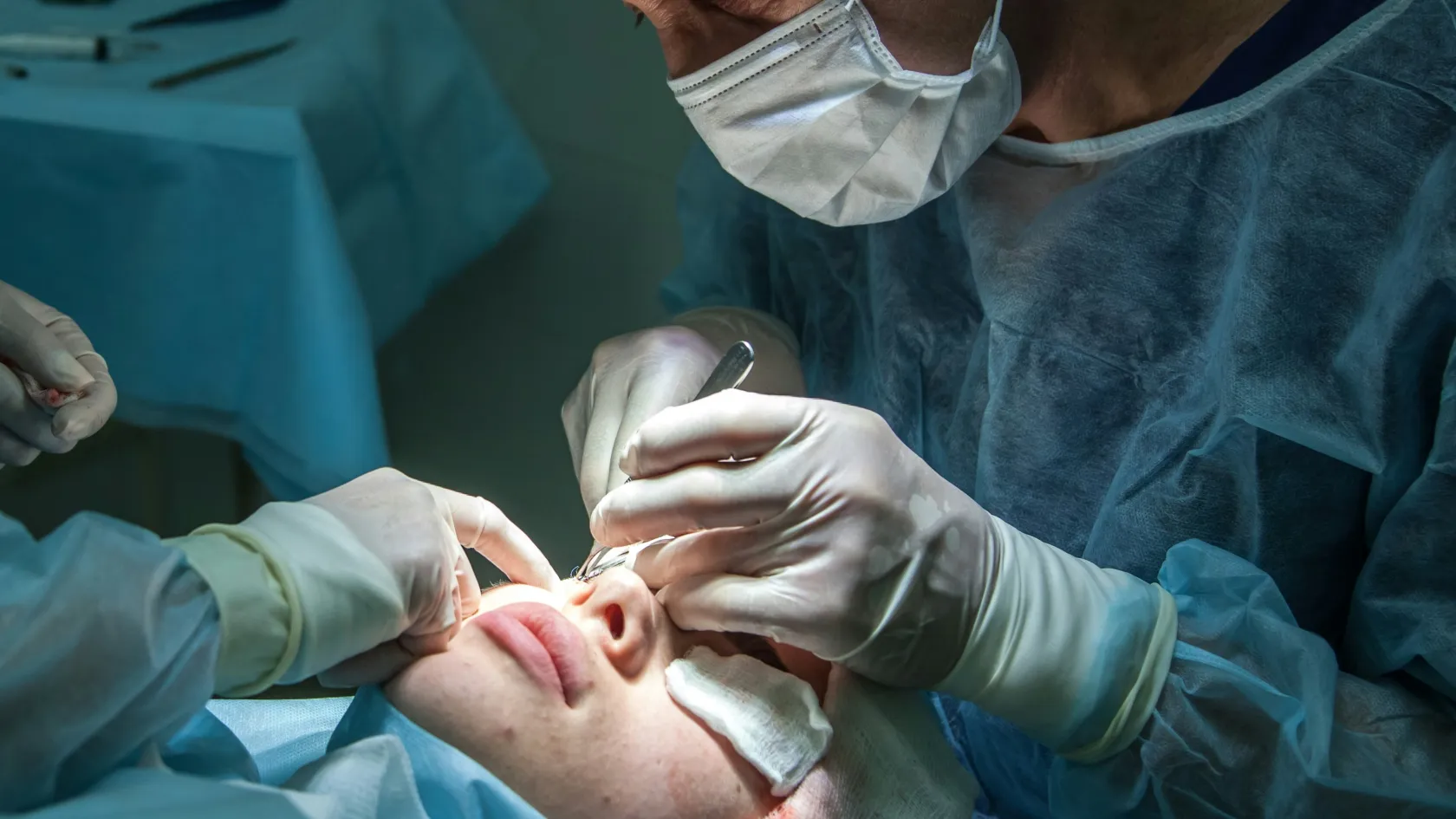
Rhinoplasty
Rhinoplasty reshapes the bone and cartilage of the nose to change its bridge, tip or symmetry, and with septoplasty it also improves breathing. In a study of 4,978 patients, 0.7 percent had a major complication. At Biruni Hospital in Istanbul, our plastic surgery team plans open or closed rhinoplasty from your photographs, with a stay of seven to ten days and video follow-up for a year.
About This Department
The nose sits at the center of the face and carries the airway. Good rhinoplasty changes its shape without costing a breath.
Rhinoplasty reshapes the bone and cartilage of the nose to change its size, profile, tip or symmetry, and when combined with septoplasty it also straightens the inner wall that divides the airway. In a prospective study of 4,978 patients, 0.7 percent had a major complication within 30 days, hematoma and infection being the most frequent (Layliev and colleagues, Aesthetic Surgery Journal, 2017). Around one patient in ten asks for a revision in the years after, a figure that rises after earlier nasal surgery or injury. In a multicenter study of septorhinoplasty, patient-rated satisfaction with the nose rose from 32.3 to 69.8 out of 100. Swelling settles over a year, and the final shape needs that long to show. This page explains the types of rhinoplasty, who is suited, planning, open and closed techniques, cartilage grafts, breathing, risks, the operation day, recovery, revision, and how patients from abroad arrange rhinoplasty at Biruni Hospital in Istanbul.
What rhinoplasty is
Rhinoplasty changes more than looks. It changes the airway, and every step of the plan has to protect breathing.
Who is suited
| Concern | What surgery can do | Limit |
|---|---|---|
| Dorsal hump | Lower or smooth the bridge | Skin thickness affects the new line |
| Wide or bulbous tip | Narrow and define the tip | Thick skin limits definition |
| Crooked nose after injury | Straighten bone and septum | Some asymmetry may remain |
| Drooping tip | Lift and support the tip | Overrotation looks unnatural |
| Blocked breathing | Straighten septum, open valves | Allergy needs separate treatment |
Age and health
Surgery refines the nose a patient has. It does not transplant another person's nose onto a different face.
Consultation and planning
What we assess
| Step | Purpose | Detail |
|---|---|---|
| Face and nose analysis | Proportion with forehead, lips and chin | Standard photographs from six angles |
| Inside of the nose | Septum, turbinates, nasal valves | Examination with a speculum or endoscope |
| Skin thickness | Predicts how much definition shows | Thick skin hides fine detail |
| Breathing history | Blockage, snoring, allergies | Questionnaire and examination |
| Imaging when needed | Bone and septum after injury | CT scan of the sinuses |
A chin that sits back makes the nose look bigger. In some faces, a small chin implant or filler balances the profile better than a larger nasal reduction.
Expectations and the mirror
Some worries about the nose come from the mind more than the nose.
A Belgian study of 226 people seeking rhinoplasty found that 33 percent showed at least moderate symptoms of body dysmorphic disorder, a condition in which a person becomes preoccupied with a slight or imagined flaw, and the severity of those symptoms bore no relation to how the nose looked to independent observers (Picavet and colleagues, Plastic and Reconstructive Surgery, 2011). A later multicenter German study found similar rates and showed that these patients gained less from surgery, even when the operation went well (Hohenberger and colleagues, Laryngoscope, 2024). We therefore ask every patient a short set of screening questions, and when the answers suggest the worry runs deeper than the nose, we recommend a talk with a psychologist first, because an operation cannot fix a distress that the mirror did not cause.
Saying no is part of the job.
Open and closed rhinoplasty
Open surgery gives the surgeon a direct view. Closed surgery leaves no outside scar and causes a little less tip swelling.
| Feature | Open | Closed |
|---|---|---|
| Visible scar | Fine line under the tip | None |
| View of cartilages | Direct | Limited |
| Tip swelling | Longer | Shorter |
| Best suited to | Complex tips, grafts, revision | Hump, minor tip work |
Cartilage grafts
| Source | Advantage | Drawback |
|---|---|---|
| Septum | Straight, same operative field | Limited amount |
| Ear | Curved, useful for tip and nostrils | Soft, small scar behind the ear |
| Own rib | Plenty, strong | Chest scar, warping risk, pain |
| Donor rib, irradiated | No second site | Some resorption over time |
| Graft | Position | Role |
|---|---|---|
| Spreader grafts | Along the bridge | Open the internal valve, straighten |
| Columellar strut | Between tip cartilages | Support tip projection |
| Alar rim grafts | Nostril edge | Prevent collapse and notching |
Breathing and the septum
Results for breathing
Why the tip decides
Surgeons debate the bridge. Patients notice the tip.
The tip carries the most delicate cartilages, the thinnest support and the greatest variation in skin between people, so it shows small errors that a hump never would. A series of 369 consecutive cosmetic rhinoplasties linked failure to address the tip at the first operation to more dissatisfaction, along with earlier nasal surgery, facial fracture and complications (Neaman and colleagues, Aesthetic Surgery Journal, 2013). A plan that treats the tip together with the bridge gives a nose that looks balanced from every angle.
Balance beats size.
Risks
- Bruising and swelling around the eyes in the first two weeks, fading from purple to yellow.
- Nosebleeds for a few days, light and self-limiting in nearly all patients.
- Numbness of the tip and upper lip, returning over weeks to months.
Among 4,978 rhinoplasty patients, the major complication rate reached 0.58 percent for rhinoplasty alone and rose to 2.09 percent when two other body areas were operated in the same session. Patients aged 40 and over carried about twice the risk (Layliev and colleagues, 2017).
| Complication | How often | Management |
|---|---|---|
| Hematoma, blood collection | 0.2 percent in the large series | Drainage |
| Infection | 0.2 percent | Antibiotics |
| Septal perforation | Rare | Observation or repair |
| Irregularity or asymmetry | Part of the revision rate | Revision after a year |
| Worse breathing | Uncommon with structural support | Graft or revision |
Common questions
Will people notice that I had surgery?
Combining procedures
| Procedure | Why | Consideration |
|---|---|---|
| Septoplasty | Breathing | Standard part of septorhinoplasty |
| Chin augmentation | Profile balance | Implant or filler |
| Eyelid surgery | Tired eyes | Adds operating time and risk |
The operation day
| Step | Timing | Note |
|---|---|---|
| Fasting | Six hours before | Clear water up to two hours before |
| Anesthesia review | Morning | General anesthesia in nearly all cases |
| Surgery | Two to four hours | Longer for revisions and rib grafts |
| Recovery room | One to two hours | Head raised, cold compresses |
| Discharge | Same evening or next morning | Written instructions |
| Medicine | Purpose | Duration |
|---|---|---|
| Painkillers | Comfort | Three to five days |
| Antibiotic | Prevention when grafts are used | Five to seven days |
| Saline spray | Keep the lining moist | Several weeks |
Before you leave
We check the dressing, explain splint care, and give a direct number for questions at any hour.
Recovery week by week
Timeline
| Time | What happens | Activity |
|---|---|---|
| Day 7 | Splint and internal splints removed | Public outings possible with light makeup |
| Week 2 | Bruising fades | Return to desk work |
| Weeks 4 to 6 | Bones stable | Gym, swimming, glasses resting on the nose |
| Month 3 | Most swelling gone | Contact sports with care |
| Month 12 | Final shape | Assessment for any revision |
Protecting the result
Avoid blowing the nose hard, bending with the head down and direct sun on the bruised skin during the first weeks.
Patience with swelling
The nose keeps changing for a year.
Swelling leaves the bridge first and the tip last, and thick-skinned noses hold it longest. Patients who judge the result at one month often feel disappointed and then pleased at six. Morning swelling that fades by evening belongs to normal healing.
Photographs help. We take them at each visit.
Revision rhinoplasty
| Measure | Rate | Linked factors |
|---|---|---|
| Complication | 7.9 percent | Previous nasal surgery or fracture |
| Dissatisfaction | 15.4 percent | Tip left untreated |
| Revision | 9.8 percent | Complications, incomplete correction |
What revision involves
| Feature | Primary | Revision |
|---|---|---|
| Approach | Open or closed | Open in nearly all |
| Graft need | Septum often enough | Ear or rib often needed |
| Operating time | Two to three hours | Three to five hours |
For patients from abroad
Plan for seven to ten days in Istanbul. The splint comes off on day seven, and the flight home follows that visit.
After you return
| Day | Step | Note |
|---|---|---|
| Day 1 | Consultation, tests, photographs | Final plan agreed |
| Day 2 | Surgery | One night in hospital if needed |
| Days 3 to 6 | Rest at the hotel | Check visit on day 3 |
| Day 7 | Splint removal | Cleared for travel |
One coordinator from the international patients office handles arrangements from the first message through discharge and answers the same WhatsApp number after you return. The office works in English, Arabic, French, Russian, Serbian, Romanian and Spanish and books interpreters for other languages, and it arranges the visa invitation letter, airport transfers, daily transport and accommodation near the hospital. Halal, vegetarian and diabetic meals, a prayer room on site, and a female physician on request wherever the rota allows.
Cost
| Item | Included | Priced separately |
|---|---|---|
| Surgery | Surgeon, anesthesia, operating room | Rib cartilage when needed |
| Hospital | Stay, medicines on discharge | Extra nights |
| Follow-up | Splint removal, video visits for a year | Revision surgery |
Rhinoplasty is priced as one package, and revision surgery is quoted separately.
References
- Layliev J, Gupta V, Kaoutzanis C, et al. Incidence and preoperative risk factors for major complications in aesthetic rhinoplasty. Analysis of 4978 patients. Aesthet Surg J. 2017;37(7):757-767.
- Neaman KC, Boettcher AK, Do VH, et al. Cosmetic rhinoplasty. Revision rates revisited. Aesthet Surg J. 2013;33(1):31-37.
- Picavet VA, Prokopakis EP, Gabriëls L, Jorissen M, Hellings PW. High prevalence of body dysmorphic disorder symptoms in patients seeking rhinoplasty. Plast Reconstr Surg. 2011;128(2):509-517.
- Hohenberger R, Endres P, Salzmann I, et al. Quality of life and screening on body dysmorphic disorder, depression, anxiety in septorhinoplasty. Laryngoscope. 2024;134(5):2187-2193.
Editor's note
Written by the Biruni Hospital medical editorial team. Reviewed by Assoc. Prof. Dr. Fatih CERAN, Plastic, Reconstructive and Aesthetic Surgery.
Medically reviewed by

Assoc. Prof. Dr. Fatih CERAN
Plastic, Reconstructive and Aesthetic Surgery
Related Treatments
View All
360 Body Liposuction
360 liposuction treats the abdomen, flanks, waist and back in one session so the midsection looks balanced from every angle. How much fat can come out safely depends on body size, and a large area needs careful planning of anesthetic dose and clot prevention. This guide covers candidates, safe volume, combining with a tummy tuck, recovery and the days to plan.
Abdominoplasty - Tummy Tuck Surgery
Abdominoplasty, or tummy tuck surgery, removes loose skin and fat from the lower abdomen, repairs muscles separated by pregnancy and creates a new navel opening, leaving a low scar inside the underwear line. After muscle repair, back pain and urinary leakage improved markedly in a multicenter study. At Biruni Hospital in Istanbul, our plastic surgery team plans full, mini or extended techniques, with a ten-day stay and video follow-up.

Arm LIFT Surgery - Brachioplasty
Arm lift surgery, or brachioplasty, removes the loose skin and fat under the upper arm after weight loss or with age, usually combined with liposuction, for a slimmer and firmer contour. The trade-off is a long scar, which we place along the inner back of the arm so it hides at rest and when the arm is raised. At Biruni Hospital in Istanbul, our plastic surgery team plans short, full or extended lifts, with a stay of seven to ten days.
Blepharoplasty - Eyelid Surgery
Blepharoplasty, or eyelid surgery, removes or repositions excess skin and fat of the upper and lower eyelids to treat hooding, bags and a tired look, and in heavy lids it can widen the upper field of vision. Scars hide in the eyelid crease or inside the lower lid. At Biruni Hospital in Istanbul, our plastic surgery team checks for a drooping lid or low brow first, monitors you closely after surgery, and removes stitches before your flight.
Brazilian Butt LIFT Surgery - BBL Surgery
A Brazilian butt lift moves your own fat from the waist, back and abdomen into the buttocks. Its safety depends on one rule, grafting only in the layer above the muscle, ideally checked by ultrasound. This guide explains why BBL once had the highest death rate in cosmetic surgery, what changed, how much fat survives, recovery without sitting, and the days to plan.