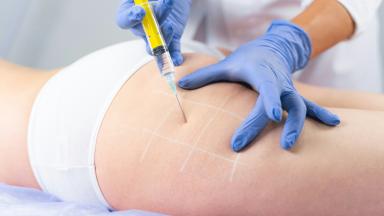
Lymphedema surgery treats chronic swelling of the arm or leg after cancer treatment when compression is no longer enough. Lymphovenous anastomosis and lymph node transfer restore drainage and reduce cellulitis, while liposuction removes the fat that builds up in advanced lymphedema. At Biruni Hospital in Istanbul, our lymphatic surgery team maps working channels with indocyanine green imaging and plans surgery with decongestive therapy.
About This Department
Plastic Surgery
Lymphedema builds when lymph fluid cannot drain from an arm or leg. Surgery reopens drainage or removes the tissue that has built up.
Lymphedema surgery treats chronic swelling of an arm or leg, most often after lymph node removal and radiotherapy for breast, gynecological or skin cancer, when compression and decongestive therapy are no longer enough. Physiological operations restore drainage, by connecting lymphatic channels to small veins, lymphovenous anastomosis, or by transplanting healthy lymph nodes, vascularized lymph node transfer. Reductive operations remove the fat and fibrous tissue that build up in long-standing lymphedema. In a meta-analysis of 648 limbs followed for more than two years, both operations reduced attacks of cellulitis, and lymph node transfer reduced arm circumference by 42.7 percent (Jungbauer and colleagues, Annals of Plastic Surgery, 2025). Surgery can also prevent lymphedema. In a randomized trial, reconnecting cut lymphatics during axillary node removal lowered its incidence from 32 to 9.5 percent (Coriddi and colleagues, Annals of Surgery, 2023). This page explains stages, tests, each operation, prevention, risks, compression after surgery, recovery, and how patients from abroad arrange lymphedema surgery at Biruni Hospital in Istanbul.
9.5
Percent developing lymphedema with immediate lymphatic reconstruction, against 32 percent without
42.7
Percent reduction in arm circumference after lymph node transfer, at more than two years
2.43
Fewer cellulitis attacks per year in the arm after lymph node transfer
Free
Review of your measurements and scans by our lymphatic surgery team
Two goals guide every plan. Restore drainage where channels still work, and remove tissue that drainage alone cannot shrink.
Physiological surgery, lymphovenous anastomosis and lymph node transfer, gives lymph a new route out of the limb. Reductive surgery, liposuction and in rare cases excision, removes the volume that accumulates. Many patients benefit from a combination, staged over months.
1
Who treats it
Lymphatic surgery uses supermicrosurgery, joining vessels of 0.3 to 0.8 millimeters under high magnification. Our lymphedema rehabilitation team provides the decongestive therapy that comes before and after.
Stages and choice of operation
Surgery works best before the swelling turns into hard fat and fibrous tissue. Early referral matters.
Stages of lymphedema
Stage
What the limb shows
Typical treatment
0, latent
Heaviness, no visible swelling
Watchful care, early therapy
I
Soft swelling that pits and settles with elevation
Therapy, early lymphovenous anastomosis
II
Swelling that no longer settles, tissue firming
Lymphovenous anastomosis or node transfer
III
Hard, enlarged limb, skin changes
Liposuction, node transfer, rarely excision
1
The decision
The stage, imaging of working channels, the proportion of fluid to fat, cellulitis history and the patient's goals decide the plan.
Primary lymphedema, present from birth or appearing in youth without an external cause, and secondary lymphedema after cancer treatment are both treated, though primary forms may have fewer working channels to connect.
Operation by situation
Situation
Operation
Aim
Early, mainly fluid, working channels
Lymphovenous anastomosis
Restore drainage
Moderate, few working channels
Lymph node transfer
New drainage tissue
Advanced, mainly fat
Liposuction
Remove excess volume
Very advanced with skin folds
Excision, rarely
Reduce size
Fluid versus fat
Long-standing lymphedema holds more than water.
Stagnant lymph stimulates fat cells to grow and fibrous tissue to form, so after several years much of the extra volume in the limb consists of solid fat that no bypass or massage can remove. A simple test helps. If a finger pressed into the swelling leaves a dent, fluid dominates and physiological surgery can help, while if no dent forms, fat dominates and liposuction becomes the main option, sometimes followed by bypass to protect the result.
Most limbs hold both.
Mapping the lymphatics
Tests before lymphedema surgery
Test
What it shows
Use
Indocyanine green lymphography
Working channels under the skin as glowing lines
Plans bypass sites
Lymphoscintigraphy
Overall lymph transport
Confirms diagnosis, stage
MR lymphangiography
Channels, fluid and fat in detail
Complex cases
Limb volume and bioimpedance
Size and fluid content
Baseline for comparison
Venous ultrasound
Vein health
Excludes other causes
Indocyanine green, injected in tiny amounts under the skin, lights up working lymph channels under an infrared camera.
We measure both limbs at the same visit, record the number of cellulitis attacks over the past year and photograph the limb, so that results after surgery can be compared fairly.
Lymphovenous anastomosis
Lymphovenous anastomosis at a glance
Feature
Detail
Note
Incisions
Two to five cuts of two to three centimeters
Along the limb
Anesthesia
Local or general
Depends on number of sites
Operating time
Two to four hours
Supermicrosurgery
Hospital stay
One to two nights
Compression resumed early
Best suited to
Early stages with working channels
Seen on lymphography
In patients followed for more than two years, lymphovenous anastomosis reduced cellulitis by about one attack per year in the arm and leg (Jungbauer and colleagues, 2025).
1
How it works
Under the microscope, a lymphatic channel of less than a millimeter is joined to a nearby small vein, letting lymph bypass the blocked nodes and flow directly into the circulation.
Why cellulitis matters
Each infection damages more lymphatics.
Cellulitis, a bacterial skin infection that turns the limb red, hot and painful, requires antibiotics and sometimes a hospital stay, and every episode scars the remaining channels and worsens the swelling. Fewer infections after surgery protect the limb over the long term, even when the change in size is modest.
Patients value this most.
Lymph node transfer
Healthy lymph nodes with their own artery and vein are taken from the neck, groin, armpit side, or from the fat around the stomach or bowel, and transplanted to the affected limb, where they act as a pump and promote new lymphatic connections.
Taking nodes can cause lymphedema at the donor site. Reverse mapping with tracers identifies nodes that drain the donor limb, so that they are left in place.
Common donor sites for lymph node transfer
Donor site
Advantage
Consideration
Gastroepiploic, around the stomach
No risk of limb lymphedema, good results at the wrist
Keyhole abdominal surgery
Supraclavicular, neck
Small scar
Careful dissection near nerves
Groin
Combines with breast reconstruction
Risk to the leg, reverse mapping needed
Omentum or jejunal mesentery
Plentiful nodes
Abdominal access
Liposuction for lymphedema
Liposuction removes the hardened fat that dominates advanced, non-pitting lymphedema. A Swedish program reported complete reduction of the excess arm volume with no recurrence over seven years, maintained by continuous compression garments (Brorson, Scandinavian Journal of Surgery, 2003).
1
Technique
A tourniquet limits bleeding, and long thin cannulas remove fat circumferentially through small incisions. A compression garment goes on in the operating room.
Compression for life
After lymphedema liposuction, compression garments are worn day and night for life. Without them, fluid fills the space again.
Comparing the operations
Physiological and reductive operations
Operation
Main effect
Compression afterward
Lymphovenous anastomosis
Drainage, fewer infections
Often reduced
Lymph node transfer
Drainage, fewer infections, smaller limb
Often reduced
Liposuction
Large, immediate volume reduction
Lifelong, continuous
Excision
Removes massive tissue and skin
Lifelong
Physiological operations work gradually, over six to twenty-four months.
Liposuction gives an immediate reduction.
Combinations often give the best long-term result.
1
Excisional surgery
For extreme cases with massive limbs and skin folds, excision of skin and tissue down to muscle, the Charles procedure, remains a last resort, with long healing and skin grafts.
Long-term follow-up favors operations that reduce infections and stabilize the limb, even if size change takes time.
Long-term results beyond two years, 648 limbs
Outcome
Lymphovenous anastomosis
Lymph node transfer
Cellulitis reduction per year, arm
1.13 fewer
2.43 fewer
Cellulitis reduction per year, leg
1.32 fewer
1.38 fewer
Circumference reduction
Not pooled
42.7 percent arm, 22 percent leg
Realistic expectations
Lymphatic surgery improves lymphedema. It does not undo the original damage.
In an upper limb meta-analysis of 448 patients, lymph node transfer reduced circumference by 28.4 percent on pooled analysis, with the best results when nodes from around the stomach were placed at the wrist (Braizat and colleagues, Annals of Plastic Surgery, 2024).
Compression continues in many. Many need less.
Preventing lymphedema at cancer surgery
Immediate lymphatic reconstruction joins lymphatic channels cut during axillary node removal to a nearby vein in the same operation, before lymphedema can begin.
1
Randomized evidence
In a randomized trial of women having axillary lymph node dissection for breast cancer, lymphedema developed in 9.5 percent with immediate reconstruction and 32 percent without, with better lymphatic function on imaging and better quality of life (Coriddi and colleagues, 2023).
Should I ask for immediate lymphatic reconstruction?
If you need axillary lymph node dissection, particularly with planned radiotherapy, ask your breast surgeon whether immediate lymphatic reconstruction is available. It adds about an hour to the operation, uses the same incision and requires a microsurgeon in the operating room. The trial results were preliminary at publication, and long-term data continue to mature.
Risks
General and specific risks
1
Low-risk surgery
Lymphovenous anastomosis carries few risks because the incisions are small and no tissue is removed. Node transfer and liposuction carry more.
Complications after lymphedema surgery
Complication
Most relevant to
Management
Wound infection or separation
All operations
Antibiotics, dressings
Seroma or lymph leak
Node transfer donor site
Drainage, compression
Donor site lymphedema
Groin or armpit node transfer
Reverse mapping prevents
Blood loss, skin numbness
Liposuction
Tourniquet, recovers
No improvement
Late-stage disease
Further surgery or therapy
Results take time, and some patients do not respond. We discuss realistic goals and the measurements we will use before surgery.
Therapy and compression
Decongestive therapy, with manual lymphatic drainage, bandaging and exercise, reduces fluid before surgery and protects the result after it. Our lymphedema rehabilitation page describes this therapy in detail.
Never stop compression on your own after surgery, since we reduce it step by step only as the measurements confirm that the new drainage is working.
Therapy around surgery
Phase
Therapy
Purpose
Before surgery
Two to four weeks of decongestive therapy
Remove fluid, measure true baseline
First weeks after
Gentle compression, no massage over incisions
Protect the joins
Months 1 to 12
Graduated compression, exercise
Support new drainage
Long term
Compression as measurements allow
Maintain the result
Recovery
1
Returning to activity
After lymphovenous anastomosis, most daily activities resume within a week. After node transfer or liposuction, two to four weeks of reduced activity are needed.
Measurements are repeated at one, three, six and twelve months, and lymphography at one year shows whether new drainage has formed.
Protecting the limb
Skin care, insect protection, avoiding cuts and treating any redness early help prevent cellulitis.
For patients from abroad
Plan for one to three weeks in Istanbul. Lymphovenous anastomosis needs the shortest stay, and node transfer or liposuction the longest. Fitness to fly is confirmed before discharge, and compression garments stay on during the flight, with regular walks in the aisle to help drainage.
1
What to send
Measurements of both limbs, lymphoscintigraphy or other imaging, photographs, details of cancer treatment, a record of cellulitis episodes and current compression.
After you return home, follow-up continues by video. Your local therapist takes the measurements and receives our compression plan. One coordinator from the international patients office handles arrangements from the first message through discharge and answers the same WhatsApp number after you return. The office works in English, Arabic, French, Russian, Serbian, Romanian and Spanish and books interpreters for other languages, and it arranges the visa invitation letter, airport transfers, daily transport and accommodation near the hospital. Halal, vegetarian and diabetic meals, a prayer room on site, and a female physician on request wherever the rota allows.
Cost
What a quote for lymphedema surgery covers
Item
Included
Priced separately
Surgery
Surgeon, anesthesia, supermicrosurgery
Second stage operations
Imaging
Indocyanine green lymphography in theater
MR lymphangiography
Aftercare
First compression garment, therapy in hospital
Long-term garments, therapy at home
The price depends on the operation, the number of bypasses, node transfer donor site and combined liposuction.
We quote after reviewing your measurements and imaging, before you travel.
Compare quotes for the same operation and ask about imaging, compression garments and follow-up measurements.
Elements that change the price
Element
Effect
Note
Node transfer
Higher
Second surgical site
Liposuction added
Higher
Garments for life
Both limbs treated
Higher
Usually staged
Staged plans are quoted stage by stage.
References
Jungbauer WN, Solomon S, Verhey EM, et al. Lymphovenous anastomosis and vascularized lymph node transfer reduce long-term cellulitis events in patients with secondary lymphedema. A systematic review and meta-analysis. Ann Plast Surg. 2025;95(5):522-530.
Coriddi M, Dayan J, Bloomfield E, et al. Efficacy of immediate lymphatic reconstruction to decrease incidence of breast cancer-related lymphedema. Preliminary results of randomized controlled trial. Ann Surg. 2023;278(4):630-637.
Braizat O, Jarrar S, El-Debs M, et al. Comparing different donor sites after vascularized lymph node transfer to the lymphedematous upper limb. A systematic review and meta-analysis of clinical outcomes. Ann Plast Surg. 2024;93(1):130-138.
Brorson H. Liposuction in arm lymphedema treatment. Scand J Surg. 2003;92(4):287-295.
Editor's note
Written by the Biruni Hospital medical editorial team. Reviewed by Assistant Professor Erman AK, Plastic, Reconstructive and Aesthetic Surgery.