
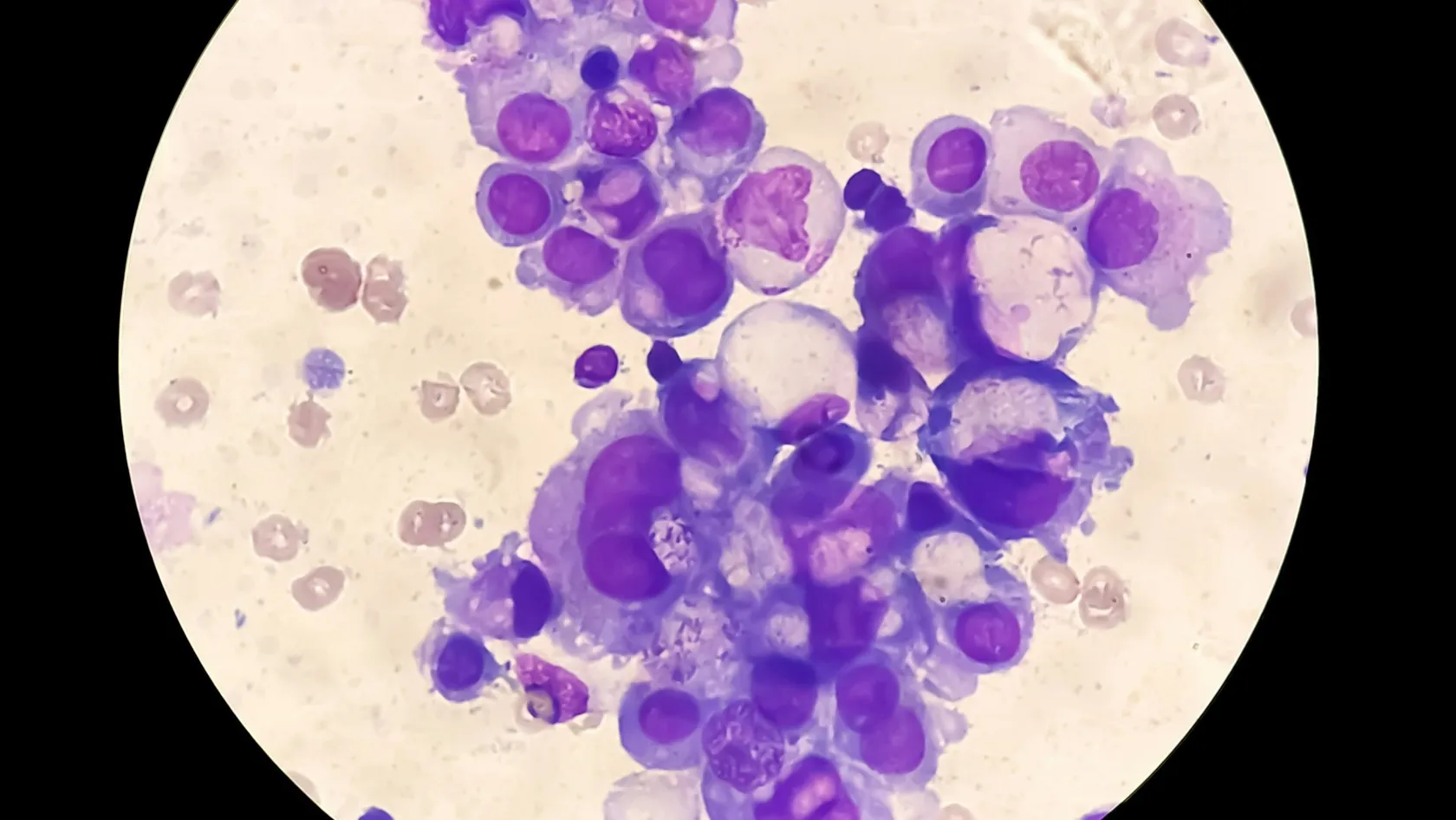
Bone Marrow Transplant For Hodgkin Lymphoma
Most people with Hodgkin lymphoma are cured by first line chemotherapy, and a transplant enters only when that fails. In a trial of 1,214 patients, three year overall survival reached 97.2 percent. For the minority who relapse, the scan before the transplant decides more than the transplant does, with five year progression free survival of 79 percent when it is clear against 23 percent when it is not. This page covers the salvage, the newer drugs, the donor transplant and the forty year tail.
About This Department
Most people with Hodgkin lymphoma are cured without one. Relapse arrives mostly in young people, and that changes every part of the calculation.
In a trial of 1,214 patients treated with modern first line chemotherapy, three year progression free survival ran at 85.7 percent and three year overall survival at 97.2 percent.
What happens before any of this
Hodgkin lymphoma sits in an unusual place among cancers. First line chemotherapy cures the large majority of people who get it, and a transplant enters the conversation only for the minority in whom that fails.
Read the survival figure again. 97.2 percent at three years. Very few cancers produce a number like that, and it is the reason Hodgkin lymphoma gets described as curable in a way that most lymphomas do not. This page is for the minority in whom the first attempt did not hold.
What a relapse actually means here
Relapse in Hodgkin lymphoma carries a different weight from relapse in most cancers, since the second attempt still aims at cure and frequently reaches it.
The numbers after a first relapse
A study group followed 409 patients whose Hodgkin lymphoma came back after modern first line treatment. Ten year progression free survival reached 48.2 percent with a confidence interval of 41.9 to 54.2, and ten year overall survival reached 59.4 percent with a confidence interval of 53.0 to 65.2, so roughly half of the people whose disease returns are still free of it a decade later. That is a serious figure and it deserves stating plainly, because families arriving after a relapse have usually been told the word relapse without being told what follows it. Two facts sit behind that number. The second course in Hodgkin lymphoma still aims at cure and not merely at control, which is unusual after a relapse and explains why the intent of the second treatment differs from what most families expect when they hear the word. Half. Hold that figure while reading the sections below.
Slide this table sideways on a small screen to reach the second column.
| Situation | What it means for the plan |
|---|---|
| Primary refractory disease, meaning the lymphoma never went away on first line treatment | The hardest group. Salvage still aims at cure, and the results are the weakest on this page, which is why the salvage regimen matters more here than anywhere |
| Early relapse, meaning it returned within twelve months of finishing treatment | Treated as chemotherapy sensitive or resistant depending on how the salvage goes, and the scan after salvage decides more than the timing did |
| Late relapse, meaning it returned after a year or more | The most favorable group, and the one where a transplant most reliably converts a relapse into a long remission |
| Stage IV at relapse | Independently associated with worse survival in the same study, so it changes the conversation without removing the intent to cure |
The trial that made this standard, and how small it was
Autologous transplant became the accepted treatment for relapsed Hodgkin lymphoma on the strength of two randomized trials, and one of them repays a close look because of its size.
Two things are true at once here. The trial established a real effect on disease control, and it was far too small to settle the survival question on its own, yet practice moved anyway, a second larger trial pointed the same way, and the transplant has held its position for three decades. Hold onto the distinction between controlling the disease and extending life. It comes back further down this page.
The scan that decides more than the transplant does
One number predicts the outcome of this transplant better than the conditioning regimen, the stem cell dose or anything else the transplant unit controls, and that number is whether the PET scan is clear on the day you go in.
This table scrolls sideways on a phone. Drag it across to reach the second column.
| Measure | PET negative against PET positive |
|---|---|
| Five year progression free survival | 79 percent against 23 percent, with a P value below 0.001 |
| Five year overall survival | 90 percent against 55 percent, with a P value of 0.001 |
| Independent effect on progression free survival | A hazard ratio of 5.26, with a confidence interval of 2.57 to 10.73 |
| What it changes in practice | Salvage chemotherapy stops being a formality before the transplant and becomes the part of the treatment that decides the result |
Why that reframes the whole sequence
Families tend to picture the transplant as the treatment and the chemotherapy before it as preparation. The numbers above reverse that. A patient who reaches the transplant with a clear scan has a roughly four in five chance of staying free of the disease at five years, while a patient who reaches it with disease still visible has closer to one in four. The transplant is identical in both cases. What differs is what the salvage chemotherapy managed to do first, so the question to put to a hematologist is not which conditioning regimen they use but what they will do if the scan after salvage is still positive. A second consequence follows. A center that transplants everybody who arrives, regardless of what the scan shows, will publish worse results than a center that insists on clearing the scan first, and the difference between the two will have almost nothing to do with the quality of their transplant units. The proportion of patients a unit takes in PET negative tells you more than its headline transplant statistics do.
Getting to a clear scan, which is the real work
Salvage chemotherapy has one job. Empty the scan before the transplant, because the previous section showed what happens when it does not.
What adding a checkpoint drug to salvage did
One trial gave nivolumab alongside a standard salvage combination to 35 patients with high risk relapsed or refractory Hodgkin lymphoma. The complete response rate came out at 86 percent and the overall response rate at 100 percent, while two year progression free survival reached 88 percent and two year overall survival 100 percent. Thirty two of the 35 went straight on to an autologous transplant, and among those the two year progression free survival after transplant was 94 percent with overall survival at 100 percent. The series is small and single armed, so treat those figures as a direction and not as a promise. The direction is clear enough. Modern salvage empties far more scans than the regimens the original trials used, and the transplant that follows a cleared scan behaves the way the previous section described. So the sequence matters more than any one step in it. Salvage, scan, then transplant if the scan is clear, and a different plan if it is not.
What the newer drugs changed
Two classes of drug arrived in Hodgkin lymphoma over the past decade and both work in the exact population this page concerns, which has unsettled a treatment order that had been stable since the nineties. Brentuximab vedotin carries a chemotherapy payload to a marker the Hodgkin cells display. Checkpoint inhibitors such as pembrolizumab and nivolumab release a brake on the immune system, and Hodgkin lymphoma turns out to be unusually vulnerable to that, for reasons rooted in the genetics of the tumor cells, so a randomized trial compared the two head to head in relapsed or refractory disease. Median progression free survival came out at 13.2 months with pembrolizumab, confidence interval 10.9 to 19.4, against 8.3 months with brentuximab vedotin, confidence interval 5.7 to 8.8. The hazard ratio was 0.65, confidence interval 0.48 to 0.88, with a P value of 0.0027. One hundred and fifty one patients received pembrolizumab and 153 received brentuximab vedotin.
None of that removes the transplant. What it does is give the salvage phase real firepower and give patients who cannot be brought to a clear scan something that still works. Both drugs also appear before the transplant, after it as consolidation, and on their own in patients unfit for high dose therapy, so the same two names turn up at three different points in a treatment plan and mean something different each time. Establish which point is being proposed.
Whether the transplant is still necessary
Hodgkin lymphoma has one genuinely live question right now, and anybody who answers it with complete confidence is ahead of the evidence.
Slide this table sideways on a small screen to reach the second column.
| The case for keeping it | The case for questioning it |
|---|---|
| Two randomized trials support it, and thirty years of practice sit behind them | Both trials predate brentuximab vedotin and the checkpoint inhibitors entirely, so they compared the transplant against options nobody would use today |
| A cleared scan followed by transplant produces around 79 percent progression free survival at five years | Modern salvage clears far more scans than the old regimens, so part of that result may belong to the salvage rather than to the transplant |
| It remains the only approach with randomized evidence for durable disease control after relapse | The late effects described further down this page are real, permanent, and fall on people in their twenties and thirties |
| Relapse after checkpoint inhibitors alone is common, and the transplant is what has historically been available afterward | Trials are running to test whether some patients can safely skip it, and the answer is not in yet |
How to hold both at once
Both things hold at the same time. The autologous transplant remains standard for a fit patient whose Hodgkin lymphoma has relapsed and whose scan can be cleared, and the boundaries of that standard are moving under it. A hematologist who says the transplant is definitely still required in every case, and one who says nobody needs it any more, are both overstating what the evidence supports. A better question to put is what would have to be true in your case for the transplant to be skipped, since a doctor who can answer that one has thought about it.
What the transplant involves
Nothing gets transplanted in the ordinary sense. Your own stem cells come out, get frozen, and go back after a chemotherapy dose the marrow could not otherwise survive.
What patients remember afterward
Mucositis, which means the lining of the mouth and gut breaking down, gets remembered longer than anything else. The worst days sit in the middle rather than at the beginning, somewhere between day five and day twelve after the cells go back, which surprises families who expect the chemotherapy itself to be the low point. Fever during that window is expected and gets treated immediately, and appetite disappears and comes back slowly over the following month. Two practical things help more than they sound like they should. Sucking ice chips during parts of the conditioning reduces mouth damage in some regimens, and it costs nothing to check whether that applies to yours. And walking, even a few minutes at a time around a small room, preserves more strength than lying still does, which matters because the weakness that follows three weeks in bed takes months to undo. Nobody feels like doing either. Both earn the effort.
The donor transplant, and where it sits
An allogeneic transplant uses somebody else cells and is a different operation with a different risk profile. In Hodgkin lymphoma it occupies a narrow place.
This table scrolls sideways on a phone. Drag it across to reach the second column.
| Measure | Result at three years |
|---|---|
| Non relapse mortality | 21 percent, meaning one patient in five died from the transplant rather than from the lymphoma |
| Relapse | 38 percent |
| Overall survival | 58 percent |
| Progression free survival | 41 percent |
| Acute graft versus host disease, grade II to IV, at 100 days | 25 percent |
Reading those numbers honestly
A non relapse mortality of 21 percent is the figure to sit with. In an autologous transplant that number runs in the low single digits, because there is no donor immune system to attack the recipient. So the donor transplant buys a graft versus lymphoma effect and pays for it with a risk of dying from the treatment that is an order of magnitude larger, and it belongs to patients who have already relapsed after an autologous transplant, or whose disease has proved it will not stay away, and the conversation should name that mortality figure out loud before anybody agrees to it. A second point belongs in that conversation. The graft versus lymphoma effect is real and it is the entire reason anybody accepts a 21 percent treatment mortality, so a hematologist proposing this should be able to say what they expect it to achieve in your specific case and what the alternative looks like if you decline. Vague answers here are a warning.
The forty year tail
One thing separates Hodgkin lymphoma from almost every other transplant conversation. Cure is common, the patients are young, and the treatment leaves a bill that arrives decades later.
Researchers followed 2,524 Hodgkin lymphoma survivors and counted cardiovascular disease over forty years. The cumulative incidence reached 50 percent, with a confidence interval of 47 to 52 percent. Half of them. The rate stayed four to six times higher than the general population even beyond 35 years from treatment, meaning the excess risk never settles back down. Mediastinal radiotherapy carried a hazard ratio of 2.7 for coronary heart disease, with a confidence interval of 2.0 to 3.7.
A separate analysis of 15,889 patients with classical Hodgkin lymphoma tracked what people eventually die of. Cardiovascular death overtook death from the lymphoma itself at around 60 months of follow up in stage I disease and around 120 months in stage II. In stage I patients the absolute excess cardiovascular risk reached 48.5, and over a long enough horizon cardiovascular disease becomes the leading cause of death in this population, ahead of both the Hodgkin lymphoma and other cancers. None of that argues against treating the lymphoma. It argues for treating the heart, starting on the day treatment finishes, because blood pressure, lipids, smoking, weight and exercise stop being general health advice in this group and become part of the cancer follow up. Request a cardiology review at the end of treatment and again every few years, with blood pressure and lipids measured rather than assumed. That request is unusual, and it should not be.
The lung injury nobody warned you about
Bleomycin sits in the standard first line combination and it damages lungs in a minority of patients, sometimes permanently and occasionally fatally. Nobody warns you.
Why it matters before a transplant
BEAM conditioning contains carmustine, which is itself capable of damaging lungs. A patient who already has bleomycin injury is entering high dose therapy with reduced reserve, so lung function testing before the transplant is not a formality, and the thing to do with that test is ask for the numbers and ask what the plan is if they come back low. Check also whether bleomycin was stopped early during first line treatment, because on modern protocols it frequently is, and knowing the cumulative dose changes the interpretation of everything that follows. Breathlessness or a dry cough during or after treatment for Hodgkin lymphoma is not something to sit on. Report it the same week. Timing deserves a note of its own. Lung damage from these drugs frequently declares itself weeks after the dose rather than during it, so a patient who felt fine through the last cycle is not a patient who escaped. The follow up breathing test matters as much as the one taken before treatment started.
Second cancers caused by the treatment
High dose chemotherapy damages the marrow that survives it, and in a small proportion of patients that damage eventually turns into a second blood cancer. Years later.
A study of 612 patients transplanted for lymphoma measured how often treatment related myelodysplasia or acute myeloid leukemia appeared afterward. The cumulative incidence reached 8.6 percent, plus or minus 2.1 percent, at six years, with 22 of the 612 patients affected. One factor stood out. Using etoposide to prime the stem cell collection carried a relative risk of 7.7, with a P value of 0.002, which is the kind of finding that changes how a unit mobilizes cells rather than whether it transplants at all.
That figure belongs in the consent conversation and rarely appears there. It is also not a reason to refuse a transplant that offers a real chance of cure, since an untreated relapse of Hodgkin lymphoma carries a far larger and far nearer risk, so the two numbers simply need to be held together instead of one being mentioned and the other not. Find out which mobilization method the unit uses and why.
Fertility, and the conversation that has to happen first
Most people facing this are young enough that fertility is a live question, and the window for doing anything about it closes before the transplant starts. That window is short.
What high dose therapy does
BEAM conditioning causes infertility in a large proportion of patients and permanently in many, while recovery of ovarian or testicular function after high dose therapy happens, and it is neither common nor predictable, and it depends heavily on age at treatment. Nobody can tell an individual patient in advance which side of that they will land on, which is precisely why the preservation conversation belongs before the first salvage cycle and not before the transplant. The published figures in this area are old and thin, which is itself part of the problem. Series reporting pregnancy after autologous transplant for lymphoma describe small numbers from small groups, and they date from an era with different conditioning and different patient ages, so no careful clinician will quote you a percentage. What they can tell you is that preservation before treatment works, that it is available here, and that the decision has to be made in days. Do it.
- Sperm banking takes days and should happen before salvage chemotherapy rather than before the transplant, since salvage itself damages fertility.
- Egg or embryo freezing takes roughly two weeks of stimulation, and that timing has to be negotiated against how soon the lymphoma needs treating.
- Ovarian tissue freezing exists for cases where there is no time for stimulation, and availability varies by center, so ask early.
- Ask for the referral to be made in the same conversation where salvage is proposed. A referral made later is frequently a referral made too late.
The question to put plainly
Put one question to the hematologist, which is how many days there are before treatment has to start, then ask the fertility service what they can do inside that number of days, because those two answers, put side by side, settle the question in an afternoon, and the alternative is discovering the answer years later.
Where the results are genuinely poor
Every page describing a treatment should name the group it works least well for, so here it is.
In the same study group series of 409 patients with a first relapse, the subgroup whose salvage therapy failed before they could reach a transplant had a five year progression free survival of 36.3 percent, with a wide confidence interval of 19.7 to 53.2. Primary refractory disease, meaning Hodgkin lymphoma that never cleared on first line treatment, independently carried worse survival, and so did stage IV disease at the time of relapse. Those are the situations where the numbers on the rest of this page do not apply, and where the conversation shifts toward the newer drugs, toward a clinical trial, and in some cases toward an allogeneic transplant.
That 36.3 percent five year figure is not a reason to stop treating. It is a reason to be told the truth about which group you are in before consenting to something that carries every one of the late effects described above, since those effects fall due long after the lymphoma has been dealt with. If a hematologist has never mentioned which of these categories applies to you, that is the first question to ask at the next appointment.
What drives the cost
No figure appears on this page, because the total follows how the treatment goes and nobody can know that in advance. What can be set out is which elements move it.
The question to put to a quotation
Any estimate for this treatment is a projection built on assumptions. Find out how many salvage cycles it assumes, whether it includes the newer drugs or prices them separately, how many inpatient days it covers, and what happens to the figure if the collection has to be repeated. A center that answers those four in writing has thought the answer through, and one that restates the total has not.
What to ask before agreeing
Most of this page reduces to a short list of questions. Early beats late here.
The clinical questions
- Which category am I in, meaning primary refractory, early relapse or late relapse, and what does that do to the figures you have quoted me.
- What is the plan if the PET scan after salvage is still positive, and at what point would you change the salvage regimen rather than proceed.
- Are the newer drugs part of this plan, and at which point.
- What is your unit non relapse mortality for an autologous transplant, and how many of these do you do in a year.
- What lung function testing has been done, what did it show, and how much bleomycin did I receive in total.
- What is the fertility preservation plan and how many days do I have to arrange it.
The question that tests the answer
Ask what would have to be true for you to skip the transplant. A hematologist who can name the conditions has weighed the question, while one who treats it as unthinkable has not looked at the last five years of evidence, and one who dismisses the transplant entirely has not looked at the thirty years before that.
What we arrange
For a treatment measured in months, the arrangements around it matter more than they do for a single operation. Think in months.
A free written opinion on your reports, your pathology and your PET scans, returned in a language you read, before anything is booked. One coordinator from the first message through to discharge and afterward, with a name and a direct number. Seven languages covered directly by the international patients team, namely English, Arabic, French, Russian, Serbian, Romanian and Spanish, with a professional interpreter arranged for anything else. A companion bed in the room for the whole admission, and accommodation nearby for the rest of the family, extended week by week as the treatment extends. Airport transfers and transport between the accommodation and the hospital. Halal, vegetarian and diabetic meals from the hospital kitchen, and a prayer room in the building. A request for a female physician put to the department and met wherever the rota allows. An invitation letter naming the hospital and the treating doctor for the visa application, and a further letter when an extension is needed. And once you are home, the same coordinator on the same WhatsApp number.
Send the file first. Nothing else needs deciding until the written opinion is in front of you.
Questions we are asked, a Hodgkin lymphoma transplant FAQ
Do most people with Hodgkin lymphoma need a transplant
No, and the figures are strongly against it. In a trial of 1,214 patients on modern first line chemotherapy, three year progression free survival was 85.7 percent and three year overall survival was 97.2 percent, so a transplant enters the picture only when the first attempt fails, which happens to a minority.
Is a transplant still curative after a relapse
For many people, yes. A study group followed 409 patients whose disease returned after modern first line treatment and found ten year progression free survival of 48.2 percent and ten year overall survival of 59.4 percent, which means half of them remain free of the lymphoma a decade after a relapse. That figure deserves hearing plainly.
Why does everybody keep talking about the PET scan
Because it predicts the result better than anything the transplant unit controls. Across 111 patients, five year progression free survival was 79 percent with a clear scan and 23 percent without one, which means the salvage chemotherapy that clears the scan does most of the work.
Could the newer drugs replace the transplant
Possibly, for some patients, and the evidence is not there yet. Pembrolizumab beat brentuximab vedotin in a randomized trial, with median progression free survival of 13.2 months against 8.3 months and a hazard ratio of 0.65. Both drugs work well in exactly this population, and trials testing whether the transplant can be skipped are running, so today it remains standard for a fit patient whose scan can be cleared.
What are the long term risks I should know about
Three matter most. Cardiovascular disease, where a study of 2,524 survivors found a forty year cumulative incidence of 50 percent, with rates staying four to six times the general population beyond 35 years and mediastinal radiotherapy carrying a hazard ratio of 2.7 for coronary heart disease. Lung injury, where bleomycin toxicity appeared in 18 percent of one series and killed 24 percent of those affected. And second blood cancers, where treatment related myelodysplasia or leukemia reached a cumulative incidence of 8.6 percent at six years after a transplant for lymphoma.
How long is the hospital stay
Two to four weeks for the transplant admission itself, most of it in a single room with restricted visiting, and the low point comes in the middle of the admission, somewhere between day five and day twelve after the cells go back. Salvage chemotherapy before that is given in cycles over weeks and is mostly not an inpatient stay. Flying home becomes possible a few weeks after discharge once the blood counts recover, and the coordinator arranges accommodation for the nights between leaving the ward and the flight.
Will this affect my fertility
It can, often permanently, and the time to act is before salvage chemotherapy rather than before the transplant. Sperm banking takes days. Egg or embryo freezing takes roughly two weeks of stimulation. Get the number of days from the hematologist before treatment must start, then ask the fertility service what fits inside it.
When is a donor transplant used instead
Rarely, and for defined situations such as relapse after an autologous transplant. A registry series of 190 patients given an allogeneic transplant as their first transplant for high risk disease reported three year non relapse mortality of 21 percent, overall survival of 58 percent and progression free survival of 41 percent, and that mortality figure sits an order of magnitude above an autologous transplant and belongs in the conversation before anybody agrees.
References
- Johnson P, Federico M, Kirkwood A, et al. Adapted treatment guided by interim PET-CT scan in advanced Hodgkin lymphoma. N Engl J Med. 2016;374(25):2419-2429.
- Linch DC, Winfield D, Goldstone AH, et al. Dose intensification with autologous bone-marrow transplantation in relapsed and resistant Hodgkin disease, results of a BNLI randomised trial. Lancet. 1993;341(8852):1051-1054.
- Brockelmann PJ, Muller H, Gillessen S, et al. Clinical outcomes of relapsed and refractory Hodgkin lymphoma patients after contemporary first-line treatment, a German Hodgkin Study Group analysis. Leukemia. 2022;36(3):772-780.
- Devillier R, Coso D, Castagna L, et al. Positron emission tomography response at the time of autologous stem cell transplantation predicts outcome of patients with relapsed and/or refractory Hodgkin lymphoma responding to prior salvage therapy. Haematologica. 2012;97(7):1073-1079.
- Mei M, Palmer J, Lee HJ, et al. Nivolumab plus ifosfamide, carboplatin, and etoposide are a highly effective first salvage regimen in high-risk relapsed/refractory Hodgkin lymphoma. Hemasphere. 2025;9(5):e70126.
- Kuruvilla J, Ramchandren R, Santoro A, et al. Pembrolizumab versus brentuximab vedotin in relapsed or refractory classical Hodgkin lymphoma (KEYNOTE-204), an interim analysis of a multicentre, randomised, open-label, phase 3 study. Lancet Oncol. 2021;22(4):512-524.
- Gutierrez-Garcia G, Martinez C, Boumendil A, et al. Long-term outcome of patients receiving haematopoietic allogeneic stem cell transplantation as first transplant for high-risk Hodgkin lymphoma, a retrospective analysis from the Lymphoma Working Party-EBMT. Br J Haematol. 2022;196(4):1018-1030.
- van Nimwegen FA, Schaapveld M, Janus CPM, et al. Cardiovascular disease after Hodgkin lymphoma treatment, 40-year disease risk. JAMA Intern Med. 2015;175(6):1007-1017.
- Lu Z, Teng Y, Ning X, et al. Long-term risk of cardiovascular disease mortality among classic Hodgkin lymphoma survivors. Cancer. 2022;128(18):3330-3339.
- Martin WG, Ristow KM, Habermann TM, et al. Bleomycin pulmonary toxicity has a negative impact on the outcome of patients with Hodgkin lymphoma. J Clin Oncol. 2005;23(30):7614-7620.
- Krishnan A, Bhatia S, Slovak ML, et al. Predictors of therapy-related leukemia and myelodysplasia following autologous transplantation for lymphoma, an assessment of risk factors. Blood. 2000;95(5):1588-1593.
Editor's note
Written by the Biruni Hospital medical editorial team. Reviewed by Prof. Dr. Ali Hakan KAYA, Hematology.
Medically reviewed by
Prof. Dr. Ali Hakan KAYA
Hematology
Related Treatments
View All
Allogeneic Bone Marrow Transplant
An allogeneic bone marrow transplant is judged against the alternative and never on its own merits. This guide sets out the two estimates that decide it, the chance the disease returns without a transplant and the chance the transplant itself kills, then shows what moves each one, from genomic classification and residual disease testing to the Disease Risk Index, the comorbidity score, donor type and age. Written for families weighing treatment in Istanbul, with every figure sourced.
Autologous Bone Marrow Transplant
An autologous bone marrow transplant collects your own stem cells, freezes them, and returns them after a chemotherapy dose the marrow could not otherwise survive. No donor, no matching, no rejection. This guide covers myeloma, where two randomized trials found it delays the disease without measurably extending life, plus lymphoma, germ cell tumors, multiple sclerosis and scleroderma, and what the collection, the dose and the recovery involve. Written for families weighing treatment here.

Autologous Stem Cell Transplant
An autologous stem cell transplant, still widely called an autologous bone marrow transplant, collects your own stem cells, freezes them, and returns them after a chemotherapy dose the marrow could not otherwise survive. No donor, no matching, no rejection. This guide covers myeloma, where two randomized trials found it delays the disease without measurably extending life, plus lymphoma, germ cell tumors, multiple sclerosis and scleroderma, and what the collection and the recovery involve.
Bone Marrow Transplant - Allogeneic Stem Cell Transplant
A bone marrow transplant, or allogeneic stem cell transplant, replaces a diseased blood and immune system with a donor's. This guide covers who it is for, how donors are found and chosen, why a young half matched relative can now beat an older fully matched stranger, what conditioning intensity decides, graft versus host disease in both forms, and the late risks that keep climbing after year ten. Written for families weighing treatment in Istanbul, with the published figures behind each claim.
Bone Marrow Transplant For Aplastic Anemia
A bone marrow transplant for aplastic anemia replaces failed blood-forming stem cells with healthy donor marrow and cures most younger patients who have a matched sibling. In a study of 599 children, failure-free survival was 87 percent after sibling transplant and 56 percent after drug treatment first. This page explains severity grades, transplant versus immune suppression, registry results, how this transplant differs, risks, the donor's part and planning at Biruni Hospital.