
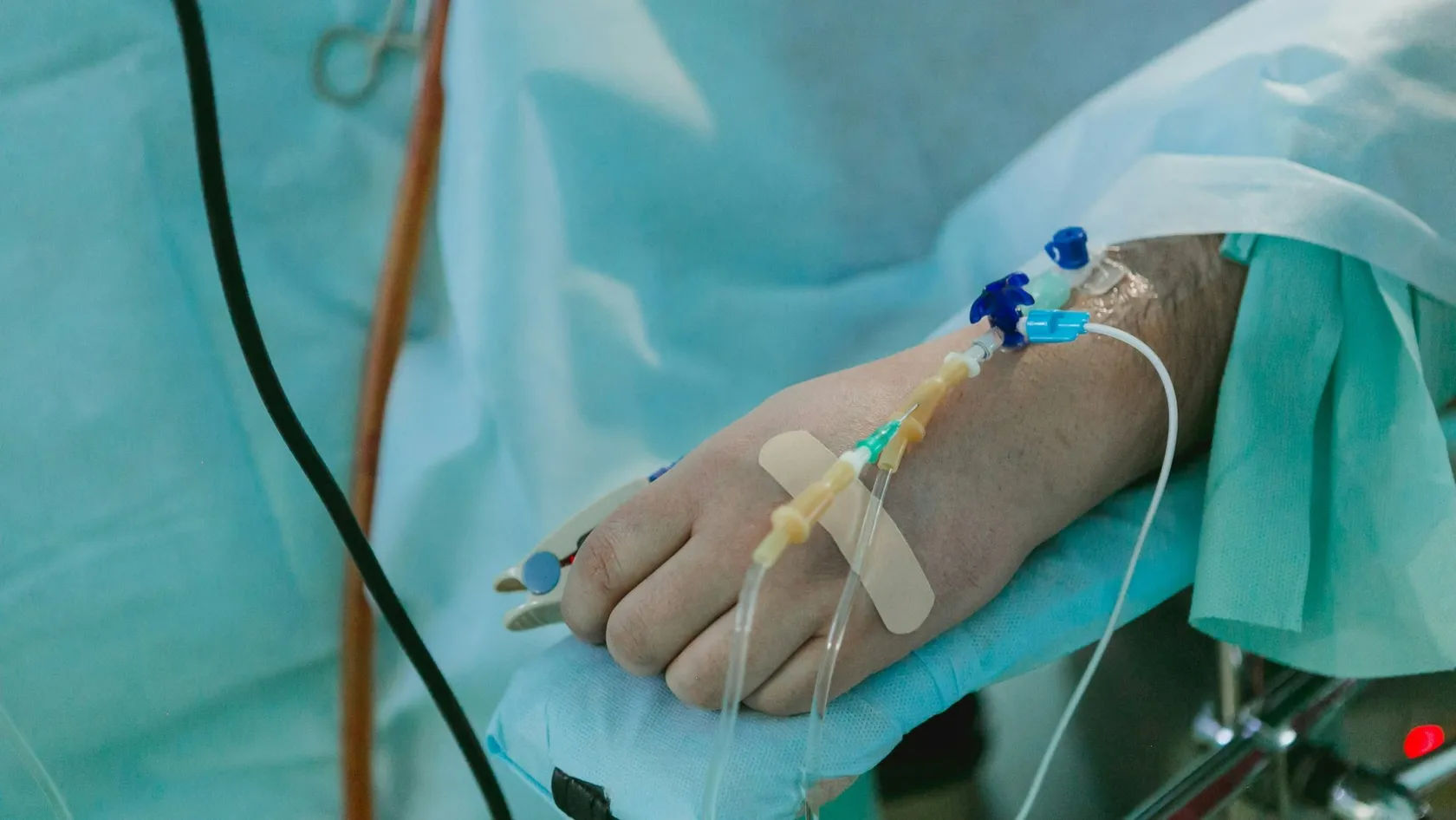
Bone Marrow Transplant - Allogeneic Stem Cell Transplant
A bone marrow transplant, or allogeneic stem cell transplant, replaces a diseased blood and immune system with a donor's. This guide covers who it is for, how donors are found and chosen, why a young half matched relative can now beat an older fully matched stranger, what conditioning intensity decides, graft versus host disease in both forms, and the late risks that keep climbing after year ten. Written for families weighing treatment in Istanbul, with the published figures behind each claim.
About This Department
Around the tenth year the leukemia stops being the main danger. After that it is the transplant, and both of those numbers have moved a long way.
One study followed 4,741 people who lived at least two years after an allogeneic transplant, across four decades of transplants. Death from the original disease flattened out at around ten years and reached 12.2 percent by thirty. Deaths caused by everything the transplant left behind kept climbing, to 22.3 percent. Infection, second cancers, lung disease and heart disease account for most of it, and every one of those figures is better for transplants performed after 2005 than for those performed before 1990.
The ten year line
An allogeneic transplant replaces a diseased blood and immune system with somebody else's. That sentence contains everything difficult about it. The new marrow works, which is the point, and the new immune system arrives with opinions about the body it has landed in, which is the price. Both halves are real. Understanding the trade in those terms makes the rest of this page readable, because almost every decision in transplant medicine is a negotiation between wanting the donor cells aggressive enough to destroy leukemia and wanting them tolerant enough to leave the skin, the gut, the eyes and the lungs alone.
The part of that finding that gets left out
Improvement across those four decades is the other half of the same finding, and it is large. Across the whole cohort, life expectancy was reduced by 20.8 percent, which works out at 8.7 years of life lost. Split by era, the figure falls steadily. People transplanted between 1974 and 1989 lost 9.9 years. Between 1990 and 2004, 6.5 years. From 2005 to 2014, 4.2 years. The reduction in late death was clearest in people transplanted as children and in those who received marrow instead of mobilized blood cells, which is a detail that matters later on this page.
The words you will hear
Transplant medicine runs on abbreviations and the abbreviations arrive faster than anybody explains them. The ones below appear in letters.
Narrow screens scroll this table sideways. Swipe or drag to reach every column.
| Term | What it means |
|---|---|
| Allogeneic | Cells from another person. Autologous means your own cells collected and given back. |
| HLA | The tissue type proteins that decide whether donor and recipient match. Ten of them are usually tested. |
| Haploidentical | A relative who matches on exactly half. A parent, a child, and half of siblings. |
| Conditioning | The chemotherapy, sometimes with radiation, given before the cells to clear space and suppress the immune system. |
| Day zero | The day the donor cells go in. Every other day is counted from it. |
| Engraftment | The day the new marrow starts producing. Defined by the neutrophil count rising and staying up. |
| GVHD | Graft versus host disease. The donor immune system attacking the recipient. Acute and chronic forms behave differently. |
| GVL | Graft versus leukemia. The same donor immune system attacking any remaining cancer, which is why the transplant works at all. |
| MRD | Measurable residual disease. Cancer detectable by sensitive testing when the marrow looks normal down a microscope. |
| Chimerism | The proportion of blood cells that are the donor's. Tested repeatedly in the first year. |
Who a transplant is for
Allogeneic transplant treats a risk level and not a disease, which explains how two people with the same diagnosis can get completely different advice.
Your own cells against somebody else's
Two operations share the word transplant and they have almost nothing in common. Families arrive confusing the two more often than they arrive confusing anything else, because a relative who sailed through an autologous transplant for myeloma sets an expectation that does not transfer.
What separates them
- Autologous uses your own stem cells, collected beforehand and returned after high dose chemotherapy. No donor, no rejection, no GVHD, and no graft versus leukemia effect either.
- Allogeneic uses another person's cells, which brings an immune system that can attack the cancer and can attack you.
- Autologous recovery takes weeks. Allogeneic recovery takes a year for the ordinary case and longer where chronic GVHD develops.
- Autologous transplant rarely cures leukemia. Allogeneic transplant does, and the difference sits almost entirely in the donor immune system.
- Risk of dying from the procedure itself is low after autologous and substantial after allogeneic, which is why nobody is offered one casually.
Finding a donor
The search starts with brothers and sisters, because each full sibling has a one in four chance of matching completely. One sibling gives 25 percent. With three siblings they reach roughly 58 percent. Parents and children match on half by definition. That used to be useless. It is now one of the most important facts in the field.
Where no sibling matches, the search moves to the international registries. They hold tens of millions of volunteer donors and many thousands of banked cord blood units. Finding a fully matched unrelated donor takes weeks, and the probability depends heavily on ancestry, because the registries are dominated by donors of northern European descent. Patients from Turkey, the Middle East, North Africa, South Asia and mixed backgrounds find matched unrelated donors far less frequently than the raw registry size suggests. That single fact is why haploidentical transplantation matters so much outside western Europe and North America, and why a unit that cannot perform it is offering a narrower service to exactly the populations that need it most.
Which donor, when there is a choice
Ten years ago the ranking was simple. It is not simple now. A matched sibling came first, a matched unrelated donor second, and a half matched relative was a last resort carrying severe graft versus host disease. Post transplant cyclophosphamide changed that ranking completely. It means a dose of chemotherapy given a few days after the cells go in, timed to delete the most aggressive donor T cells while leaving the rest of the graft alone.
What the comparison shows
Researchers in Atlanta asked a narrower question about donor choice. Their series of 406 consecutive transplants compared recipients of a haploidentical transplant from a donor aged 35 or under against recipients of a matched sibling or matched unrelated transplant from a donor aged 35 or over. Three year survival came out at 62 percent for the young half matched group, 64 percent for the older matched siblings and 54 percent for the older unrelated donors. Disease free survival ran 58, 55 and 44 percent in the same order. Relapse was lowest in the young haploidentical group at 24 percent against 37 percent for older unrelated donors. And moderate to severe chronic graft versus host disease was significantly less common after the half matched transplant than after either matched option. Donor age, in other words, now competes with donor matching, and where the choice is between a young relative who matches on half and a stranger over 35 who matches fully, the evidence supports the relative.
Marrow or blood
Donor cells come from one of two places. Either the donor goes to an operating room and marrow is drawn from the back of the pelvis under anesthesia, or the donor takes a growth factor injection for four days and the cells are filtered out of a vein in the arm over a few hours. Blood now supplies most transplants almost everywhere, partly because it asks less of donors and partly because the cells engraft faster. Easier and faster are not the same as better. The trial said so.
What the randomized trial found
Forty eight American and Canadian centers randomly assigned 551 patients with unrelated donors to receive either filtered blood cells or marrow, then followed them for two years. Survival came out at 51 percent for blood and 46 percent for marrow, a gap small enough that the trial could not call it real. Two other results were real. Graft failure, meaning the new marrow never took, happened in 3 percent of the blood group and 9 percent of the marrow group. Chronic graft versus host disease at two years happened in 53 percent of the blood group and 41 percent of the marrow group. Neither acute GVHD nor relapse differed. So the choice trades a higher risk of the graft never taking against a higher risk of a chronic disease that can last for years, and reasonable teams weigh that differently depending on the diagnosis and on how much marrow failure is already present. A patient with aplastic anemia, where there is no leukemia to attack and chronic GVHD buys nothing, gets marrow. A patient with high risk leukemia gets blood.
Conditioning, and how hard it has to be
Before the donor cells arrive the existing marrow has to be cleared and the existing immune system suppressed enough that it cannot reject them. Conditioning does that, and its intensity ranks among the two or three decisions that shape everything afterward.
Full intensity conditioning destroys the marrow outright and cannot be reversed. If the donor cells fail to engraft after it, there is nothing to fall back on. Reduced intensity conditioning suppresses rather than destroys, leans much harder on the donor immune system to finish the job, and is what made transplant possible for people over 60 and for people carrying organ damage from earlier treatment.
Teams frame the choice as fitness against disease control, and the trade is a real one and not a soft one.
What the marrow test before it decides
Shortly before conditioning starts a marrow sample is taken, and it gets read two ways. Down a microscope, where a pathologist counts blast cells and calls remission at under 5 percent. And by flow cytometry, which finds leukemia cells at roughly one in ten thousand and reports them as measurable residual disease. The second reading is the one that should change the plan.
Investigators took 743 people with acute myeloid leukemia, all of them in microscopic remission and all with a flow test done before transplant, then separated them by that result and by conditioning intensity. In the group that tested negative, intensity made almost no difference, which is a useful thing to know because it means a frail patient with a clean test is not being short changed by a gentler regimen. Where the test came back positive the difference was large. Three year relapse free survival ran 69 percent after full intensity conditioning, against 47 percent after reduced intensity and 47 percent after the gentlest regimens. Overall survival ran 71 percent against 55 and 52. Relapse itself was 18 percent against 30. The instruction that falls out of this is uncomfortable and clear. Where the pre transplant marrow still carries measurable disease and the patient is fit enough to survive it, full intensity conditioning is worth the extra early risk, and choosing a gentler regimen for comfort in that situation costs about twenty points of survival.
Find out whether the flow test was done. In many places it is not, and the plan gets built without it.
The day they call day zero
Everybody who watches the transplant itself comes away disappointed. No operating room, no surgeon. A bag of cells, red or pale depending on the source, is hung on a drip stand and runs into a central line over anything from twenty minutes to a couple of hours, with a nurse checking observations and a doctor somewhere nearby. People eat lunch through it.
What the days around it look like
Counting runs backward and forward from that bag. Conditioning occupies the negative days, usually somewhere between day minus seven and day minus two, and it is the part that makes people feel ill. A rest day or two sits between the last chemotherapy and the cells. Then day zero. Day zero itself is quiet. Then the difficult stretch, roughly day two to day twelve, when the conditioning has flattened the blood counts and the new marrow has not started yet. Mouth ulceration comes back in almost every account people give afterward, and it gets treated with strong painkillers because it deserves them. Nausea, diarrhea, fevers and transfusions all belong to this window. Nobody warns families enough about it. Family members find it distressing that the worst days come after the transplant rather than before, so it is worth saying plainly beforehand that this is expected and not a sign the transplant has failed.
Waiting for the count to rise
Engraftment gets declared when the neutrophil count climbs above half a unit and stays there for three consecutive days. With blood cells it typically happens somewhere between day 11 and day 16. With marrow it runs a few days later. Platelet recovery lags behind by a week or two and sometimes by much longer.
The daily count becomes the center of everything for the family. Watching the number cannot be avoided and mostly does not help, since a flat count for two days in a row means very little and a single rise means very little too. The trend across a week carries the information. Alongside the count, a chimerism test measures what proportion of the circulating cells carry the donor's genetic signature, and it is repeated at intervals through the first year. Full donor chimerism means the new system has taken over completely. Mixed chimerism means both systems are present, which is expected early after reduced intensity conditioning and worrying if it appears late or starts falling, because falling donor chimerism precedes relapse by weeks.
The first hundred days
Discharge comes somewhere between three and five weeks after day zero, and it is not the end of anything. The hundred day mark is the conventional boundary of the early period, and for a patient traveling from abroad it is the number that dictates accommodation, visas and how long somebody has to stay with them.
Life in that window is narrow. Clinic visits start at two or three a week and thin out slowly. Blood goes off at every one of them. A long list of drugs has to be taken on schedule, and the immunosuppressant that prevents graft versus host disease is the one that cannot be missed, because its blood level is checked constantly and a low reading is followed by a dose change rather than a shrug. Food rules apply, visitor rules apply, and a fever above 38 degrees is not something to observe at home overnight. A fever means being seen the same day, every time, because a transplant patient can deteriorate in hours and the ordinary signs of infection are absent when there are no white cells to produce them. Most people carry an exhaustion that sleep does not fix. Appetite comes back slowly, taste comes back strangely, and hair regrows from around the third month, sometimes a different color or texture than before. None of this is a complication. This period has that shape for everybody, and knowing it in advance makes it easier to sit through.
Acute graft versus host disease
Acute GVHD attacks three targets and only three. Skin, which produces a rash that usually starts on the palms, the soles and behind the ears. Gut, which produces diarrhea that is measured by volume rather than described. Liver, which shows up as a rising bilirubin and a yellow tinge. Doctors grade it from one to four on how much of each is involved, and the grade drives how hard it gets treated.
Grade one means skin only and gets a steroid cream. Grade two brings systemic steroids into it. Grades three and four are serious illness requiring admission, and steroid refractory disease, meaning GVHD that does not respond to steroids within a few days, carries a high mortality and is where the newer agents such as ruxolitinib now sit. Most acute GVHD appears in the first hundred days, though reduced intensity conditioning and donor lymphocyte infusions can push it later, and the old rule that anything after day 100 must be chronic has been abandoned. What matters practically is that a rash and loose stools in week three are reported rather than tolerated, because early treatment works far better than late treatment and the threshold for starting steroids drops the longer a patient waits.
Chronic graft versus host disease
Chronic GVHD behaves like a different illness wearing the same name. It behaves like an autoimmune disease, it can involve almost any organ, and it is the single largest reason that transplant survivors are still not well years afterward.
Where it shows up
Dry, gritty eyes that stop tolerating screens. A dry mouth with ulceration and a changed sense of taste. Skin that thickens and tightens, sometimes enough to restrict how far a shoulder or a knee will move. Nails that ridge and lift. Joints that stiffen. Lungs, in the form of bronchiolitis obliterans, which narrows the small airways and is the most dangerous manifestation because it stays silent until lung function has already dropped. Liver, gut, and the genital tract in both sexes, which gets asked about far less than it should be. It affects somewhere between a third and half of people after allogeneic transplant, more after blood cells than after marrow, and treatment means long term immunosuppression, which brings its own infection risk and its own bone and metabolic consequences. Steroids remain the first line. They always have. Ruxolitinib, ibrutinib and belumosudil have all arrived for steroid refractory disease in the last few years, and extracorporeal photopheresis is used in centers that have it. The honest summary is that chronic GVHD is better managed than it was and it is not solved.
What chronic GVHD costs outside hospital
Medical papers report chronic GVHD in organ systems and severity grades. Patients experience it as whether they can still do their job.
The survey nobody quotes
Researchers asked 165 survivors living with chronic graft versus host disease what had happened to their working lives. Eighty of them had been employed when they went in for the transplant. Of those eighty, 61.3 percent had taken disability leave, 58.8 percent had cut their hours, 27.5 percent had moved to a less demanding job and 33.8 percent had left a job altogether. Seven in ten reported that their household income had fallen. Nearly three quarters needed regular help from a caregiver, and the cost landed on the caregivers too, with 34.5 percent of them reducing their own hours and 16.6 percent leaving their own jobs. Nobody should read these numbers as a reason to refuse a transplant that is otherwise indicated. They are a reason to plan for a household running on less for longer than anybody expects, and a reason to ask what a unit offers in the way of physiotherapy, eye care, dental care and psychological support rather than assuming the treatment ends when the hematology clinic is happy.
The prevention that changed
For thirty years, preventing graft versus host disease after a matched transplant meant a calcineurin inhibitor with methotrexate. That combination worked well enough that it stopped being questioned. In 2023 a randomized trial questioned it.
Four hundred and thirty one adults having reduced intensity transplants from matched donors were randomly assigned either the old combination or post transplant cyclophosphamide with tacrolimus and mycophenolate. The primary measure was survival at one year with no relapse and no significant graft versus host disease. It came out at 52.7 percent with the new regimen against 34.9 percent with the old one, a hazard ratio of 0.64 with a confidence interval running from 0.49 to 0.83.
Severe acute GVHD was less common. Chronic GVHD needing systemic treatment was less common. More people were off immunosuppression entirely at one year, which is the outcome patients actually feel. Overall survival, disease free survival, relapse, death from causes other than relapse and engraftment did not differ in any substantial way, so nothing was traded away to get it.
Post transplant cyclophosphamide, developed to make half matched transplants survivable, has now moved into fully matched transplants as well. Put the question to any unit, because the answer reveals how recently the protocol was revised.
Why GVHD is not simply a complication
Suppose graft versus host disease could be abolished tomorrow by removing every donor T cell before the bag was hung. It has been tried. Relapse rates go up.
The donor immune system that attacks the skin and the gut is the same donor immune system that hunts down surviving leukemia cells. Patients who develop mild chronic GVHD relapse less often than patients who develop none. This is why a transplant cures leukemia and a very high dose of chemotherapy on its own does not, and it is why the goal has never been to eliminate the graft versus host reaction but to aim it.
That sentence holds the whole difficulty of the field. Every drug that reduces GVHD risks reducing the anti leukemic effect with it, and post transplant cyclophosphamide earned its place precisely because it appears to separate the two better than what came before. It also explains something that confuses families badly, which is why a doctor may sound almost content about a mild rash at week five. A little is protective. A lot is dangerous. Reading which one is in front of you is most of the skill.
Infection and a rebuilt immune system
After engraftment the counts look normal on paper long before the immune system works. Neutrophils return in weeks. T cell function takes a year or more, and where chronic GVHD develops and immunosuppression continues, it takes longer still. The blood count lies.
The pattern of infection follows a timetable. Bacterial and fungal infections dominate the neutropenic weeks. Viral reactivation dominates the months after engraftment, with cytomegalovirus, Epstein Barr virus and adenovirus monitored by weekly blood tests so that treatment starts on a rising number rather than on symptoms. Encapsulated bacteria and late fungal infection belong to the period beyond six months, particularly in people still on steroids.
Some of this prevention runs for years. Antiviral and antifungal prophylaxis and cotrimoxazole against pneumocystis are standard, and the stop date depends on immune recovery tests and not on the calendar. Find out when yours stops.
Starting the vaccinations again
A transplant erases immunity acquired earlier in life, including immunity from childhood vaccination. The whole schedule has to be given again, and it is one of the parts most easily lost when a patient goes home to a different country.
When it starts and what it involves
- Inactivated vaccines usually begin at six to twelve months, and the exact timing depends on whether immunosuppression has stopped.
- Pneumococcal, haemophilus, meningococcal, tetanus, diphtheria, pertussis, polio and hepatitis B are all repeated as a full course rather than a booster.
- Influenza vaccine is given every year and can start earlier than the rest, from about four months.
- Live vaccines, which includes measles, mumps and rubella and varicella, are held back until around two years and only where immunosuppression has stopped and there is no active chronic GVHD.
- Household members should be vaccinated too, because protecting the people around a survivor is part of protecting the survivor.
On a phone this table slides left and right. Drag it across to see the second column.
| Time after transplant | What is usually given |
|---|---|
| 4 months | Influenza, then annually |
| 6 to 12 months | Pneumococcal conjugate, haemophilus, meningococcal, tetanus and diphtheria, pertussis, inactivated polio |
| 12 months onward | Hepatitis B, pneumococcal polysaccharide after the conjugate course, human papillomavirus where age appropriate |
| 24 months | Measles, mumps and rubella and varicella, only if immunosuppression has stopped and chronic GVHD is inactive |
Who is supposed to do it
International patients get lost at exactly this point. A schedule agreed in one country is carried out by a family doctor in another, frequently without a copy of what was planned. Every patient treated here leaves with the schedule written out by date and by vaccine, in English, with the antibody tests that should accompany it, so that a doctor anywhere can pick it up without having to guess.
Fertility, and what to do beforehand
Conditioning usually ends fertility. Full intensity regimens almost always do, reduced intensity regimens do so less reliably, and still enough of the time that nobody should count on the exception, and the window to act closes before conditioning starts. Nobody reopens it later.
- Men can bank sperm, which takes a day or two and is straightforward wherever a laboratory exists.
- Women can freeze eggs or embryos where there is time for stimulation, and ovarian tissue can be frozen where there is not.
- Children face the same loss without being able to decide about it, so the conversation belongs with the parents and, where the child is old enough, with the child.
- Hormone replacement is usually needed afterward for women, and testosterone is sometimes needed for men, both of which protect bone as well as everything else.
The part that gets skipped
Transplants get arranged quickly, because the disease does not wait and because a remission is a window rather than a state. In that rush the fertility conversation is the one that falls off the list, and it cannot be had afterward. If nobody has raised it with you, raise it yourself. A delay of a few days for sperm banking is almost never clinically significant, and the small number of cases where the disease genuinely cannot allow even that should be explained to you rather than assumed.
What happens after year ten
Most published survival curves stop at five years. Trial design produced that convention and biology did not, and for transplant it misleads actively, because the curve that counts keeps moving long after the paper has been written. Transplant curves move for decades.
What the thirty year follow up shows
Among people who had already survived two years, death from the original disease coming back leveled off at around a decade and finished at 12.2 percent by thirty years. Death from everything else did not level off. It reached 22.3 percent and was still rising at the end of follow up. Breaking that down, infection accounted for 10.7 percent of survivors at a rate 52 times the general population, second cancers for 7.0 percent at 4.8 times, cardiovascular disease for 4.6 percent at 4.1 times and lung disease for 2.7 percent at 13.9 times. Taken together, survivors thirty years and more from transplant were still dying at 5.4 times the expected rate. Read the list again and notice what is on it. Infection, a second cancer, a heart and a set of lungs. Not one of those four is leukemia, and not one of them is inevitable either, since every one of them has screening or prevention attached to it that works when somebody remembers to do it.
Who does better than the average
Two groups stood out. People transplanted before the age of eighteen, and people who received bone marrow rather than filtered blood cells. The second of those connects directly back to the chronic GVHD difference between the two sources, which is a reminder that a decision taken on a single day in a treatment room is still producing consequences twenty years later. Marrow or blood. One conversation, twenty years of consequence.
Nothing here argues against transplant. It argues for a follow up plan that assumes decades and not years.
The survivorship checks
If late complications keep accumulating, the follow up has to keep going. What that means in practice is a written schedule that somebody owns, and the commonest failure in international transplant care is that nobody owns it once the patient has flown home. Somebody has to be named.
Who is holding the list
A survivorship plan works when one named person is responsible for it and the patient carries a copy. For somebody treated abroad, that means leaving with a document that states the diagnosis, the conditioning regimen given, the donor type, the GVHD history, every drug and its intended stop date, the vaccination schedule and the screening intervals, written in English and dated. A family doctor anywhere in the world can act on that. Nobody can act on a discharge summary that describes the first three weeks and stops, and the gap between those two documents is where most late complications are found at the point where they have already done their damage instead of at the point where a blood test would have caught them. Write the plan down. Carry it. Hand it over at every new appointment for the rest of your life, because the doctor in front of you will not have seen a transplant survivor this year and possibly not this decade.
Our coordinator keeps the schedule too, and sends the reminder rather than waiting to be asked.
The numbers, honestly
Transplant outcomes vary more by patient than by center, which makes any single headline figure close to meaningless. The ranges below come from the published series quoted on this page, so that the figures a team gives you have something to be compared against. Treat every one of them as a range.
Pull this table sideways on a small screen to reach all three of its columns.
| What was measured | Reported figure | In whom |
|---|---|---|
| Three year survival, young half matched donor | 62 percent | 406 consecutive transplants, donor aged 35 or under |
| Three year survival, matched sibling over 35 | 64 percent | Same series |
| Three year survival, unrelated donor over 35 | 54 percent | Same series |
| Two year survival, blood against marrow, unrelated donor | 51 against 46 percent | 551 randomized patients, difference not statistically significant |
| Graft failure, blood against marrow | 3 against 9 percent | Same trial |
| Chronic GVHD at two years, blood against marrow | 53 against 41 percent | Same trial |
| One year survival free of relapse and significant GVHD | 52.7 against 34.9 percent | 431 randomized adults, new prophylaxis against old |
| Three year relapse free survival where the marrow test was positive | 69 percent full intensity against 47 percent reduced | 743 patients with acute myeloid leukemia |
| Five year survival, half matched marrow against double cord blood | 42 against 36 percent | 368 randomized patients |
| Death from recurrence by thirty years | 12.2 percent | 4,741 people alive at two years |
| Death from other causes by thirty years | 22.3 percent | Same cohort, still rising at the end of follow up |
Request the figures of the unit treating you, in your disease and at your risk level, and treat a refusal as information.
Having this done in Istanbul
Nobody should think of a transplant as a trip. It works as a relocation of several months, and the arrangements around it matter almost as much as the medicine, because a family that runs out of money or accommodation at week nine has a clinical problem and not only a logistical one. Most people spend three to five weeks as an inpatient, which is twenty to thirty five nights on the ward, and then stay within reach of the hospital until around day 100, so an international family should plan on roughly ninety further nights in a hotel or an apartment with a companion. Fitness to fly home is judged on counts, on whether GVHD is active and on how much immunosuppression is still running, and it is normally somewhere past three months rather than at a fixed date. What drives the cost of all of this is the donor type and search, the conditioning regimen, how long the inpatient stay actually runs, whether complications need intensive care, and how much of the outpatient period is spent here. We put the whole of that in writing before anybody books a flight, with the parts that could change named as parts that could change.
Questions worth asking
Ten questions separate units from one another, and every one of them is answerable in a sentence by anybody who knows their own practice.
A unit that answers all ten without hesitating is a unit that audits itself.
Questions we are asked, a bone marrow transplant FAQ
Is a bone marrow transplant the same as a stem cell transplant
Same procedure, different sources. The cells can come from marrow in the pelvis or from a vein after four days of injections. Allogeneic is the word that matters, because it means somebody else donated them.
How long does the whole thing take from the first appointment
Donor typing and searching take weeks, longer where no sibling matches and the registries have to be searched. Once a donor is confirmed, conditioning runs about a week, the inpatient stay runs three to five weeks, and the close outpatient period runs to around day 100. Plan on four to six months away from ordinary life, and longer if chronic graft versus host disease develops.
What is the chance of finding a donor if I have no brothers or sisters
Higher than it used to be, and it depends on your background. The international registries hold tens of millions of volunteers, and they are dominated by donors of northern European descent, so a patient from Turkey, the Middle East, North Africa, South Asia or a mixed family is matched far less often than the raw size of those registries suggests. That used to be the end of the conversation. It ended, because half matched transplantation works. A parent matches on exactly half by definition, a child matches on exactly half by definition, and half of all siblings match on half as well, which means almost every patient has a usable donor somewhere in the family even when the registries return nothing. Where two or three relatives are available, the team then chooses between them on age, on cytomegalovirus status, on donor specific antibodies and on sex.
Is a half matched transplant worse than a fully matched one
Not in the way it once was. Across 406 consecutive transplants, three year survival ran 62 percent for young half matched donors, 64 percent for older matched siblings and 54 percent for older unrelated donors. Severe chronic GVHD was least common in the half matched group. Donor age now competes with donor matching.
Will I definitely get graft versus host disease
No, and a mild version is not simply bad news. Acute GVHD affects a large minority and chronic GVHD somewhere between a third and half of people. The same donor immune response also attacks any remaining leukemia, and that is how transplant cures disease that chemotherapy alone does not, and why the aim is to control the reaction and not to abolish it.
Does the donor go through anything difficult
Blood donation means four days of injections that ache in the bones, then a few hours on a machine. Marrow donation means an anesthetic and a sore lower back for a day. The donor is assessed by a separate team. Donors can also change their mind.
Can children have this
Yes, and children do better than adults on almost every measure. Across the thirty year follow up of long term survivors, people transplanted under the age of eighteen had a smaller loss of life expectancy than any other group. Fertility and growth need planning before conditioning starts, which is the conversation most often left too late.
What happens if the leukemia comes back after a transplant
It depends on when. Early relapse leaves very little room. The options narrow sharply inside the first six months. Later relapse leaves more room, and the moves available include withdrawing immunosuppression so the donor immune system works harder, infusing extra donor lymphocytes, targeted drugs where the genetics allow one, and a second transplant in selected people. Not one of those moves is guaranteed to work, and all of them should be discussed before it is needed, since families who have already heard the plan cope far better with the phone call than families hearing it for the first time under pressure.
Do I really need to stay for a hundred days
Close to it. The period up to around day 100 carries the highest risk of graft versus host disease and of infection, and it needs clinic visits two or three times a week with blood tests at each. Flying earlier means those checks are either skipped or handed to a team that was not part of the decisions. Fitness to fly is judged on counts, on GVHD activity and on remaining immunosuppression. Not on the calendar.
References
- Bhatia S, Dai C, Landier W, et al. Trends in late mortality and life expectancy after allogeneic blood or marrow transplantation over 4 decades, a Blood or Marrow Transplant Survivor Study report. JAMA Oncol. 2021;7(11):1626-1634.
- Bolaños-Meade J, Hamadani M, Wu J, et al. Post transplantation cyclophosphamide based graft versus host disease prophylaxis. N Engl J Med. 2023;388(25):2338-2348.
- Anasetti C, Logan BR, Lee SJ, et al. Peripheral blood stem cells versus bone marrow from unrelated donors. N Engl J Med. 2012;367(16):1487-1496.
- Karam E, Laporte J, Solomon SR, et al. Who is a better donor for recipients of allogeneic hematopoietic cell transplantation, a young HLA mismatched haploidentical relative or an older fully HLA matched sibling or unrelated donor. Biol Blood Marrow Transplant. 2019;25(10):2054-2060.
- Ramsey SD, Bansal A, Sullivan SD, et al. Cost effectiveness of haploidentical bone marrow transplantation versus double umbilical cord blood transplantation, results from BMT CTN 1101. Transplant Cell Ther. 2023;29(7):464.e1-464.e8.
- Yu J, Lal LS, Gable J, et al. Chronic graft versus host disease and work productivity, patient and caregiver perspectives. Transplant Cell Ther. 2023;29(7):470.e1-470.e9.
- Morsink LM, Sandmaier BM, Othus M, et al. Conditioning intensity, pre transplant flow cytometric measurable residual disease, and outcome in adults with acute myeloid leukemia undergoing allogeneic hematopoietic cell transplantation. Cancers. 2020;12(9):2339.
Editor's note
Written by the Biruni Hospital medical editorial team. Reviewed by Gökhan Özgür, Internal Medicine (Hematology).
Medically reviewed by
Gökhan Özgür
Internal Medicine (Hematology)
Related Treatments
View All
Allogeneic Bone Marrow Transplant
An allogeneic bone marrow transplant is judged against the alternative and never on its own merits. This guide sets out the two estimates that decide it, the chance the disease returns without a transplant and the chance the transplant itself kills, then shows what moves each one, from genomic classification and residual disease testing to the Disease Risk Index, the comorbidity score, donor type and age. Written for families weighing treatment in Istanbul, with every figure sourced.
Autologous Bone Marrow Transplant
An autologous bone marrow transplant collects your own stem cells, freezes them, and returns them after a chemotherapy dose the marrow could not otherwise survive. No donor, no matching, no rejection. This guide covers myeloma, where two randomized trials found it delays the disease without measurably extending life, plus lymphoma, germ cell tumors, multiple sclerosis and scleroderma, and what the collection, the dose and the recovery involve. Written for families weighing treatment here.

Autologous Stem Cell Transplant
An autologous stem cell transplant, still widely called an autologous bone marrow transplant, collects your own stem cells, freezes them, and returns them after a chemotherapy dose the marrow could not otherwise survive. No donor, no matching, no rejection. This guide covers myeloma, where two randomized trials found it delays the disease without measurably extending life, plus lymphoma, germ cell tumors, multiple sclerosis and scleroderma, and what the collection and the recovery involve.
Bone Marrow Transplant For Aplastic Anemia
A bone marrow transplant for aplastic anemia replaces failed blood-forming stem cells with healthy donor marrow and cures most younger patients who have a matched sibling. In a study of 599 children, failure-free survival was 87 percent after sibling transplant and 56 percent after drug treatment first. This page explains severity grades, transplant versus immune suppression, registry results, how this transplant differs, risks, the donor's part and planning at Biruni Hospital.
Bone Marrow Transplant For Hodgkin Lymphoma
Most people with Hodgkin lymphoma are cured by first line chemotherapy, and a transplant enters only when that fails. In a trial of 1,214 patients, three year overall survival reached 97.2 percent. For the minority who relapse, the scan before the transplant decides more than the transplant does, with five year progression free survival of 79 percent when it is clear against 23 percent when it is not. This page covers the salvage, the newer drugs, the donor transplant and the forty year tail.