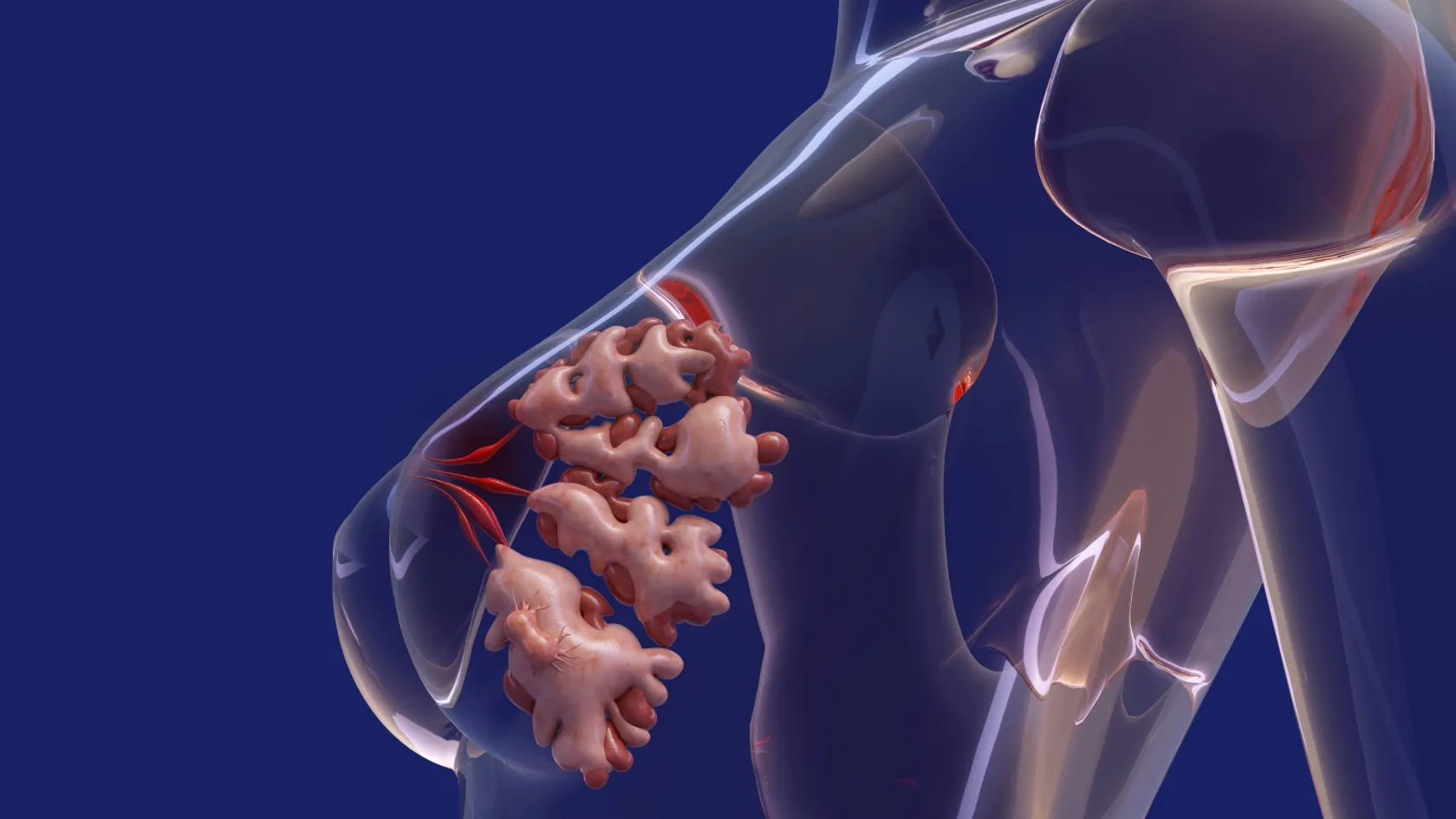
Whether cancer cells have reached the lymph nodes shapes the rest of breast cancer and melanoma treatment. Sentinel lymph node biopsy removes only the first one to three nodes that drain the tumor, through a small cut, and spares most patients a full node dissection. This guide explains who needs it, how it is done, what the major trials found, how to read the result, the risks and how long to stay in Istanbul.
About This Department
Surgical Oncology
The first nodes tell the story. The rest can usually stay.
In the ALMANAC trial, arm swelling one year after surgery affected 5 percent of women after sentinel node biopsy against 13 percent after standard axillary surgery.
1 to 3
Nodes usually removed in a sentinel node biopsy
5% vs 13%
Arm swelling at one year, sentinel biopsy against axillary surgery
1 day
Hospital stay in a published Istanbul sentinel node package
Free
Review of your biopsy and scans before you book
Free consultation
The review costs nothing and carries no obligation. Send your biopsy report, ultrasound and any scans, and our surgical oncology team will tell you whether a sentinel node biopsy is needed, whether it can be done with your main operation, and how long to plan for. A coordinator replies in your own language.
A breast cancer or a melanoma has been diagnosed. The lymph nodes feel and look normal on examination and ultrasound, and the treatment team needs to know whether any cancer cells have reached them, because that answer shapes the rest of the treatment. Sentinel lymph node biopsy finds and removes the first one to three nodes that drain the tumor, through a small cut, so that a pathologist can examine them closely, sparing most patients the removal of all the nodes in the armpit or groin. Below you will find what a sentinel node is, who needs the test, how it is done, what the large trials found in breast cancer and melanoma, how to read the result, the risks, the recovery, how long to stay in Istanbul, and the follow-up at home.
What a sentinel node is
What lymph nodes do
Lymph nodes are small, bean-shaped filters along the lymph channels, packed with immune cells. Clusters sit in the armpit, groin and neck.
Lymph fluid drains from a tumor along small channels to a first node, or a small group of nodes, before it travels further. Cancer cells that escape usually stop there first. If these sentinel nodes are free of cancer, the remaining nodes in that basin almost always are too, and if they contain cancer, the result guides the next step. Before this technique, surgeons removed most of the nodes in the armpit, which carried a high risk of arm swelling, numbness and stiff shoulders, and found no cancer in most of them. The test stages the cancer. It tells the team how far the cancer has spread, which in turn decides whether chemotherapy, radiotherapy to the nodes, immunotherapy or further surgery is needed, and it adds only minutes to the main cancer operation when done at the same time.
Remove the first nodes, read them closely, and spare the rest.
Why not just scan the nodes
Ultrasound, CT and PET miss small deposits of cancer, often only a few millimeters across. A pathologist examining the actual node finds them.
Who needs the test
1
Confirm the diagnosis
A needle biopsy of the tumor confirms the cancer type.
2
Check the nodes
Examination and ultrasound of the nodes.
3
Decide on the test
The team weighs whether the node result would change treatment.
The test is used most in
early breast cancer with normal-feeling nodes and a normal axillary ultrasound,
melanoma of intermediate thickness, or thinner melanoma with high-risk features,
some gynecological cancers, such as endometrial, cervical and vulvar cancer,
and selected head and neck, skin and other cancers.
This table scrolls sideways on a narrow screen. Swipe or drag to see every column.
Where sentinel node biopsy is used and why
Cancer
Node basin
What the result decides
Breast
Armpit
Need for further axillary surgery, radiotherapy and chemotherapy
Melanoma
Armpit, groin or neck, depending on the site
Stage, follow-up schedule and immunotherapy after surgery
Endometrial and cervical
Pelvic nodes
Need for radiotherapy and wider node surgery
Vulvar
Groin
Need for full groin dissection
When it is not needed
Nodes already shown to contain cancer by needle biopsy are treated directly. In some older women with small, hormone-sensitive breast cancers and a normal ultrasound, the test can be omitted, as described below.
How the biopsy is done
Usually part of the main operation
For breast cancer and melanoma, the biopsy is done through a separate small cut during the lumpectomy, mastectomy or wide excision, under the same anesthetic.
1
Tracer injection
A small amount of radioactive tracer is injected near the tumor or under the nipple, hours before surgery or the day before, and a scan maps where it drains.
2
Blue dye or a magnetic tracer
Often added in the operating room, staining the nodes so they can be seen.
3
Finding the nodes
A handheld probe detects the radioactive nodes through a cut of two to four centimeters.
4
Removal
One to three nodes are removed, usually together with the main cancer operation.
5
Pathology
The nodes are sliced thinly and stained, with the final report in five to seven days.
The tracer carries a small radiation dose. Blue dye turns the urine green for a day and can stain the skin for months.
In breast cancer
Sentinel node or full dissection
Over 5,611 women took part in NSABP B-32, randomized with breast cancer and normal-feeling nodes to sentinel biopsy plus full axillary dissection, or sentinel biopsy alone with dissection only if the sentinel nodes contained cancer. In the 3,989 women with negative sentinel nodes, survival at eight years was 91.8 and 90.3 percent, statistically equivalent. ALMANAC in Britain measured the gain in quality of life. At one year, arm swelling affected 5 percent after sentinel biopsy against 13 percent after standard axillary surgery, and sensory loss 11 against 31 percent.
When the sentinel node contains cancer
ACOSOG Z0011 then took 891 women with one or two positive sentinel nodes who were having breast-conserving surgery with radiotherapy. Ten-year survival was 86.3 percent without further axillary surgery and 83.6 percent with full dissection.
What changed in practice
Many women with one or two positive sentinel nodes now keep the rest of their armpit nodes, with radiotherapy and drug treatment controlling the disease.
Scroll sideways on small screens to see every column.
Trials that reshaped axillary surgery in breast cancer
Trial
Women
Finding
NSABP B-32, 2010
5,611
Sentinel biopsy alone as safe as full dissection when the sentinel nodes are clear
ALMANAC, 2006
1,031
Arm swelling at one year in 5 percent against 13 percent
ACOSOG Z0011, 2017
891
No survival loss without dissection for one or two positive nodes
SOUND, 2023
1,463
Small cancers with a normal ultrasound did as well without any axillary surgery
Omitting the test altogether
In SOUND, women with breast cancers up to 2 centimeters and a normal axillary ultrasound were randomized to sentinel biopsy or no axillary surgery. Distant disease-free survival at five years was 97.7 and 98.0 percent. The test can now be omitted for some, when its result would not change the rest of the treatment.
In melanoma
For melanoma, the sentinel node is the strongest single guide to the risk of recurrence. It is offered to patients whose melanoma is of intermediate thickness, or thinner but with features such as ulceration that raise the risk, and the tracer is injected around the scar of the original excision, so the scan can show drainage to an unexpected basin, for example to both armpits from a melanoma on the back. MSLT-II randomized 1,934 patients with cancer in the sentinel node to immediate removal of all remaining nodes or close watching with regular ultrasound. Survival did not differ. Melanoma-specific survival at three years reached 86 percent in both groups. Dissection controlled the node basin better, but arm or leg swelling followed in 24.1 percent against 6.3 percent with watching, so patients with a positive sentinel node are now followed with ultrasound every few months and offered treatment with modern immunotherapy or targeted drugs instead of further surgery, which has changed the outlook for stage III melanoma.
On a phone, slide the table sideways to see every column.
MSLT-II at three years
Measure
Completion dissection
Ultrasound watching
Melanoma-specific survival
86 percent
86 percent
Control of the node basin
92 percent
77 percent
Lymphedema
24.1 percent
6.3 percent
Signs it may be time
A breast cancer or melanoma with normal-feeling nodes and a normal ultrasound, where the node result would change radiotherapy, systemic treatment or follow-up.
Talk to us first
Nodes already proven to contain cancer, inflammatory breast cancer, or a small, low-risk breast cancer in an older woman where the result would not change treatment.
Risks and how they are managed
A small operation with small, mostly short-lived risks.
Arm or leg swelling
Lymphedema is far less common than after full dissection. Early signs are heaviness or a tight ring or sleeve, and a lymphedema therapist treats it early.
Numbness and seroma
A patch of numbness under the arm. Fluid can collect and may need draining.
Allergy to blue dye
Rare, mostly a rash, occasionally more serious, and the team is prepared for it.
A missed node
Uncommon with combined tracer and dye. Follow-up imaging covers the node basin.
The recovery
Done alone, the biopsy needs a day or one night in hospital. Daily tasks with the arm return within a day or two. Gentle shoulder exercises start the next day to keep full movement, raising the arm along a wall and rolling the shoulders several times a day, and heavy lifting, carrying shopping on that side and vigorous sport wait two weeks, while a small dressing covers the cut and stitches under the skin dissolve on their own. A lump of fluid may build up under the arm in the first week or two, and the nurse can drain it in a minute through a fine needle if it is uncomfortable. Driving returns when you can turn the wheel freely. Recovery is set by the main operation done at the same time, such as a lumpectomy, mastectomy or wide excision of a melanoma, which takes longer. A lymphedema therapist can show you how to look after the arm and spot early swelling.
How long to stay in Istanbul
Plan for five to seven days if the biopsy is done alone.
A published Istanbul sentinel node biopsy package lists one day in hospital and includes the biopsy and transfers, with the hotel left out. The pathology report arrives in five to seven days and is reviewed with you before you fly, and when the biopsy accompanies breast or melanoma surgery, the stay follows that operation. Fitness to fly is confirmed at the wound check.
What decides the cost
Whether the biopsy is done alone or with the main cancer operation, the tracer and imaging, the number of node basins, pathology and nights in hospital set most of the figure.
A quote you can compare names the procedure, the tracer and the stay, and that figure comes only after a surgical oncologist reviews your biopsy, scans and treatment plan. The review costs nothing.
Arranging the trip
Send your pathology report, ultrasound and any scans on WhatsApp, and a coordinator answers and stays with you from planning through the results and the follow-up at home. The team works in English, Arabic, French, Russian, Serbian, Romanian and Spanish, and interpreters cover other languages. A family member can stay in the room on the companion bed. The international office books a hotel, sends the visa invitation letter ten days before travel and arranges transfers, with halal, vegetarian and diabetic meals, a prayer room and a female physician on request.
Once you are back home
Your pathology report and treatment plan are shared with your oncologist at home, and the Istanbul team stays available through the coordinator to discuss the next steps. Radiotherapy and chemotherapy, if needed, can also be delivered at our hospital on the same site.
Fever, a red, hot or leaking wound, rapid swelling under the arm, or new swelling of the arm or leg. Each needs a doctor soon.
Sentinel lymph node biopsy FAQ
How many nodes are removed?
Usually one to three.
Is sentinel node biopsy painful?
Discomfort under the arm or in the groin for a few days, eased by simple painkillers.
What if the sentinel node has cancer?
Many patients now avoid further node surgery, with radiotherapy, drug treatment or close ultrasound follow-up instead.
Can lymphedema still happen?
Yes, but in far fewer patients than after full dissection, 5 percent against 13 percent in ALMANAC.
Is the tracer safe?
The radiation dose is small, and the tracer leaves the body within a day or two.
Can a family member stay with me?
Yes. A relative sleeps on the companion bed in your room, and the international office books a hotel for others.
References
Krag DN, Anderson SJ, Julian TB, et al. Sentinel-lymph-node resection compared with conventional axillary-lymph-node dissection in clinically node-negative patients with breast cancer. Overall survival findings from the NSABP B-32 randomised phase 3 trial. Lancet Oncol. 2010;11(10):927-933.
Mansel RE, Fallowfield L, Kissin M, et al. Randomized multicenter trial of sentinel node biopsy versus standard axillary treatment in operable breast cancer. The ALMANAC Trial. J Natl Cancer Inst. 2006;98(9):599-609.
Giuliano AE, Ballman KV, McCall L, et al. Effect of axillary dissection vs no axillary dissection on 10-year overall survival among women with invasive breast cancer and sentinel node metastasis. The ACOSOG Z0011 (Alliance) randomized clinical trial. JAMA. 2017;318(10):918-926.
Gentilini OD, Botteri E, Sangalli C, et al. Sentinel lymph node biopsy vs no axillary surgery in patients with small breast cancer and negative results on ultrasonography of axillary lymph nodes. The SOUND randomized clinical trial. JAMA Oncol. 2023;9(11):1557-1564.
Faries MB, Thompson JF, Cochran AJ, et al. Completion dissection or observation for sentinel-node metastasis in melanoma. N Engl J Med. 2017;376(23):2211-2222.
Editor's note
Written by the Biruni Hospital medical editorial team. Reviewed by Prof. Dr. Mustafa Teoman YANMAZ, Medical Oncology.