
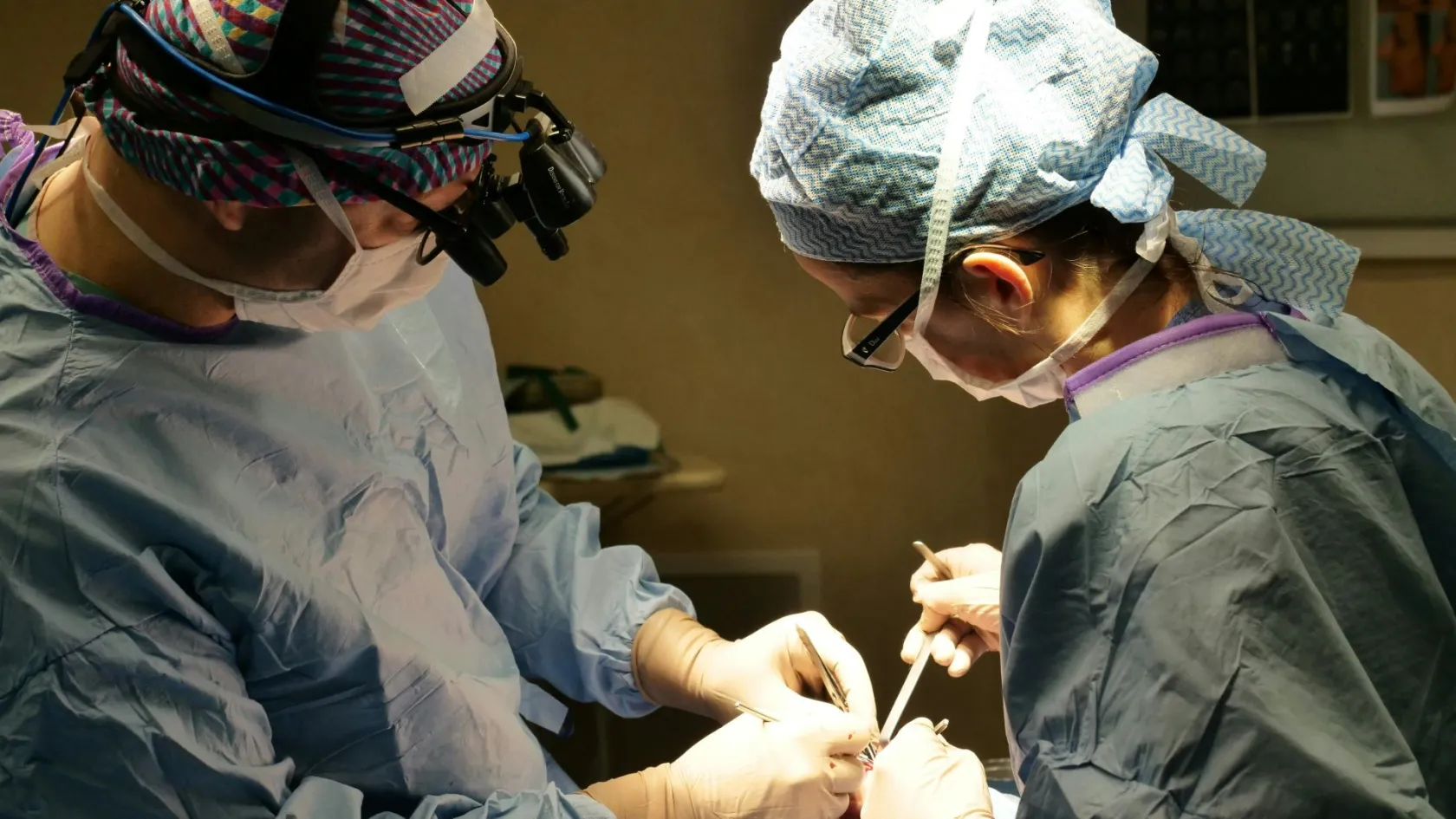
Laparoscopic Gynecologic Surgery
Three or four cuts the width of a pencil do the work of a 20 cm incision, and randomised data put the return to normal life almost two weeks earlier.
About This Department
A Cochrane review of 47 randomized trials covering 5102 women compared the ways a hysterectomy can be done for non-cancerous disease. Keyhole surgery returned women to normal activity 13.6 days sooner than an open operation. It also produced urinary tract injuries at more than twice the rate. And the approach that came out ahead of both, where the anatomy allowed it, was the vaginal one that almost nobody advertises. This article covers which gynecological operations laparoscopy suits, where it earns its reputation and where it does not, what the evidence says about robots, fibroid morcellation and endometriosis, and what recovery and travel involve.
Free consultation
Find out which approach your own anatomy calls for
The review costs nothing and commits you to nothing. Send any pelvic ultrasound or MRI with the actual images, the report describing the size and position of fibroids or cysts, a note of previous abdominal or pelvic operations and cesarean sections, and a summary of the treatments already tried. A gynecologist will tell you whether keyhole, vaginal or open surgery fits your case and what each would involve.
What laparoscopy does in gynecology
Laparoscopy means operating inside the abdomen through several incisions of five to twelve millimeters, with a camera passed through one of them and long instruments through the others, while carbon dioxide holds the abdominal wall away from the organs and the surgeon works from the image on a screen instead of from a direct view into an open wound. The principles do not change. What gets removed, repaired or reconstructed follows open surgery exactly.
Nearly the whole benign gynecological repertoire is now performed this way.
- Hysterectomy. Removal of the uterus, with or without the tubes and ovaries, for heavy bleeding, fibroids, adenomyosis or prolapse.
- Myomectomy. Removal of fibroids with the uterus left in place, for women who want to keep the option of pregnancy or simply keep the organ.
- Ovarian cystectomy and oophorectomy. Removal of a cyst from an ovary, or removal of the ovary itself.
- Endometriosis surgery. Excision or ablation of deposits, division of adhesions, and in advanced cases work on the bowel, bladder or ureter alongside a colorectal or urological surgeon.
- Tubal surgery. Treatment of ectopic pregnancy, removal of hydrosalpinx before fertility treatment, and sterilization.
- Prolapse repair. Sacrocolpopexy, which lifts the vaginal vault and secures it to the sacrum with mesh.
Cancer operations follow different rules and belong in their own discussion, so this article stays with benign disease throughout.
Keyhole, vaginal or open
Marketing for medical travel presents this as a two-way choice between modern keyhole surgery and old-fashioned open surgery, and that framing leaves out the option that the evidence actually favors. Three routes exist for removing a uterus. Through the abdominal wall as an open operation, through several small ports as a laparoscopy, and through the vagina with no abdominal incision at all. Each has been tested against the others in randomized trials, and the results are not the ones the brochures imply. According to PubMed, a Cochrane review of 47 randomized trials covering 5102 women compared them directly. Women having keyhole hysterectomy returned to normal activity a mean of 13.6 days sooner than those having open surgery, with fewer wound infections and fewer febrile episodes, at the cost of a longer operation and urinary tract injuries at 2.4 times the odds. Vaginal hysterectomy came out ahead of both approaches on recovery, and the reviewers found no advantage of laparoscopy over it (Aarts et al, 2015).
This table scrolls sideways on a narrow screen. Swipe or drag to see every column.
| Route | What it offers | What it costs |
|---|---|---|
| Vaginal | Fastest recovery, no abdominal incision, shortest operation | Needs a mobile, modest-sized uterus and adequate vaginal access |
| Laparoscopic | Recovery close to vaginal, and a full view of the pelvis for adhesions or endometriosis | Longer operating time and 2.4 times the odds of urinary tract injury against open surgery |
| Open | Direct access for a very large uterus, dense adhesions or suspected cancer | Slowest recovery, more wound infection, longer stay |
Reaching for laparoscopy in every case applies a preference. Explaining why the vaginal route was ruled out in your case applies the evidence, and that explanation is a reasonable thing to request before agreeing to anything.
The robot, and what the trials found
Robotic assistance means the same keyhole operation performed with instruments controlled from a console instead of held directly in the surgeon's hands. Three engineering advantages come with it, and they are real.
- The wrists at the instrument tips articulate, which matters in deep, confined spaces.
- The view is three-dimensional rather than flat.
- Tremor is filtered out of every movement.
The robot remains a tool. The surgeon supplies the variable that changes outcomes.
Which is why a unit charging a premium for the console should be able to say what that premium buys in your particular case rather than in general.
Those advantages count most in complex suturing and in spaces a straight instrument reaches badly. For routine benign gynecology, the randomized evidence does not show a patient benefit. The same Cochrane review found no difference between robotic and conventional laparoscopic hysterectomy in return to normal activities, visceral injury or major long-term complications, and it noted that the studies did not even report satisfaction or quality of life.
Fibroids, morcellation and the rare cancer
A fibroid or a uterus too large to pass through a twelve millimeter port has to be reduced before it can leave the abdomen. Morcellation does that, cutting the tissue into strips that can be drawn out through a small opening. The difficulty comes from a small number of masses that look and behave like fibroids and turn out under the microscope to be leiomyosarcoma, a cancer that cutting up inside the abdomen will scatter.
How often the fibroid is not a fibroid
In a Canadian province, 28 women received a confirmed diagnosis of uterine leiomyosarcoma over 15 years, against roughly 26 212 hysterectomies performed in the same period, giving an estimated rate near one in 853. Of the cases whose records could be retrieved, 60 percent were occult, meaning nobody suspected cancer before the operation, and five underwent unintended morcellation (Wu et al, 2019), according to PubMed.
Estimates vary between populations and rise steeply with age, so no single figure settles the question, and the practical conclusion holds whichever figure is used, which is that scans cannot reliably tell a fibroid from a sarcoma before surgery and the emphasis therefore falls on how the tissue leaves the body. Prediction is not available. Containment is.
Contained morcellation answers the problem, and most units have adopted it. The specimen goes into a sealed bag inside the abdomen, and the cutting happens within it. Nothing spills. The alternatives run to a small extension of one incision, or removal through the vagina, either of which takes the specimen out whole. Establish which method your surgeon uses. Treat uncontained power morcellation as a reason to ask further questions.
Endometriosis, and what surgery can promise
Laparoscopy carries a stronger association with endometriosis than with any other condition, and endometriosis also attracts the promises that run furthest ahead of the evidence. PubMed indexes a Cochrane review of 14 randomized trials covering 1563 women, which compared laparoscopic treatment against diagnostic laparoscopy alone and against other laparoscopic techniques. The finding on fertility was reasonably solid. Laparoscopic treatment probably improves the rate of viable intrauterine pregnancy, with an odds ratio of 1.89 across three trials and 528 women, graded as moderate quality evidence (Bafort et al, 2020). The finding on pain was not solid at all. Evidence comparing overall pain after treatment against diagnostic laparoscopy alone came from single trials with a handful of participants and was graded very low quality, and the long-running argument over whether excision beats ablation had no adequate trial behind it either.
None of that means surgery fails to help pain. Plenty of women improve after it. It means the trials are too small and too few to prove the size of the benefit, and a clinic promising a definite figure for pain relief is going beyond what anyone can currently support. Where fertility is the goal, the evidence gets stronger and the conversation gets easier.
Deep endometriosis involving the bowel, bladder or ureter is a different operation again, needing a colorectal or urological surgeon in theater and a unit that does this work regularly. Establish which category your case falls into before traveling anywhere.
When keyhole surgery is the wrong choice
Five situations push the decision away from laparoscopy, and a unit that never mentions any of them is selling rather than advising.
- A uterus large enough to fill the abdomen and leave the camera nowhere to work.
- Dense adhesions from several previous open operations, which make safe entry difficult, lengthen the operation considerably and raise the chance of an injury to bowel that has stuck to the abdominal wall.
- Heart or lung disease that will not tolerate a prolonged period tipped steeply head-down with the abdomen inflated.
- Any suspicion of cancer in a mass that would otherwise be morcellated.
- A vaginal route that is available and simpler, which the evidence favors where the anatomy permits it.
Conversion from keyhole to open surgery partway through happens in a small minority of cases and belongs in the consent conversation as a planned possibility. A surgeon who converts when the view is poor is exercising judgment, and the alternative is persisting in conditions where injuries occur.
Theater day, and going home the same evening
Admission happens on the morning of surgery for almost all benign laparoscopy. Under general anesthesia the first port goes in, usually through the navel, the abdomen is inflated with carbon dioxide, and the remaining ports are placed under direct vision. The table tilts head-down so the bowel falls away from the pelvis. A catheter drains the bladder during the operation and comes out before you wake or shortly after. An hour covers a diagnostic laparoscopy or a simple cystectomy, one to two hours a straightforward hysterectomy, and three or more a complex myomectomy or advanced endometriosis case with a second surgeon involved.
Then comes the part that surprises people. Shoulder pain.
Residual carbon dioxide irritates the diaphragm, which shares a nerve supply with the shoulder tip, so the brain reads the signal as coming from the shoulder, and the sensation lasts a day or two, eases with walking, and has nothing whatever to do with the shoulder itself. Nobody warns women about it.
Same-day discharge rests on a protocol
Two Canadian teaching hospitals introduced a same-day discharge protocol for total laparoscopic hysterectomy built on patient education, structured perioperative care and close follow-up. Same-day discharge rose from 18.3 percent in the preceding year to 79.1 percent among enrolled patients, with no significant difference in perioperative complications or readmission rates (Nensi et al, 2018), according to PubMed. Going home the same evening is safe where the pathway supports it, which for an international patient means a hotel with someone in the room and a phone number that answers.
One night in hospital is common for a hysterectomy, and none at all for a diagnostic laparoscopy or a simple cyst removal.
Risks specific to keyhole surgery
Serious complications stay uncommon, and the specific risks of laparoscopy differ from those of open surgery in ways that deserve understanding before consenting. Injury to the bladder or the ureter is the one the Cochrane data singles out, occurring at 2.4 times the odds of open surgery across the hysterectomy trials, and it happens for a simple anatomical reason, which is that the ureter runs within a centimeter of the point where the uterine blood supply has to be divided. Recognized during the operation, it is repaired then and there. Recognized afterward, it means a second procedure.
This table scrolls sideways on a narrow screen. Swipe or drag to see every column.
| Risk | Why it happens | What it means in practice |
|---|---|---|
| Bladder or ureter injury | The ureter runs within a centimeter of the point where the uterine blood supply has to be divided, and the Cochrane hysterectomy data puts this at 2.4 times the odds of open surgery | Recognized during the operation it is repaired then and there. Recognized afterward it means a second procedure |
| Entry injury to bowel or a major vessel | The very first port goes in before anything inside can be seen | Rare, and the reason a surgeon moves the entry site away from the navel in a woman with a previous midline scar |
| Vaginal vault dehiscence | Where the uterus is removed the top of the vagina is stitched closed, and that closure can open in the following weeks | Nothing enters the vagina for six weeks, and this is the reason for that rule |
| Clots in the leg or lung | Any pelvic surgery raises the risk | Early walking is the single most effective thing against them |
| Port site hernia and infection | A larger port site is a hole in the abdominal wall that has to close | Watch the sites through the second week, when an infection typically declares itself |
Entry injuries are different in kind. They involve bowel or major blood vessels, they are rare, and they occur as the very first port goes in, before anything inside can be seen, which is the reason surgeons move the entry site away from the navel in women who carry a previous midline scar.
Bleeding needing transfusion, infection at a port site or in the pelvis, and hernia through a larger port site make up most of the remainder. Where the uterus is removed, the top of the vagina is stitched closed, and that closure can open in the following weeks, so nothing enters the vagina for six weeks. Clots in the leg or lung remain possible after any pelvic surgery. Early walking is the single most effective thing against them. Adhesions form after every abdominal operation and form less after laparoscopy than after open surgery, though nobody can promise a woman that she will not develop them.
Getting back to normal
Wind pain, shoulder-tip pain and more tiredness than the size of the incisions would suggest fill the first three days, and short frequent walks around the room do more for all three than lying still, while simple painkillers taken regularly beat waiting for the pain to build. Through the first two weeks the port sites become comfortable, appetite returns, and driving becomes possible once an emergency stop would not make you flinch, which for most women falls in the second week after a diagnostic procedure and the third after a hysterectomy. Lifting stays restricted for four to six weeks so the port sites can close properly, and where the uterus was removed, nothing enters the vagina for six weeks. Office work resumes somewhere between two and four weeks depending on the operation. After the equivalent open surgery it takes six to eight.
What needs a phone call the same day
Two things need contacting someone about the same day. A port site that becomes hot, red and increasingly painful, and abdominal pain that worsens instead of easing after the third day, since the second can be the first sign of an injury recognized late.
Planning the trip
Seven to ten days in the country covers a straightforward keyhole procedure, with a day or two at the front for imaging review, blood tests, anesthetic assessment and the consultation itself, none or one night as an inpatient, and the balance left for a wound check and a fitness-to-fly assessment before departure. Complex cases run longer. A myomectomy for multiple fibroids, or advanced endometriosis with bowel involvement, stretches the plan to two or three weeks. Flying too soon after abdominal surgery raises the clot risk, so the departure date belongs to the surgical team rather than to the airline. Make three arrangements before you fly. Somebody to stay with you for the first two nights. This matters most where same-day discharge is planned. A named person at home who can see you if a port site becomes infected in the second week. And a plan for the histology report, which for a myomectomy or a cyst removal is the document that confirms what the tissue actually was, and which issues after most international patients have left.
That last one matters more than it sounds, because the histology report is the document that would identify an unexpected cancer in tissue everyone assumed was benign. Ask for it in English, and ask how many working days it takes. That date decides something practical, which is whether you wait in the country for the result or have it sent on to your own doctor after you have flown.
What moves the price
Four things separate one quote from another. Which operation the surgeon performs, since a diagnostic laparoscopy and a laparoscopic hysterectomy with extensive adhesiolysis have little in common in theater time. Whether robotic assistance is used, which carries consumable costs per case and frequently a separate line on the invoice. What disposable instruments the operation consumes, including energy devices, staplers and containment bags. And how many nights the stay runs, which the operation and the recovery together determine.
What a published package usually buys
Body weight, scarring from earlier operations and any condition that complicates the anesthetic all push the figure upwards as well. A published package here ordinarily buys the surgeon and anesthesiologist, theater time, an agreed number of nights, the imaging and bloods before surgery, the laboratory work on whatever is removed, and transfers with an interpreter, leaving flights, extra nights, the management of a complication and any repeat procedure to be paid separately.
Before accepting a quote, establish what happens financially if the operation converts from keyhole to open, whether robotic assistance changes the figure and by how much, whether histopathology and its delivery to your own doctor are included, and how many nights the quote assumes with the cost of each additional one. None of it can be answered by a price list. It needs a surgeon who has opened your scans. That review costs nothing.
Back home, and the follow-up
Carry four things. The operative note describing what was found and what was done, the histopathology report on anything removed, a copy of the imaging, and a written note of every restriction with the date it ends. Where a mesh was used for prolapse repair, the make and model belong in your records permanently, and a woman who cannot name her own implant years later has been let down by the paperwork rather than by the surgery. Once you are home, follow-up for benign laparoscopy stays brief. A single review at four to six weeks settles most cases, arranged either with the operating team remotely or with your own doctor, and remote follow-up works well here because there is little to examine and much to discuss. Where endometriosis was treated, the conversation continues, since surgery is one part of a longer plan that includes medical treatment and, where relevant, fertility care.
One instruction outlasts all the others. Any new abdominal pain, fever or wound discharge inside the first month goes to a doctor and not to a search engine, and having the name and number of someone who already knows your case turns that from a frightening decision into an easy one. Get the number before you leave.
Frequently asked questions
Is keyhole surgery always better than open surgery?
Is robotic surgery worth paying extra for?
Is morcellation of fibroids dangerous?
Will laparoscopic surgery cure my endometriosis pain?
Can I really go home the same day?
Can I fly home a few days after keyhole surgery?
References
- Aarts JWM, Nieboer TE, Johnson N, Tavender E, Garry R, Mol BWJ, Kluivers KB. Surgical approach to hysterectomy for benign gynecological disease. Cochrane Database Syst Rev. 2015;2015(8):CD003677.
- Wu CQ, Woo LY, Giede KC, et al. Occult leiomyosarcomas in a Canadian province. A retrospective cohort study. J Obstet Gynaecol Can. 2019;41(1):46-51.
- Bafort C, Beebeejaun Y, Tomassetti C, Bosteels J, Duffy JMN. Laparoscopic surgery for endometriosis. Cochrane Database Syst Rev. 2020;10(10):CD011031.
- Nensi A, Coll-Black M, Leyland N, Sobel ML. Implementation of a same-day discharge protocol following total laparoscopic hysterectomy. J Obstet Gynaecol Can. 2018;40(1):29-35.
Editor's note
Written by the Biruni Hospital medical editorial team. Reviewed by Prof. Dr. Metin GÜDEN, Radiation Oncology.
Medically reviewed by

Prof. Dr. Metin GÜDEN
Radiation Oncology
Related Treatments
View All-
Cytoreductive, Debulking Surgery - Ovarian Cancer
Debulking surgery for ovarian cancer, from complete cytoreduction to HIPEC. Surgery or chemotherapy first, recovery, hospital stay and when you can fly.
-

Gynecologic HIPEC Surgery
Heated chemotherapy improved five-year survival in one precise situation in ovarian cancer and did nothing measurable in the others. Knowing which one you are in is everything.
-
HIPEC
Heated chemotherapy soaks into tissue by about three millimetres. Everything this treatment can and cannot do for you follows from that one measurement.
-
Uterine Cancer Surgery
Keyhole hysterectomy matched open surgery in uterine cancer at 81.6 against 81.3 percent. The same approach lost by ten points in cancer of the cervix.
-

Vulvar Cancer Surgery
Operating on the vulva alone caused complications in 21.8 percent of women. Adding a full groin clearance took that figure to 54.2 percent in the same cohort.