
Laparoscopic Appendectomy
Appendicitis stopped being an automatic operation, and a lump of hardened bowel content the size of a pea now decides whether antibiotics can work for you. Six randomized trials pooled at patient level in 2025 put complications at 15 percent with antibiotics against 6.3 percent with surgery where that stone is present, while two in three people avoid an operation where it is absent. This guide covers who suits each route, keyhole against open surgery, children, older patients and recovery.
About This Department
Appendicitis stopped being an automatic operation. A stone the size of a pea decides which path fits you.
Six randomized trials have now compared antibiotics with surgery for appendicitis, and pooling every patient in them produced one finding that changes consultations. Without a small hardened lump inside the appendix, two men in three avoided an operation for a year. With one, antibiotics more than doubled the complication rate and half came to surgery anyway.
No longer an automatic operation
For a century the rule was simple. Appendicitis meant an operation, tonight, because an appendix left alone bursts and a burst appendix kills people. Generations of surgeons were trained to accept a proportion of normal appendices removed as the price of never missing one, and nobody argued, because the alternative was a young person dying of something preventable. That rule was correct for the era that produced it and it has quietly stopped being the whole truth. What changed was the scan. A CT now shows a surgeon whether the appendix is merely inflamed or already perforated, whether an abscess has formed, and whether a small hardened lump of stool has blocked the opening. That last detail turns out to matter more than anybody expected, and knowing it in advance makes it possible to offer a treatment that would have been reckless to offer blind.
Antibiotics, in other words. Given properly, to the right patient, instead of an operation.
Six randomized trials have now tested that, and in 2025 a group pooled the individual records of 2,101 patients from six of them and applied one consistent definition of a complication across all the data. The headline result is that antibiotics were safe. The result worth carrying into a consultation is what happened when they split the patients by whether a stone was visible on the scan, because those two groups behaved so differently that treating them as one condition no longer makes sense.
What is happening inside you
A blocked tube that cannot drain
The appendix hangs off the first part of the large bowel as a narrow blind tube, with one opening and no way out. Block that opening and whatever the lining secretes has nowhere to go, so pressure rises inside the tube, the wall swells, the blood supply within the wall gets squeezed, bacteria multiply in stagnant contents, and the tissue begins to die from the inside outward. Left long enough the wall gives way and the contents spill into the abdomen. That whole sequence, from first ache to perforation, runs across a day or two, and the variability in how fast it moves is one reason nobody can safely promise a patient that waiting is fine. Some appendices perforate in twelve hours. Others sit inflamed for four days and settle without anybody touching them. Nothing measurable at the bedside separates those two people reliably, which is the whole reason this condition has been treated as an emergency for as long as it has.
The pain follows the anatomy in a way that is genuinely useful to recognize. It starts vaguely near the navel, because the swollen tube sends signals through nerves that cannot localize well. Hours later it moves and sharpens into the lower right corner of the abdomen, because by then the inflamed appendix is touching the lining of the abdominal wall, which localizes pain precisely. That migration is worth more diagnostically than any single blood test.
The words on your discharge letter
The stone that decides
An appendicolith means a lump of hardened bowel content that has settled in the opening of the appendix and set there. It shows on a CT scan as a bright dot, a few millimeters across, and radiologists mention it in a single clause near the end of a report that almost no patient ever reads.
Until recently nobody treated it as a decision point. The pooled trial data changed that.
Among 193 patients with a stone who were given antibiotics, 29 had a complication within the year, which is 15.0 percent. Among 190 patients with a stone who had surgery, 12 did, which is 6.3 percent. The odds of a complication were nearly three times higher on antibiotics, and 48.7 percent of the stone group given antibiotics came to an operation within twelve months anyway. Among patients without a stone, that figure was 30.6 percent.
Which makes the mechanism easy to picture. A blockage that a course of antibiotics cannot dissolve stays where it is, so the tube stays blocked, and the inflammation returns as soon as the drug stops holding it down. Without the stone, the swelling that closed the opening subsides and the tube drains again. Two different situations wearing the same name. So the practical instruction for a patient is short and specific. Ask whether your scan showed an appendicolith. A yes tilts the decision firmly toward an operation. A no opens the door to a genuine choice, and that choice deserves a proper conversation rather than a default.
Antibiotics against surgery
Pooling individual patient records, instead of published summaries, lets researchers apply one definition of harm to everybody, which matters here because the original trials counted complications differently enough to make their headline figures hard to compare. Two thousand one hundred and one adults with appendicitis confirmed on imaging went into that analysis, split almost exactly in half between the two treatments.
Narrow screens scroll this table sideways. Swipe or drag to reach every column.
| Measure | Antibiotics first | Surgery first |
|---|---|---|
| Complication of any grade at one year | 5.4 percent | 8.3 percent |
| Had an appendectomy within the year | 33.9 percent | 97.5 percent |
| Complication where a stone was present | 15.0 percent | 6.3 percent |
| Came to surgery where a stone was present | 48.7 percent | Already operated on |
Read the first row carefully before anybody quotes it at you. Antibiotics produced fewer complications than surgery overall, 5.4 percent against 8.3, and the confidence interval around that difference crossed the line of no difference, which means the honest reading is that the two treatments came out similar on harm rather than that antibiotics won. The second row is the one with no ambiguity in it. A third of the antibiotic patients had an operation inside the year, and the other two thirds still had their appendix.
What five years showed
One year answers a question like this badly, and one Finnish trial followed its patients for five. Five hundred and thirty adults between 18 and 60, all with appendicitis confirmed on CT and all uncomplicated, were randomized to an operation or to antibiotics. The pattern that emerged is the most useful long term picture anybody has published.
- Seventy of 256 antibiotic patients, 27.3 percent, had an operation within the first year.
- Thirty more had one between one year and five, so the cumulative figure reached 39.1 percent at five years.
- Most of the recurrences were mild. Of 85 who came to surgery for a recurrence, 76 had uncomplicated appendicitis, two had complicated appendicitis, and seven turned out to have no appendicitis at all.
- The curve flattened after the second year, with most of the recurrences arriving early rather than being spread evenly across the five.
Columns run past the edge on a small screen. Slide the table across to read them.
| Time since treatment | Had come to an operation |
|---|---|
| One year | 27.3 percent |
| Two years | 34.0 percent |
| Three years | 35.2 percent |
| Four years | 37.1 percent |
| Five years | 39.1 percent |
How to read those studies
The detail that flatters the antibiotics
The Finnish trial reported a five year complication rate of 24.4 percent in the surgical group against 6.5 percent in the antibiotic group, a gap of 17.9 percentage points, and that figure gets quoted constantly. It needs one piece of context to be read properly.
The detail that flatters the surgery
Cutting the other way, the trials recruited only patients with uncomplicated appendicitis confirmed on a CT scan, a narrower group than the people who actually arrive at an emergency department holding their right side. Anybody whose scan showed a perforation, an abscess or free fluid was never eligible, so none of these results apply to them, and quoting a trial result to a patient who would have been excluded from that trial is one of the commonest ways good evidence gets used badly.
Who antibiotics suit
Given all of that, a shape emerges for who should be offered the non surgical route and who should be steered away from it.
None of it replaces a surgeon at a bedside, and all of it belongs in your head before that conversation starts.
Patients for whom antibiotics make genuine sense share a profile. An adult, with appendicitis confirmed on a scan and never guessed at, with no appendicolith, no perforation, no abscess and no free fluid. Somebody who can come straight back to a hospital if the pain returns, which rules out the man flying out tomorrow morning and the woman going to a place three hours from the nearest surgical unit. Somebody for whom avoiding an operation carries real value, whether because of heart or lung disease that makes an anesthetic risky, or because of work or family circumstances over the next two weeks that surgery would wreck. Against that sit the situations where an operation is the better answer. A stone on the scan. Any sign that the appendix has already given way. A patient whose immune system is suppressed. Somebody who would rather settle the matter permanently than carry a one in three chance of a repeat attack and a second hospital admission at an unpredictable moment, which is a preference and not a clinical error.
Pregnancy and childhood both sit outside the evidence described above, since the trials recruited non pregnant adults. Appendicitis in pregnancy is managed by surgeons and obstetricians together, and the operation is generally done rather than delayed, because a perforation threatens the pregnancy far more than an anesthetic does.
Keyhole against open
Where an operation is chosen, the keyhole version is now the default nearly everywhere, and the reasons show up consistently across very large comparisons.
Three small ports. A camera. Out through the navel in a bag.
This table also scrolls sideways on a narrow screen. Swipe or drag to reach every column.
| Outcome | Direction |
|---|---|
| Wound infection | Substantially lower with keyhole, consistently, across every group studied |
| Hospital stay | Shorter, by around one day in children and closer to three in older adults |
| Abscess inside the abdomen | No meaningful difference in current data |
| Operating time | Longer with keyhole, by roughly seven to twelve minutes |
| Death after surgery in older patients | Lower with keyhole, with an odds ratio of 0.33 across 339,000 patients |
The claim that expired
One objection to keyhole appendectomy circulated for years and deserves a section of its own, because it shows how surgical evidence behaves over time and because older surgeons still repeat it occasionally.
It held that removing an inflamed appendix through ports left more pus behind and produced more abscesses inside the abdomen afterward. It sounded mechanically sensible, it was supported by the trials of the day, and it shaped practice for the better part of a decade. Then it stopped being true.
Which happens to surgical claims more than anybody comfortable with evidence would like, and which is why the date on a piece of advice matters as much as its content.
- A cumulative analysis of 64 randomized trials tracked that question year by year as the trials accumulated.
- Pooling everything published up to and including 2001 produced a clear result in favor of open surgery, with an odds ratio of 2.35 for abscess formation.
- After 2001 that advantage faded steadily as instruments and technique improved, and the pooled figure across all years settled at 1.32 with a confidence interval crossing one, meaning no difference.
So the objection was true when it was made and stopped being true afterward, which is an uncomfortable property of surgical evidence and a good reason to ask when a piece of advice was last checked. The authors of that analysis drew a wider lesson from it. Reading a single pooled figure from a meta analysis, without looking at how it moved over the years that produced it, can give a confident answer to a question whose answer has already changed.
Older patients
Appendicitis in an older person is a more dangerous illness than the same diagnosis in a student, and the reasons stack on top of each other. Pain arrives less dramatically, so people wait longer. Other conditions muddy the picture. Perforation comes sooner. By the time somebody makes the diagnosis, a larger proportion have already burst, and the mortality figures for this condition look very different at seventy from the way they look at twenty, and why a vague ache in an older person deserves more suspicion than the same ache in a teenager.
Which makes the evidence on approach unusually clear in this group. A meta analysis pooling twelve studies, covering 126,237 keyhole operations and 213,201 open ones in older patients, found death after surgery substantially lower with the keyhole route, with an odds ratio of 0.33. Complications overall were lower, wound infection markedly so, abscess rates were similar, the operation took around seven minutes longer and the hospital stay ran nearly three days shorter. Numbers that large come from registries and never from trials and carry the selection problems that registries always carry, with fitter patients more likely to be offered the keyhole route in the first place. Registry data also records what was coded and not what was found, and coding in emergency work is famously rough, so a proportion of those open operations were keyhole operations that ran into trouble. Even allowing generously for that, the direction is consistent enough that age on its own is a poor reason to choose the open operation.
Children, and the difficult cases
When the appendix has already burst
For a child with a simple inflamed appendix, keyhole surgery has been standard for years and nobody argues about it, and the argument was instead about children whose appendix had already perforated or turned gangrenous, where the fear of leaving infection behind kept many surgeons opening the abdomen. A meta analysis brought together six randomized trials and thirty three comparative studies covering more than seven thousand children with complicated appendicitis to settle it.
It settled it.
Keyhole surgery came out ahead on nearly everything measured. Hospital stay came out shorter by a day. Surgical site infection was substantially lower, with an odds ratio of 0.37. Readmissions were fewer, postoperative bowel obstruction was less common, reoperation was less common, and children started eating sooner. The abscess rate, which was the whole basis of the objection, came out essentially identical between the two, and since that was the single reason surgeons had been opening these children's abdomens, the argument for doing so disappeared with it.
What that means for a worried parent
A child arriving with a perforated appendix is genuinely ill and the days after surgery are harder than for a simple case, with a longer course of antibiotics and a real chance of a collection needing drainage later. The route the surgeon takes is no longer the variable to worry about. Ask instead how often this unit operates on children, whether a pediatric surgeon is involved, and what happens if a collection forms in the second week, since that complication shapes how the two weeks after surgery actually go far more than the route the instruments took.
Washing out the abdomen
Surgeons have been having a small technical argument for decades that patients never hear. Where the appendix has burst and pus is sitting in the abdomen, should the surgeon pour in liters of saline and suck it out again, or simply suck out what is there without irrigating? Instinct says washing must help.
The evidence says otherwise.
Seventeen studies covering 5,315 patients were pooled to compare the two and found no statistical advantage for irrigation in the rate of abscess afterward, in reoperation, in hospital stay or in wound infection. What it did find was that operating time ran lower in the suction only group, and that the clinical numbers, without reaching significance, consistently favored suction alone. The suspicion behind that is that washing spreads contamination around the abdomen instead of removing it, and mentioning this on a patient page is deliberate, since the surest sign that a unit reads its own literature is that it has an opinion on questions like this one and can say what that opinion rests on.
The operation itself
Under an hour, three small holes
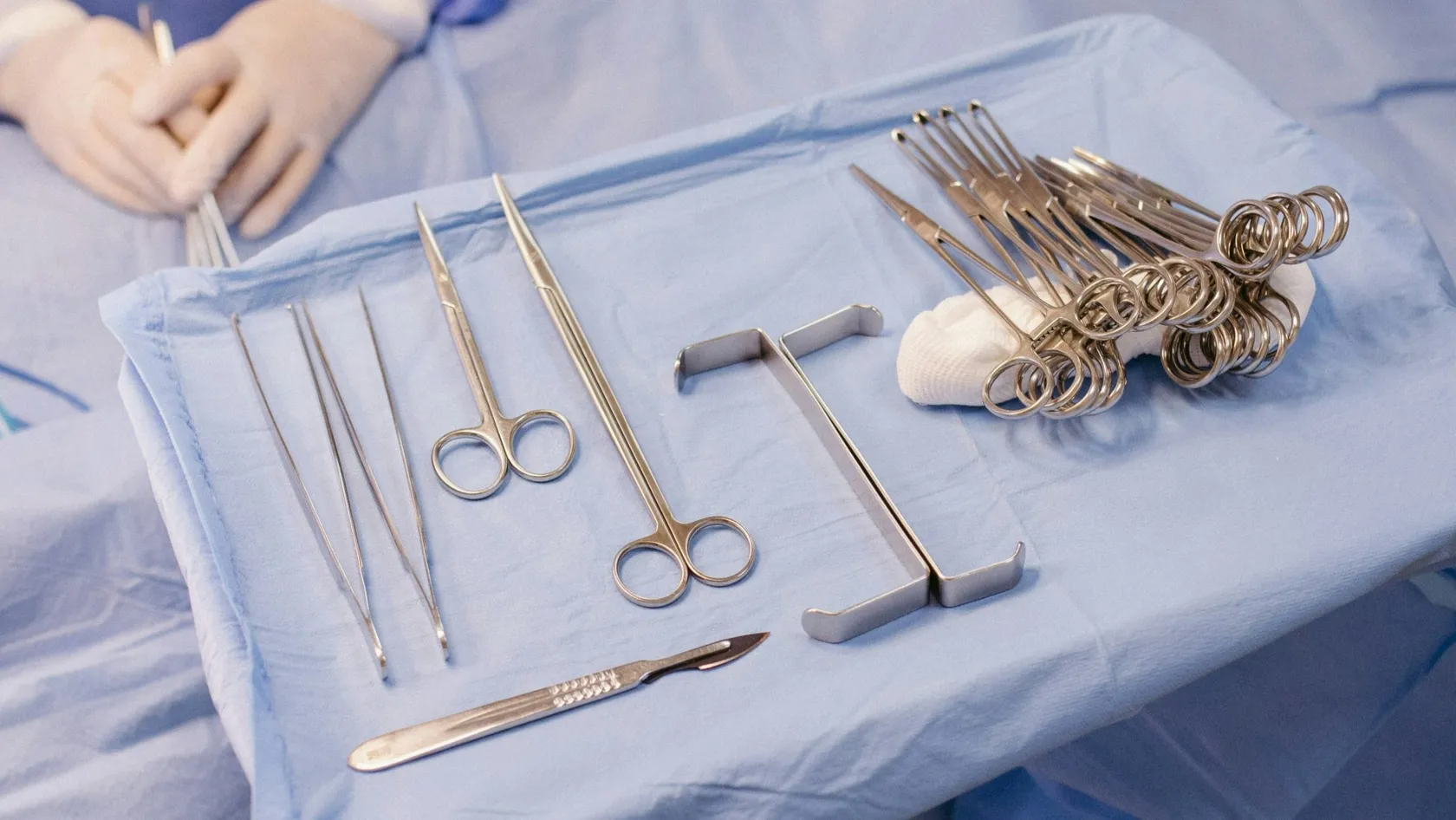
General anesthetic, a urinary catheter only where the operation is expected to run long, and antibiotics given at induction, then carbon dioxide fills the abdomen, a port goes in at the navel, and two more go in low down. The appendix is found, freed from anything stuck to it, its blood supply sealed, and its base closed with a loop, a clip or a stapler depending on how inflamed the base has become. Out it comes through the navel port inside a bag, so that nothing infected touches the wound on the way through. Forty minutes covers a straightforward case and an hour and a half is unremarkable for a difficult one, and the difference between those two lies almost entirely in how stuck the appendix has become to whatever was next to it, which nobody can predict from the outside and which the surgeon discovers in the first three minutes.
When the appendix looks normal
Occasionally the surgeon finds a healthy appendix, which is the situation the camera handles better than an incision does, because he can then look properly at the rest of the abdomen before deciding what to do, and a normal looking appendix comes out anyway once he is already in there, on the grounds that leaving it behind guarantees future confusion the next time that patient has right sided pain. Where something else is found, an inflamed piece of small bowel, an ovarian cyst, an infection of the tubes, the decision changes on the spot, and this is precisely the moment when consent that covers only one operation becomes an obstacle.
Recovery
Simple appendicitis removed through ports recovers faster than patients expect, and it follows a reliable pattern. Home on the same day or the next morning. Eating on the evening of surgery, walking immediately, and back at a desk within a week. Once the appendix has burst, everything stretches. Several days in hospital, a course of intravenous antibiotics, and a longer tail of tiredness that catches people out because they were told this was keyhole surgery and assumed that meant minor. What was keyhole was the way in. What happened inside was an abdomen full of infection being cleaned out, and the body treats that exactly as seriously as it deserves.
A handful of details account for most of the questions asked in that first week.
- Shoulder tip pain on the first day comes from gas left under the diaphragm, is harmless, and disappears within a day or two.
- Eat when you feel like it, since there is no benefit in starving after a keyhole appendectomy and early eating shortens recovery.
- Walking from the first evening lowers the risk of clots and chest problems more effectively than anything else available.
- Lifting waits two weeks, or four to six where the abdomen was contaminated.
- Driving resumes once an emergency stop would not make you flinch, which for most people means five to seven days.
Something genuinely does differ from the common expectation here. The bowel takes a few days to wake up after being handled, so bloating, irregular bowel habit and a sense of fullness are ordinary in the first week and mean nothing on their own. Increasing pain in that same week means something quite different and belongs in the next section.
When to go back
One problem dominates the serious list after this operation, which is a collection of pus forming inside the abdomen, which declares itself between the fourth day and the second week and which treats straightforwardly once somebody picks it up early. Almost everybody who runs into trouble had noticed something several days before acting on it, and the reason they waited is almost always the same one, which is that they had been told to expect discomfort and could not tell where ordinary discomfort ended.
Here is where that line sits.
What the pathologist finds
The report nobody discusses beforehand
Every appendix removed goes to a laboratory, and the report coming back a week later confirms what everybody expected. A small number do not. One appendix in every few hundred contains a tumor nobody suspected, most often a small neuroendocrine growth at the tip. Almost all are found by accident, almost all are early, and almost all are cured by the operation that has already happened.
Which is why the pathology report matters and why somebody has to be responsible for reading it. A patient discharged on day one, with the report arriving a week later into a hospital system he has already left, is the way an incidental finding gets missed. Establish before you leave who will read that report and how they will reach you, and get that in writing if you are traveling home to another country.
The planned operation later
Some readers arrive at this page with a different situation entirely. Their appendicitis happened weeks or months ago, it was treated with antibiotics and sometimes with a drain into an abscess, the acute illness settled, and somebody has now suggested removing the appendix as a planned operation. That goes by the name interval appendectomy, and it remains the one version of this procedure that can be arranged calmly, which makes it the one version that travels. Whether it should be done at all is genuinely debated. Against it sits the observation that many people never have a second attack, so a proportion of these operations remove an appendix that would have caused no further trouble. For it sits the recurrence risk, which sits near one in four over the following years, and a second consideration that gets less attention. In adults past forty, a mass in that corner of the abdomen occasionally turns out to be a bowel cancer imitating appendicitis, and a colonoscopy before any planned operation is standard practice for that reason.
How the first attack behaved tips the balance for most surgeons. Somebody whose appendix perforated and formed an abscess has a more inflamed, more scarred field and a higher chance of it happening again, which is why that person is offered the planned operation, while somebody whose mild attack settled on tablets alone, with no stone on the scan, has a reasonable case for leaving well alone and seeing what happens.
Having this done in Istanbul
Acute appendicitis is an emergency and belongs in the nearest capable hospital. Nobody should board a plane with right sided abdominal pain, and any clinic willing to book a flight for somebody in that situation is behaving badly. This section is written for three other groups, being people already living in or visiting Istanbul, people who fell ill while traveling and are now deciding what to do next, and people arranging a planned interval operation after an attack that has already settled.
In an emergency the sequence is the ordinary one. Assessment in the emergency department, blood tests, an ultrasound or a CT scan depending on age and build, and a surgical opinion. Where the scan shows uncomplicated appendicitis with no stone, we set out both options and the figures behind them, without presenting surgery as the only path. Where it shows a stone, a perforation or an abscess, we say plainly that an operation is the better choice and why.
That conversation takes five minutes and belongs in the middle of the night as much as in a clinic.
Planning an interval operation, send the scan images themselves and not the report alone, along with the discharge summary from the original admission, the antibiotics you were given, and the colonoscopy result if you are over forty and have had one, after which a surgeon reads it and replies in writing, at no charge, and where the sensible answer is to leave the appendix alone, the reply says so and offers no date.
Plan three to four nights for a planned operation, covering the consultation, the procedure as a day case or with one night on the ward, and a wound check before you travel. Fitness to fly is confirmed in writing on day two or three, after an examination that morning. We work in seven languages without booking an interpreter, those being English, Arabic, French, Russian, Serbian, Romanian and Spanish, and anything else is arranged in advance, while one coordinator takes your first message and stays with you to discharge, then answers on WhatsApp once you are home, and the pathology report goes to you in writing with an explanation and to your own doctor on the same day. A companion sleeps in the room on a bed the ward provides, hotel nights and transfers are booked before you land, an invitation letter for a visa application leaves our office around ten days ahead of the flight, meals come halal, vegetarian or adjusted for diabetes, and a prayer room sits on the ward floor.
Nobody is charged for that reply.
On cost, we publish no figures. The price turns on whether the appendix has burst, on how many nights the ward keeps you, and on whether a collection needs draining afterward, and an emergency admission cannot be quoted in advance at all.
Appendectomy FAQ
Can I really just take antibiotics
If you are an adult, your scan shows uncomplicated appendicitis, and there is no stone in the appendix, yes, with a two in three chance of still having your appendix a year later and a four in ten chance of coming to surgery within five years.
What is an appendicolith and why does it matter
Simply a hardened lump blocking the appendix. Antibiotics cannot dissolve it, so the blockage persists, and in the pooled trial data those patients had more than double the complication rate on antibiotics and came to surgery about half the time within a year.
How long will I be off work
A week for desk work after a simple keyhole operation, two to three weeks for physical work, and longer where the appendix had burst, while antibiotic treatment alone puts most people back sooner, by eleven days in one trial.
Does losing the appendix cause problems later
No meaningful ones. It carries immune tissue and may act as a reservoir for gut bacteria, and people without one live ordinary lives. No dietary restriction follows and no supplement is needed.
What if the surgeon finds a normal appendix
He will look around for another cause, which is something the camera does well, and he will then remove the appendix anyway so that future right sided pain never gets confused by it. Finding another explanation happens frequently enough in women to be worth expecting.
Will I have visible scars
Three, each a centimeter or so, with the largest hidden in the navel. Within a year most struggle to find two of them.
Is surgery safe during pregnancy
Operating beats waiting, because a perforated appendix threatens the pregnancy considerably more than an anesthetic does, and surgeons and obstetricians do it together, with the approach is chosen according to how advanced the pregnancy is.
References
- Scheijmans JCG, Haijanen J, Flum DR, et al. Antibiotic treatment versus appendicectomy for acute appendicitis in adults, an individual patient data meta-analysis. Lancet Gastroenterology and Hepatology. 2025;10(3):222-233.
- Salminen P, Tuominen R, Paajanen H, et al. Five-year follow-up of antibiotic therapy for uncomplicated acute appendicitis in the APPAC randomized clinical trial. JAMA. 2018;320(12):1259-1265.
- Ukai T, Shikata S, Takeda H, et al. Evidence of surgical outcomes fluctuates over time, results from a cumulative meta-analysis of laparoscopic versus open appendectomy for acute appendicitis. BMC Gastroenterology. 2016;16:37.
- Low ZX, Bonney GK, So JBY, et al. Laparoscopic versus open appendectomy in pediatric patients with complicated appendicitis, a meta-analysis. Surgical Endoscopy. 2019;33(12):4066-4077.
- Wang D, Dong T, Shao Y, et al. Laparoscopy versus open appendectomy for elderly patients, a meta-analysis and systematic review. BMC Surgery. 2019;19(1):54.
- Burini G, Cianci MC, Coccetta M, et al. Aspiration versus peritoneal lavage in appendicitis, a meta-analysis. World Journal of Emergency Surgery. 2021;16(1):44.
Editor's note
Written by the Biruni Hospital medical editorial team. Reviewed by Op. Dr. Nadi Nazım ÖZTÜRK, General Surgery.
Medically reviewed by

Op. Dr. Nadi Nazım ÖZTÜRK
General Surgery
Related Treatments
View All
Bariatric Surgery - Weight Loss Surgery
Followed for 24 years, people who had weight loss surgery lived a median of 3.0 years longer than those who did not, and 5.5 years less than the general population. Both numbers come from the same study.
Breast Cancer Surgery
Across 202,934 women with the same early disease, the proportion who kept the breast ran from 58.5 to 75.5 percent depending on the region. Breast cancer surgery is not one decision. It is four, and this page maps them.

Breast Conserving Surgery
Two hundred and four women with two or three cancers in the same breast kept that breast, and recurrence at five years was 3.1 percent. Most of the reasons women are told they cannot keep the breast have quietly stopped being true.

Breast Lump Removal
Of 3,305 people under forty seen at one breast clinic, 29 had cancer. Most lumps are something else, and most of those never need an operation. This page covers how to tell which lump yours is and when removal earns its place.
Central Venous Port Implantation
A port is implanted in half an hour and then kept for years. Almost everything that later goes wrong with it was settled in that half hour, or is settled by how the device is flushed and accessed every week.