
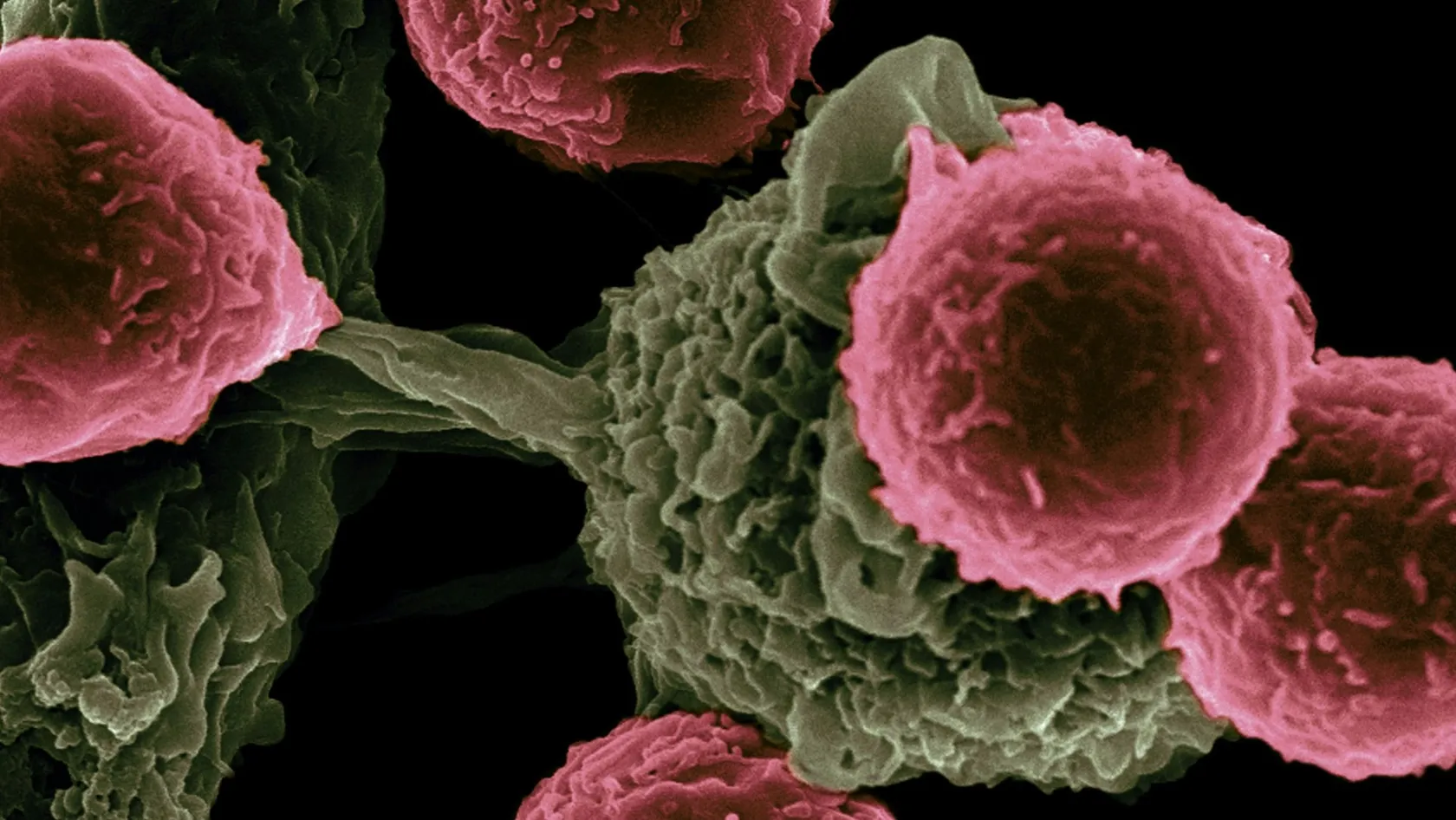
Bone Marrow Transplant For Leukemia
Bone marrow transplant for leukemia means four different things, because leukemia is four diseases sharing one word. This guide separates them, showing where transplant now sits in AML, ALL, CML and CLL, how targeted tablets and immune treatments removed the indication in two of them and narrowed it in a third, and what residual disease testing does to the decision. Written for families weighing treatment in Istanbul, with every figure sourced.
About This Department
Leukemia is four diseases wearing one word. Transplant means something different in each of them, and in two it has almost disappeared.
Chronic myeloid leukemia used to be the single commonest reason to transplant anybody anywhere in the world. A tablet took that away, and ten year survival on it reached 83 percent in the trial that introduced it. Chronic lymphocytic leukemia went the same way more recently. Acute lymphoblastic leukemia kept the indication but moved it, and now shares it with antibodies and engineered cells, and acute myeloid leukemia is where most transplants for leukemia now happen, and a new drug pair has started sending people there who could never have reached it before.
Four leukemias, four answers
Ask whether leukemia needs a bone marrow transplant and the only honest first response is to ask which leukemia, because the four main types have almost nothing in common beyond the name, and over the past twenty years their relationship with transplant has moved in four different directions. Four diseases. Four answers.
Narrow screens scroll this table sideways. Swipe or drag to reach every column.
| Leukemia | Where transplant sits now | What changed |
|---|---|---|
| Chronic myeloid, CML | Rare. Reserved for drug resistance, intolerance of several drugs, or advanced phase | Targeted tablets turned a fatal disease into a managed one |
| Acute myeloid, AML | The main indication. Offered in intermediate and adverse risk disease, and after relapse | Genomic risk grouping and residual disease testing decide who |
| Acute lymphoblastic, ALL | Narrower than it was, and still standard for higher risk adults and for residual disease that will not clear | Antibodies and engineered cells now clear disease that chemotherapy could not |
| Chronic lymphocytic, CLL | Uncommon. Mostly for disease that has failed both modern drug classes, or has transformed | Targeted inhibitors replaced chemotherapy and delayed transplant for years |
What a transplant actually is
Strip away the vocabulary and an allogeneic transplant is a swap. Your blood and immune system are removed and a donated one is put in its place. That is the whole idea.
The words in the letters
Leukemia correspondence runs on initials, and the initials arrive faster than anybody defines them.
A short glossary
AML stands for acute myeloid leukemia, ALL for acute lymphoblastic leukemia, CML for chronic myeloid and CLL for chronic lymphocytic. Allogeneic means the cells came from another person. Remission means the microscope no longer sees leukemia, which is a lower standard than it sounds. MRD means measurable residual disease, the leukemia a sensitive test finds when the microscope cannot. Conditioning means the chemotherapy given before the donor cells. Day zero names the day they go in. GVHD stands for graft versus host disease, the donated immune system attacking the patient. A tyrosine kinase inhibitor is the tablet that transformed CML. Blinatumomab describes an antibody that drags immune cells onto leukemia cells. And CAR T means the patient own T cells, collected, genetically modified to recognize leukemia, and given back. Two more appear constantly and are worth having in advance, so conditioning intensity describes how hard the pre transplant chemotherapy hits, with full intensity destroying the marrow outright and reduced intensity suppressing it and leaning on the donor immune system to finish the job. And chimerism describes what proportion of the blood cells circulating after a transplant belong to the donor, tested repeatedly through the first year, where a falling proportion often arrives weeks before a relapse does.
Chronic myeloid leukemia
CML tells the clearest story in cancer medicine, and it explains why this page has to be split by disease.
One abnormal gene fusion drives the whole illness, and once a drug existed that blocked the protein that fusion makes, the disease stopped behaving like a cancer and started behaving like a chronic condition managed with a daily tablet and a blood test every few months. Transplant, which had been the only cure and which killed a substantial minority of the people it was offered to, went from first line treatment to a reserve option inside five years.
In the trial that established the first of these tablets, patients newly diagnosed in chronic phase were followed for a median of 10.9 years. Estimated overall survival at ten years was 83.3 percent. Complete cytogenetic response, meaning the abnormal chromosome could no longer be found, occurred in 82.8 percent. Just under half the patients were still on the original drug at the end of the study, and serious events judged related to it were uncommon and concentrated in the first year of treatment.
On a phone this table slides left and right. Drag it across to see the last column.
| Before targeted tablets | Now | |
|---|---|---|
| Standard first treatment | Allogeneic transplant where a donor existed | A daily tablet |
| Who gets a transplant | Most newly diagnosed patients under about 55 | Patients failing several drugs, intolerant of them, or in advanced phase |
| What decides it | Whether a donor could be found | How the disease responds to drugs, measured by a blood test |
| Main long term worry | Chronic graft versus host disease | Drug side effects, adherence and cost of lifelong treatment |
When CML still needs one
Rare does not mean never, and the patients who still need a transplant for CML tend to be the ones whose disease stopped cooperating early.
The situations that still lead there
Failure of two or more of the tablets, particularly where a resistance mutation has been found that the remaining drugs do not cover, then genuine intolerance, meaning side effects severe enough that no available drug can be taken reliably, which matters because these drugs only work while they are being swallowed. Progression to accelerated phase or blast crisis, where the disease has changed character and behaves like an acute leukemia. And a small number of patients whose disease responds but never deeply enough, leaving a measurable level that predicts eventual progression. In all of those the conversation returns to donors and conditioning, and it returns with better transplant outcomes than the 1990s produced, because supportive care improved in every direction during the years the tablets were doing the work.
Acute myeloid leukemia
AML now accounts for most leukemia transplants, and it carries the hardest decision of the four.
Why it is different
No single drug controls AML the way a tablet controls CML, because AML is not one abnormality but dozens in shifting combinations, and chemotherapy puts most patients into remission and a large proportion relapse afterward, and the probability of that relapse varies enormously depending on the genetics found at diagnosis. The transplant question in AML is therefore a comparison. On one side sits the chance the leukemia returns after chemotherapy alone. On the other sits the chance the transplant itself kills somebody who might have stayed well. Where the first clearly exceeds the second, transplant is offered. Where it does not, offering one does harm, and the evidence for that is specific rather than theoretical.
Which AML, and why it matters
Every patient with AML is sorted into a risk group at diagnosis. That sorting decides almost everything that follows.
The three groups
Favorable risk covers a handful of specific genetic changes that respond very well to chemotherapy and relapse comparatively rarely, while adverse risk covers changes associated with early relapse, including certain chromosome losses and mutations in genes that govern how cells repair damage. Intermediate risk collects everything left over, and it forms the largest group and the one where opinions differ.
What moves a patient between groups
Sequencing has broken the old three way split into something finer, and a mutation that looks harmless alone can look dangerous in combination, and beyond genetics, the response to the first course of chemotherapy carries independent weight, and so does whether sensitive testing still finds disease once the microscope reports remission. A patient can start in the intermediate group and be treated as adverse because the residual disease test stayed positive, which is a good example of why the group assigned on day one should be revisited rather than carried forward unquestioned.
The practical rule most teams work to is that favorable risk AML in first remission does not get a transplant, adverse risk does where the patient can survive one, and intermediate risk is decided by the residual disease result and by what the patient is willing to accept. Anyone being offered a transplant for AML should be told which of those three situations they are in, in those words.
The pair that opened the door
For decades the patients who most needed a transplant for AML were often the ones least able to get into remission first, because standard chemotherapy is brutal and many older patients cannot survive it, until a trial of 431 previously untreated patients, median age 76, compared azacitidine with venetoclax against azacitidine with placebo. Median overall survival came out at 14.7 months against 9.6, with a hazard ratio for death of 0.66. Complete remission occurred in 36.7 percent against 17.9. Composite complete remission came out at 66.4 percent against 28.3. Febrile neutropenia of grade three or worse was commoner on the combination, at 42 percent against 19. The transplant relevance of that trial is indirect and important. A remission buys the entry ticket to an allogeneic transplant, and a gentler way of achieving one means that patients who would previously have been told they were too frail to be treated at all now sometimes arrive at the transplant conversation. Whether they should then have the transplant is a separate question answered by the same arithmetic as everybody else.
Acute lymphoblastic leukemia in adults
ALL in adults behaves worse than ALL in children, and the transplant question in adults was settled by a trial design that removed most of the usual bias.
The donor and no donor comparison
An international trial run across Britain and the United States assigned adults in first remission to transplant or to further treatment purely on whether a matched sibling existed, which approximates a randomization nobody could have performed deliberately. In patients without the Philadelphia chromosome, five year overall survival came out at 53 percent for those with a donor against 45 percent for those without, and relapse was significantly lower in the donor group. The benefit was clear in standard risk patients and disappeared in high risk ones. In that group the number of people dying from the transplant itself rose far enough to cancel out the reduction in relapse. A separate randomized comparison in the same trial found five year survival of 46 percent with chemotherapy against 37 percent with an autologous transplant, which ended the use of autologous transplant in adult ALL.
The test that outranks everything
One measurement in ALL predicts outcome more powerfully than the genetics, the age, the white count at diagnosis or the treatment protocol. Only one.
A meta analysis pooled 39 publications covering 13,637 patients to ask what clearing measurable residual disease is worth. For children the hazard ratio for event free survival in those who cleared it was 0.23. For adults it was 0.28. Overall survival hazard ratios were 0.28 in both groups. The effect held across every subgroup examined, across different testing methods, across different cutoff levels and across different times of measurement.
Those numbers run very large, and they explain why residual disease testing now drives the transplant decision in ALL more than anything else, since a patient whose test clears and stays clear has a good chance without a transplant. A patient whose test stays positive after the planned treatment has a poor chance without one, whatever the genetics said at diagnosis.
Ask for the result. Ask what method produced it and what the cutoff was. Then keep the paper.
Antibodies and engineered cells
Two treatments arrived in ALL within a few years of each other and both of them do something transplant used to be needed for, which is clearing disease that chemotherapy cannot.
Pull this table sideways on a small screen to reach all three of its columns.
| Antibody that redirects T cells | Engineered T cells | |
|---|---|---|
| What it is | A protein that binds a leukemia marker with one end and a T cell with the other | The patient own T cells, collected and modified to recognize the leukemia marker |
| Who was studied | 405 adults with relapsed or refractory disease, randomized 2 to 1 against chemotherapy | 75 children and young adults with relapsed or refractory disease at 25 centers |
| Main result | Median survival 7.7 months against 4.0, hazard ratio 0.71 | Remission within three months in 81 percent, all of them clearing residual disease |
| Remission rate | 34 percent with full count recovery against 16 percent | Event free survival 73 percent at six months and 50 percent at twelve |
| Main toxicity | Neurologic events and cytokine release, mostly manageable | Cytokine release in 77 percent and neurologic events in 40 percent |
| Relationship to transplant | 24 percent of each arm went on to transplant | Some patients go to transplant afterward and some are observed instead |
What this did to the decision
Neither treatment abolished transplant in ALL. What they did was change the order of the moves, so a patient with disease that refuses to clear can now be given one of these to clear it, and can then go to transplant from a much better starting position, which matters enormously because transplanting somebody whose leukemia is still active produces poor results. In some children the engineered cells have held the disease long enough that transplant was not performed at all, and whether that is a durable strategy or a postponement is a question the field is still arguing honestly. What no patient should accept is being told that one of these treatments makes transplant unnecessary as a general rule, because the evidence does not say that yet. The right question to put to a team proposing either of them is what happens next if it works, since the two plans that follow a good response are genuinely different and the choice between them should be made deliberately and explained.
Children with ALL
Childhood ALL supplies the result everybody reaches for whenever anybody wants to be cheerful about cancer, and the cure rate with chemotherapy alone runs high enough that most children never come near a transplant.
- Most children are cured by chemotherapy given over two to three years, and the transplant question never arises.
- Transplant is considered for the minority whose residual disease will not clear, whose leukemia carries particular high risk genetics, or who relapse early.
- Relapse after a long first remission is treated differently from relapse during treatment, and the two should never be described to a family in the same words.
- Engineered T cells now sit between chemotherapy and transplant for relapsed disease, and in some children they replace it.
- Growth, fertility, hormone function and schooling all have to be planned before conditioning starts, because conditioning affects every one of them and the conversation cannot be had afterward.
Chronic lymphocytic leukemia
CLL followed the CML pattern roughly fifteen years later, and the effect on transplant numbers has been similar.
What replaced chemotherapy
For years the standard first treatment was a three drug chemotherapy and antibody combination that worked well in patients with one genetic feature and badly in patients without it, until inhibitors that block the signals keeping the leukemic cells alive then arrived, taken as tablets, and the comparison was not close.
The trial that settled it
Five hundred and twenty nine previously untreated patients aged seventy or under were randomly assigned to an inhibitor with an antibody or to the old chemotherapy combination, and at a median follow up of 33.6 months, three year progression free survival was 89.4 percent against 72.9, with a hazard ratio of 0.35. Three year overall survival was 98.8 percent against 91.5, with a hazard ratio for death of 0.17. In the subgroup lacking the favorable genetic feature, where the old regimen had always performed worst, progression free survival was 90.7 percent against 62.5. Serious infections ran half as common on the newer treatment, at 10.5 percent against 20.3. The trial stopped early at a planned interim analysis because the difference had already crossed the threshold set for it, which is the strongest form of evidence a comparison of this kind can produce and the reason the result changed practice almost immediately.
When CLL still gets a transplant
Three situations keep the operation on the table.
The remaining indications
Disease that has progressed on both an inhibitor of the signaling pathway and an inhibitor of the survival protein, which leaves very little else with durable activity, then transformation into an aggressive lymphoma, which behaves like a different disease and is treated like one. And young patients with particularly hostile genetics whose disease keeps returning quickly despite good drugs, where a cure that carries early risk starts to look better than a series of temporary controls. In all three the decision is made with the same arithmetic used everywhere else on this page, and in all three the numbers are tighter than they are in acute leukemia, which is a reason to seek a second opinion instead of a reason to decide quickly. Tighter numbers also mean that reasonable specialists disagree more here than anywhere else in leukemia, and a family that hears two different recommendations has encountered a genuinely close call and not an error by one of the two doctors.
The pattern across all four
Step back from the four diseases and the same shape appears in each of them.
Where a drug controls the disease reliably, transplant retreats to the patients that drug fails. Where no drug controls it reliably, transplant stays, and the decision turns on how likely the leukemia is to return against how likely the transplant is to kill. In every one of the four, the measurement that moves the decision most is not the diagnosis but the depth of response, tested by methods far more sensitive than a microscope.
That explains why a page on transplant for leukemia spends so much of its length on drugs and on laboratory tests. The operation has not changed very much in twenty years, and everything around it has, and the effect has been to make the indication narrower, better targeted, and considerably more dependent on getting the diagnosis exactly right at the start.
When in the course it happens
Transplant sits at different points in the four diseases, and the point matters as much as the decision.
- In AML, usually in first remission for intermediate and adverse risk, and after a second remission has been achieved where the first attempt was chemotherapy alone.
- In adult ALL, in first remission for higher risk disease, and for residual disease that will not clear.
- In childhood ALL, usually after relapse or for residual disease that persists, and rarely in first remission.
- In CML, after failure or intolerance of several drugs, or immediately in advanced phase.
- In CLL, after both modern drug classes have failed, or after the disease has transformed into an aggressive lymphoma.
The published figures
Below sit the numbers quoted across this page, each with the group of patients it describes, so that anything a team tells you has something to sit next to.
This table scrolls sideways on a narrow screen. Slide it to reach the third column.
| What was measured | Reported figure | In whom |
|---|---|---|
| Ten year survival on a targeted tablet, CML | 83.3 percent | Newly diagnosed chronic phase, median follow up 10.9 years |
| Complete cytogenetic response, CML | 82.8 percent | Same trial |
| Five year survival with a matched sibling donor, adult ALL | 53 percent against 45 percent | Philadelphia negative adults in first remission, donor against no donor |
| Five year survival, chemotherapy against autologous transplant, adult ALL | 46 percent against 37 percent | Randomized comparison in the same trial |
| Event free survival for clearing residual disease, ALL | Hazard 0.23 in children and 0.28 in adults | 39 publications covering 13,637 patients |
| Median survival, redirecting antibody against chemotherapy, relapsed ALL | 7.7 months against 4.0 months | 405 adults randomized 2 to 1 |
| Remission within three months, engineered T cells, ALL | 81 percent | 75 children and young adults across 25 centers |
| Median survival, newer drug pair in untreated AML | 14.7 months against 9.6 months | 431 patients, median age 76 |
| Three year progression free survival, inhibitor against chemotherapy, CLL | 89.4 percent against 72.9 percent | 529 previously untreated patients aged 70 or under |
How to read a table like that
- Every figure describes a group. None of them predicts what happens to one person, and a team quoting a single percentage without naming the group it came from is overselling what the field can do.
- Numbers from different studies cannot be lined up against each other. The populations differ, the eras differ, the supportive care differs and the definitions of remission have moved more than once.
- A hazard ratio is a comparison and not a probability. A ratio of 0.28 means the risk was roughly a quarter of the comparison group, and says nothing on its own about the absolute chance.
- Older trials understate what modern transplant achieves, because everything around the procedure improved while the trials were running.
The figure that is missing
Nothing on this page tells you the risk of dying from a transplant, because that figure belongs to the individual patient and not to the disease, since it is built from age, organ function, the donor available and the intensity of conditioning planned, and in published series it ranges from under one in ten to better than one in three. Any unit proposing a transplant should give you that estimate as a range, with the score behind it, before anybody signs anything.
What to ask before agreeing
Anybody who knows their own practice can answer these six questions in a sentence each, and the answers tell you more than any brochure.
Write the answers down as you get them. You will be asked to repeat them to three different people. Probably more.
Deciding this from another country
Leukemia moves faster than paperwork, which is the central difficulty of arranging treatment abroad for it.
What travel adds and what it buys
Time costs most. Reports have to be translated, a visa obtained and flights booked, and in an acute leukemia being held in remission by treatment, weeks are not neutral, and continuity is the second cost, since a patient transplanted in one country and followed in another depends on a handover that has to be written properly or it does not happen. Money comes third, and it belongs in the open. What drives the cost of a transplant for leukemia is the donor type and search, the conditioning regimen, how long the inpatient stay runs, whether complications need intensive care, how much of the outpatient period is spent here and how long a companion stays. Against those sits the reason people travel, which is reaching a unit that performs the operation often enough to be good at it, and one that can transplant from a half matched relative when the international registries return nothing usable. That capability is not universal.
What we arrange
A transplant works as a relocation and not a trip, and the scaffolding around it decides whether a family reaches the end of it intact.
How long you are actually here
The ward stay runs three to five weeks, which comes to somewhere between twenty and thirty five nights. After discharge the clinic wants you back two or three times a week until roughly day one hundred, so a further ninety nights in an apartment or hotel nearby is the realistic figure to budget for. Nobody signs off a flight home on a calendar date. It gets signed off on blood counts, on whether graft versus host disease is active and on how much immunosuppression is still running, and in practice that lands past the third month.
What we will not claim
Hospital pages on leukemia promise things. Here follows what we will not.
We will not quote a survival figure before we have read the marrow report, the genetics and any residual disease result, because a number produced without those describes somebody else, and we will not tell you that transplant is the answer for a leukemia where the published evidence says a drug is. A remission achieved by an antibody or by engineered cells will not be presented to you here as proof that transplant has become unnecessary, because the field has not established that. We will not quote our own results as a single percentage without saying which patients produced it. And we will not describe the procedure as safe, since the published risk of dying from it rather than from the leukemia runs from under one in ten to better than one in three depending entirely on who is being transplanted. If a unit has given you a clean figure with no range attached, ask which patients it came from.
Questions we are asked, a leukemia transplant FAQ
Does every leukemia patient need a bone marrow transplant
Far from it. Most people with chronic myeloid leukemia now take a tablet and never come near one, most children with acute lymphoblastic leukemia are cured by chemotherapy, and most people with chronic lymphocytic leukemia are managed with targeted drugs, and transplant concentrates in acute myeloid leukemia and in higher risk acute lymphoblastic leukemia.
Which leukemia has the strongest transplant indication
Acute myeloid leukemia with intermediate or adverse risk genetics, and acute lymphoblastic leukemia in adults whose residual disease will not clear, and in both, the chance of the leukemia returning without a transplant is high enough to outweigh the risk of the procedure in patients fit to survive it.
Is it true that a tablet replaced transplant in CML
For most patients, yes. In the trial that introduced the first of those tablets, ten year survival reached 83.3 percent and complete cytogenetic response 82.8 percent, with follow up running almost eleven years, and transplant is now reserved for patients who fail or cannot tolerate several drugs, or whose disease has entered an advanced phase.
What is measurable residual disease and why does everyone keep mentioning it
Leukemia that a sensitive test finds when a microscope reports remission, and in acute lymphoblastic leukemia, a pooled analysis of 13,637 patients found that clearing it carried a hazard ratio of 0.23 for event free survival in children and 0.28 in adults. It moves the transplant decision more than almost anything measured at diagnosis.
Do CAR T cells mean my child can avoid a transplant
Sometimes, and nobody can promise it, because in the study that led to approval, 81 percent of 75 children and young adults with relapsed or refractory disease reached remission within three months, with event free survival of 50 percent at twelve months. Some children go on to transplant afterward and some are observed. That choice is made case by case and should be explained as an open question rather than a settled one.
How risky is the transplant itself
That depends on the patient and not on the leukemia, and published non relapse mortality across modern series runs from under one in ten to better than one in three, driven by age, organ function, donor type and the intensity of conditioning. Ask for your own estimate as a range, and ask which score produced it.
My relative had a transplant twenty years ago and it was terrible. Is it the same now
No. The operation stays broadly similar and everything around it has changed, including how donors are matched, how graft versus host disease is prevented, how infections are monitored and how patients are selected, and outcomes from the 1990s understate what a modern unit achieves, which is one reason older family experience is a poor guide to a current decision.
Can I get an opinion without traveling to Istanbul
Yes, and it costs nothing. Send the marrow report, the genetics or sequencing panel, any residual disease result, the treatment given so far and any donor typing already done, and you receive a written opinion, and where it agrees with the plan you already have, it says so.
How long would I need to stay
Twenty to thirty five nights as an inpatient, then around ninety more nights near the hospital while clinic visits run two or three times a week, and flying home is judged on blood counts, on whether graft versus host disease is active and on remaining immunosuppression, which usually puts it past three months.
References
- Hochhaus A, Larson RA, Guilhot F, et al. Long term outcomes of imatinib treatment for chronic myeloid leukemia. N Engl J Med. 2017;376(10):917-927.
- Goldstone AH, Richards SM, Lazarus HM, et al. In adults with standard risk acute lymphoblastic leukemia the greatest benefit is achieved from a matched sibling allogeneic transplantation in first complete remission, final results of the International ALL Trial MRC UKALL XII and ECOG E2993. Blood. 2008;111(4):1827-1833.
- Berry DA, Zhou S, Higley H, et al. Association of minimal residual disease with clinical outcome in pediatric and adult acute lymphoblastic leukemia, a meta analysis. JAMA Oncol. 2017;3(7):e170580.
- Kantarjian H, Stein A, Gökbuget N, et al. Blinatumomab versus chemotherapy for advanced acute lymphoblastic leukemia. N Engl J Med. 2017;376(9):836-847.
- Maude SL, Laetsch TW, Buechner J, et al. Tisagenlecleucel in children and young adults with B cell lymphoblastic leukemia. N Engl J Med. 2018;378(5):439-448.
- DiNardo CD, Jonas BA, Pullarkat V, et al. Azacitidine and venetoclax in previously untreated acute myeloid leukemia. N Engl J Med. 2020;383(7):617-629.
- Shanafelt TD, Wang XV, Kay NE, et al. Ibrutinib and rituximab or chemoimmunotherapy for chronic lymphocytic leukemia. N Engl J Med. 2019;381(5):432-443.
Editor's note
Written by the Biruni Hospital medical editorial team. Reviewed by Gökhan Özgür, Internal Medicine (Hematology).
Medically reviewed by

Gökhan Özgür
Internal Medicine (Hematology)
Related Treatments
View All
Allogeneic Bone Marrow Transplant
An allogeneic bone marrow transplant is judged against the alternative and never on its own merits. This guide sets out the two estimates that decide it, the chance the disease returns without a transplant and the chance the transplant itself kills, then shows what moves each one, from genomic classification and residual disease testing to the Disease Risk Index, the comorbidity score, donor type and age. Written for families weighing treatment in Istanbul, with every figure sourced.
Autologous Bone Marrow Transplant
An autologous bone marrow transplant collects your own stem cells, freezes them, and returns them after a chemotherapy dose the marrow could not otherwise survive. No donor, no matching, no rejection. This guide covers myeloma, where two randomized trials found it delays the disease without measurably extending life, plus lymphoma, germ cell tumors, multiple sclerosis and scleroderma, and what the collection, the dose and the recovery involve. Written for families weighing treatment here.

Autologous Stem Cell Transplant
An autologous stem cell transplant, still widely called an autologous bone marrow transplant, collects your own stem cells, freezes them, and returns them after a chemotherapy dose the marrow could not otherwise survive. No donor, no matching, no rejection. This guide covers myeloma, where two randomized trials found it delays the disease without measurably extending life, plus lymphoma, germ cell tumors, multiple sclerosis and scleroderma, and what the collection and the recovery involve.
Bone Marrow Transplant - Allogeneic Stem Cell Transplant
A bone marrow transplant, or allogeneic stem cell transplant, replaces a diseased blood and immune system with a donor's. This guide covers who it is for, how donors are found and chosen, why a young half matched relative can now beat an older fully matched stranger, what conditioning intensity decides, graft versus host disease in both forms, and the late risks that keep climbing after year ten. Written for families weighing treatment in Istanbul, with the published figures behind each claim.
Bone Marrow Transplant For Aplastic Anemia
A bone marrow transplant for aplastic anemia replaces failed blood-forming stem cells with healthy donor marrow and cures most younger patients who have a matched sibling. In a study of 599 children, failure-free survival was 87 percent after sibling transplant and 56 percent after drug treatment first. This page explains severity grades, transplant versus immune suppression, registry results, how this transplant differs, risks, the donor's part and planning at Biruni Hospital.