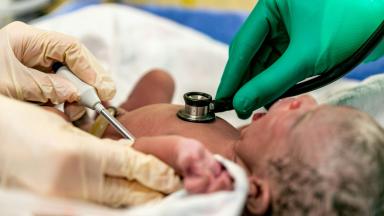
Tonsillectomy in children removes the tonsils, often with the adenoids, when enlarged tonsils cause sleep apnea or when throat infections keep returning. In a randomized trial, sleep studies normalized in 79 percent of children after surgery against 46 percent with waiting. At Biruni Hospital in Istanbul, our pediatric ENT surgeons and anesthetists plan surgery, pain relief and a recovery stay close to the hospital through the bleeding window.
About This Department
Pediatric ENT
Large tonsils can block a child's breathing at night, and repeated throat infections can take weeks from school. Removing them helps when the reasons are clear.
Tonsillectomy in children, tonsil removal, takes out the two tonsils at the back of the throat, often together with the adenoids behind the nose. The two main reasons are obstructive sleep apnea, where enlarged tonsils narrow the airway during sleep, and frequent, documented throat infections. In a randomized trial of 464 children aged five to nine with sleep apnea, sleep studies returned to normal in 79 percent after adenotonsillectomy, against 46 percent with watchful waiting, and behavior, quality of life and symptoms improved more with surgery (Marcus and colleagues, New England Journal of Medicine, 2013). Bleeding after discharge, the main serious risk, occurred in 3.6 percent with conventional techniques in a Cochrane review, peaking five to ten days after surgery (Pynnonen and colleagues, 2017). This page explains when surgery helps, sleep studies, infection criteria, techniques, preparation, risks and bleeding, pain relief, the day of surgery, recovery, and how families from abroad arrange tonsillectomy at Biruni Hospital in Istanbul.
79
Percent of children whose sleep study normalized after surgery, against 46 percent with watchful waiting
464
Children aged five to nine in the randomized sleep apnea trial
3.6
Percent bleeding after discharge with conventional tonsillectomy in a Cochrane review
Free
Review of your child's history by our pediatric ENT team
The tonsils are two pads of lymph tissue on either side of the throat, and the adenoids sit higher, behind the nose. Both grow most between ages two and seven and then shrink, which is one reason many younger children with mild symptoms improve as they get older.
Removing tonsils and adenoids does not weaken a child's immunity in any measurable way. Many other lymph tissues in the throat and body continue the work.
Tonsillectomy and adenoidectomy
When sleep apnea is the reason, surgeons remove both tonsils and adenoids, adenotonsillectomy. For repeated tonsillitis alone, the tonsils may be removed without the adenoids.
Reasons for surgery
Main indications
Reasons for tonsillectomy in children
Reason
What it looks like
Note
Obstructive sleep apnea
Loud snoring, pauses in breathing, restless sleep
Most common reason today
Repeated tonsillitis
Frequent documented sore throats with fever
Criteria apply
Peritonsillar abscess
Pus beside the tonsil, difficulty opening the mouth
After one or two episodes
PFAPA syndrome
Regular fevers with mouth ulcers and sore throat
Surgery often curative
Asymmetric or suspicious tonsil
One tonsil much larger
Rare, needs examination
Large tonsils that cause no breathing problem and no infections do not need removal. Size alone decides nothing.
Will my child get fewer colds after tonsillectomy?
Colds, coughs and ear infections come from viruses that affect the whole airway and continue after tonsillectomy. The operation reduces sore throats from tonsillitis and breathing problems during sleep, which are the reasons we offer it.
Sleep apnea
In obstructive sleep apnea, enlarged tonsils and adenoids narrow the throat during sleep. Breathing stops and restarts many times a night, sleep fragments and oxygen may drop.
Randomized trial of early adenotonsillectomy, 464 children aged 5 to 9
Outcome
Early surgery
Watchful waiting
Sleep study normalized at seven months
79 percent
46 percent
Attention and executive function
No significant difference
No significant difference
Behavior, quality of life, symptoms
Greater improvement
Smaller improvement
Surgery did not change attention test scores, but it improved behavior, quality of life, symptoms and sleep study results (Marcus and colleagues, 2013).
1
Waiting can work too
Almost half the children in the watchful waiting group improved on their own over seven months, which is why mild cases can be watched with nasal steroid sprays.
Sleep studies
Sleep study severity in children
Severity
Apnea-hypopnea index
Usual approach
Mild
1 to 5 events per hour
Watchful waiting or nasal sprays
Moderate
5 to 10 per hour
Surgery usually advised
Severe
Over 10 per hour
Surgery, overnight monitoring
Snoring can matter
Occasional snoring with a cold harms no one.
Loud snoring most nights, especially with pauses, gasping, mouth breathing, restless sleep, bedwetting, morning headaches, daytime tiredness or difficulty concentrating at school, deserves an assessment, because poor sleep over months affects a child's mood, attention and growth, and parents who record a short video of their child sleeping give the doctor some of the most useful information available.
A phone video helps.
Repeated throat infections
Counting infections
Seven or more documented episodes in the past year.
Five a year for two years.
Three or more a year in each of the past three years.
What counts as an episode
Feature
Example
Why
Sore throat with fever
Above 38.3 degrees
Distinguishes from colds
Swollen neck glands or tonsil pus
Seen by a doctor
Documented
Positive strep test
Throat swab
Bacterial infection
Antibiotic treatment
Recorded
Severity
1
Watchful waiting
Children with fewer episodes improve over time in many cases, and a period of recording episodes often comes before surgery.
Peritonsillar abscess
An abscess beside the tonsil needs drainage and antibiotics. After a second abscess, tonsillectomy is usually advised.
Surgical techniques
All techniques remove the tonsils through the open mouth, with no external cuts. Surgeons choose the method they use most safely.
Tonsillectomy techniques
Technique
How it works
Note
Cold steel dissection
Scissors and dissector, ties or light cautery
Long track record
Bipolar or monopolar diathermy
Heat cuts and seals vessels
Less bleeding during surgery
Coblation
Radiofrequency at lower temperature
Slightly less pain on day one
Intracapsular, partial
Most of the tonsil removed, capsule left
Less late pain, small regrowth risk
What the evidence shows
Is coblation better than other techniques?
A Cochrane review of 29 trials found slightly less pain on the first day with coblation, little or no difference by day seven, similar bleeding in the first 24 hours and a possibly higher rate of later bleeding, 5 percent against 3.6 percent, with low-quality evidence (Pynnonen and colleagues, Cochrane Database of Systematic Reviews, 2017). Surgeon experience matters more than the device.
Partial tonsillectomy
Removing the tonsil inside its capsule caused less pain in the later days of recovery in a meta-analysis of children (Daskalakis and colleagues, European Archives of Oto-Rhino-Laryngology, 2021).
Assessment before surgery
1
Bleeding history
We ask about nosebleeds, heavy bleeding after cuts or dental work, and family bleeding disorders. A positive history leads to blood tests before surgery.
Children with severe sleep apnea, obesity, Down syndrome, heart or lung conditions or very young age stay overnight for monitoring.
2
Timing
Surgery is planned at least two to three weeks after a throat infection or cold has settled.
Checks before tonsillectomy
Check
Who needs it
Why
Examination and history
All children
Confirm the indication
Sleep study
Uncertain or severe sleep apnea
Grade severity
Blood count and clotting
Bleeding history
Reduce bleeding risk
Heart assessment
Severe sleep apnea
Pressure in lung vessels
Medicines
Stop aspirin and herbal supplements before surgery as advised.
Risks
Sore throat and ear ache for seven to ten days.
Bad breath and white patches in the throat while it heals.
Temporary change in voice.
Complications after tonsillectomy
Complication
When
Management
Bleeding within 24 hours
In hospital
Observation, sometimes return to theater
Bleeding after discharge
Days 5 to 10 most often
Emergency review, sometimes cautery
Dehydration
First week
Fluids, sometimes a drip
Breathing problems after surgery
First night, severe sleep apnea
Overnight monitoring
Regrowth after partial removal
Months to years
Rarely needs further surgery
Serious complications are rare. Bleeding is the one to know about.
Bleeding after tonsillectomy
1
Why it happens
The white healing layer over the tonsil beds separates around days five to ten, and small vessels underneath can bleed.
Most bleeds are small and stop by themselves, but any bleeding needs review, and a few children need a short operation under anesthesia to seal the vessel.
What should we do if my child bleeds after tonsillectomy?
Sit your child up, lean them forward and ask them to spit out blood rather than swallow it. Go straight to the nearest emergency department or call an ambulance if bleeding is more than a few streaks. Bring your discharge letter. Even a small bleed should be checked the same day, since it can be followed by a larger one.
The second week
Many parents expect recovery to get steadily better. It does not always.
Pain rises again in many children around days four to seven as the healing layer separates, and that is also when bleeding is most likely, so children stay close to a hospital, avoid rough play and keep drinking even when the throat hurts.
By two weeks most are back to normal.
Pain relief
1
Regular doses
Paracetamol and ibuprofen given on a regular schedule for the first week control pain better than doses given only when the child complains.
Pain relief after tonsillectomy
Medicine
Use
Note
Paracetamol
Regular, by weight
Foundation of pain relief
Ibuprofen
Regular, by weight
Safe for most children after tonsillectomy
Codeine
Not used
Dangerous in some children
Ice cream, cold drinks
Comfort
Encourage drinking
Codeine is not given to children after tonsillectomy, since some children convert it into morphine very quickly, with dangerous breathing problems.
Anti-inflammatory medicines during surgery reduce pain and vomiting. A meta-analysis of 11,729 children found that a lower dose of ketorolac controlled pain without the extra early bleeding seen with higher doses (Kim and colleagues, Otolaryngology Head and Neck Surgery, 2025).
The day of surgery
A typical day
Step
Timing
Note
Fasting
Solids six hours, clear fluids one hour
Standard rules for children
Anesthesia
Parent present at induction
Gas or drip
Surgery
30 to 45 minutes
Through the mouth
Recovery
Several hours
Drinking before discharge
Discharge
Same evening or next morning
Overnight for sleep apnea and young children
Children go home only when they are drinking well, comfortable and showing no bleeding.
A parent stays with the child at induction and through recovery.
1
Overnight stay
Children under three, those with severe sleep apnea or other conditions stay overnight with oxygen monitoring.
Recovery at home
Plan ten to fourteen days away from school or nursery. Soft and normal foods are both fine, and eating helps healing.
1
Activity
Quiet play at home in the first week, no swimming, sports or travel far from a hospital for two weeks.
White or yellow patches in the throat show normal healing.
Ear ache is common and comes from nerves shared between throat and ear. It fades as the throat heals.
Food and drink first
Drinking matters most.
A child who drinks too little becomes dehydrated, feels more pain and may bleed more, so cold water, diluted juice and ice lollies count.
Offer drinks every hour.
For families from abroad
1
Length of stay
Plan for ten to fourteen days in Istanbul. Bleeding risk peaks five to ten days after surgery, and we prefer children to stay near the hospital through that window. Fitness to fly is confirmed at a check before departure.
What to send
A record of throat infections with dates, any sleep study, a short video of your child sleeping, bleeding history and other health conditions. After you return home, follow-up continues by video at two weeks and three months.
A typical stay
Day
Step
Note
Day 1
Consultation and checks
Plan agreed
Day 2
Surgery
Same day or overnight
Days 3 to 10
Recovery near the hospital
Check visit on day 7
Day 10 to 14
Final check
Cleared for travel
One coordinator from the international patients office handles arrangements from the first message through discharge and answers the same WhatsApp number after you return. The office works in English, Arabic, French, Russian, Serbian, Romanian and Spanish and books interpreters for other languages, and it arranges the visa invitation letter, airport transfers, daily transport and accommodation near the hospital. Halal, vegetarian and diabetic meals, a prayer room on site, and a female physician on request wherever the rota allows.
Cost
The price depends on tonsils alone or with adenoids, the technique, any sleep study and an overnight stay.
We quote after reviewing your child's history, before you travel.
What a quote for pediatric tonsillectomy covers
Item
Included
Priced separately
Surgery
ENT surgeon, pediatric anesthetist, operating room
Ear tubes if added
Hospital
Day case or one night
Extra nights, readmission
Aftercare
Medicines, check visit, video follow-up
Sleep study
Compare quotes for the same procedure and ask about overnight monitoring and the plan if bleeding occurs after discharge.
References
Marcus CL, Moore RH, Rosen CL, et al. A randomized trial of adenotonsillectomy for childhood sleep apnea. N Engl J Med. 2013;368(25):2366-2376.
Pynnonen M, Brinkmeier JV, Thorne MC, Chong LY, Burton MJ. Coblation versus other surgical techniques for tonsillectomy. Cochrane Database Syst Rev. 2017, issue 8, CD004619.
Daskalakis D, Tsetsos N, Karagergou S, Goudakos J, Markou K, Karkos P. Intracapsular coblation tonsillectomy versus extracapsular coblation tonsillectomy. A systematic review and a meta-analysis. Eur Arch Otorhinolaryngol. 2021;278(3):637-644.
Kim DH, Jang DW, Hwang SH. Dose-related effects and bleeding risk of ketorolac in pediatric tonsillectomy. Otolaryngol Head Neck Surg. 2025;172(3):821-832.
Editor's note
Written by the Biruni Hospital medical editorial team. Reviewed by Assoc. Dr. Hasret AYYILDIZ CİVAN, Pediatric Gastroenterology.