
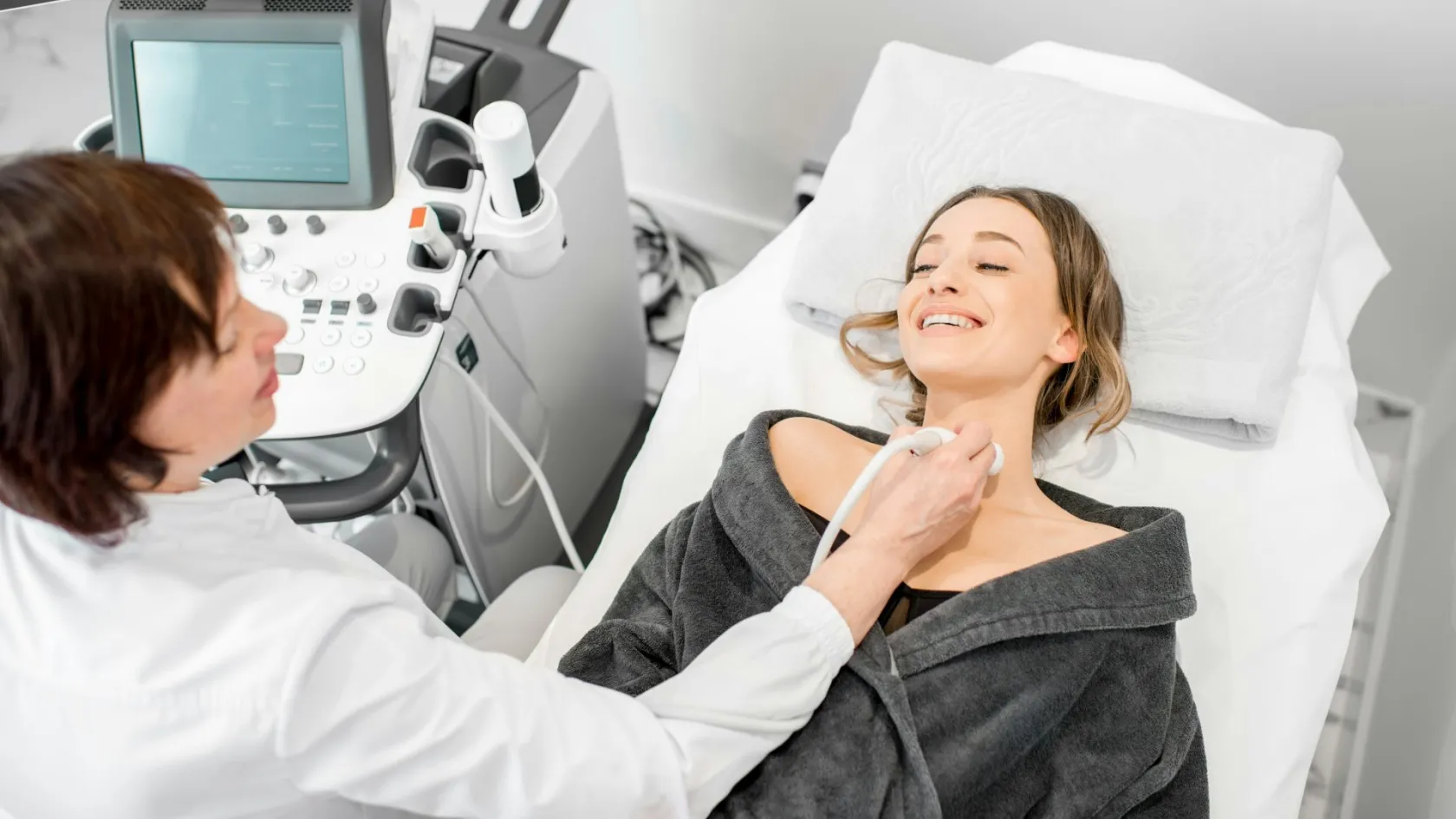
Thyroidectomy - Thyroid Removal Surgery
Researchers estimate that more than three quarters of thyroid cancers diagnosed across 63 countries would never have caused harm. The operation is safe. The questions worth asking are whether you need it, and whether half the gland would do.
About This Department
Across 63 countries, researchers estimated that 1,736,133 of 2,297,057 thyroid cancers diagnosed between 2013 and 2017 were overdiagnosed, meaning they would never have caused a symptom or a death. That is more than three quarters. Thyroid surgery is safe and it is frequently the right answer, and the first question worth asking is not how the operation goes but whether you need it at all, and if so how much of the gland has to come out.
Free consultation
Ask whether the whole gland has to go, and whether it has to go now
Both questions have real answers and both change what the rest of your life looks like. Send the neck ultrasound report with the nodule sizes and their risk scores, the needle biopsy result with its category, your thyroid blood tests including TSH and antibodies, any CT or scan of the neck, and your medication list. A surgeon and an endocrinologist review the file and tell you whether an operation is indicated, whether half the gland would do, and what watching instead would involve. No fee, no obligation, and a coordinator replies in your own language.
Three reasons a thyroid comes out
Every thyroid operation belongs to one of three situations, and they have almost nothing in common except the incision.
- Cancer, or a nodule that might be one. The commonest reason and the one this page spends most of its time on, because it is also the one where the decision is least obvious. Most thyroid cancers grow slowly, most are cured, and a large share of the ones being found today would never have troubled anybody.
- A gland that has grown too big. A large goiter pressing on the windpipe or the gullet, or one growing down behind the breastbone. The case here is mechanical. Something is in the way. Removing it fixes the problem.
- An overactive gland. An overactive thyroid that has not settled on tablets or radioiodine, most often from Graves disease or a hot nodule. Surgery is one of three competing treatments here. The choice turns on your eyes, your plans for pregnancy and what you have already tried.
Establish which of the three applies to you before reading any further, because the rest of this page weighs a decision that only the first group has to make. A patient whose windpipe is being squeezed does not need persuading that the operation is worthwhile, and neither does somebody whose overactive gland has defeated two rounds of tablets. The argument that follows is for the person holding a biopsy report and a choice.
The overdiagnosis problem
Countries where diagnoses climbed most steeply are the ones that screened hardest, many of them offering neck ultrasound to people with no symptoms at all. Several of them, including South Korea, the United States, Canada and parts of Western Europe, have since seen the numbers turn downward as that practice was reconsidered.
How a nodule is worked up
Arrive with all five done and you can have a real conversation on the first day. A patient arriving with a scan and a diagnosis but no biopsy category is not, and the first thing that will happen is the work above.
What the biopsy says
Needle biopsies are reported in six categories. Three of them cover almost every patient reading this, so find yours on the report and read only that paragraph, because the three lead to completely different conversations.
Benign
Much the commonest result, and it means no operation is needed on grounds of cancer at all. A benign nodule still comes out if it is large enough to press on something or if it keeps growing, and otherwise it is simply followed with a repeat scan at an interval somebody sets for you. Patients are surprised to be sent away with a lump still in their neck, and being sent away is the correct treatment.
Indeterminate
Cells were found that could belong to a harmless growth or to a cancer, and telling the two apart needs the whole nodule under a microscope. Overtreatment lives here. The traditional answer was to remove the lobe to find out, and a majority of those turn out benign. Ask whether a molecular test on the same sample could settle it without surgery, and ask what the unit's own rate of cancer is in this category.
Malignant
Cancer, confirmed. In the great majority of cases that means papillary thyroid cancer. This is the diagnosis that sounds worst and behaves best. The conversation that follows is about how much gland to remove, and whether an operation is needed at all yet. The next two sections are written for you.
Two other categories exist as well. A non-diagnostic result means too few cells were collected, so the needle is repeated. A suspicious result sits next to malignant and is treated as though it were.
Watching a small cancer
For a papillary cancer of about a centimeter or less, sitting inside the gland, away from the windpipe and the nerve, with no involved lymph nodes, an established alternative exists. It is called active surveillance and it means scanning at intervals and operating only if something changes. An American center followed 291 such patients with tumors up to a centimeter and a half. Growth of three millimeters or more occurred in 11 of them, which is 3.8 percent, with a cumulative incidence of 2.5 percent at two years and 12.1 percent at five, and no patient developed spread to lymph nodes or beyond during the whole period of surveillance. Where tumors did grow, the median doubling time was a little over two years, which is a pace that leaves plenty of room to act. A Japanese hospital that pioneered the approach reports ten-year figures from a much longer program, in which about 8.0 percent of nodules enlarged by three millimeters or more over that decade and 3.8 percent developed new lymph node involvement. Nobody in the program has developed distant spread or died of thyroid cancer, whether they stayed under surveillance or went on to surgery. The clearest comparison came from the same hospital, which followed 2,153 patients with low-risk microcarcinoma, of whom 1,179 chose surveillance and 974 chose immediate surgery. Nobody in either group developed distant spread. Nobody died of the disease. What differed was the price. Transient hoarseness occurred in 4.1 percent of the operated group against 0.6 percent of those watched, temporary low calcium in 16.7 percent against 2.8 percent, and permanent low calcium in 1.6 percent against 0.08 percent. Two operated patients were left with permanent hoarseness. And 66.1 percent of the operated group ended up on a thyroid hormone tablet against 20.7 percent of those watched.
Surveillance is not for everybody. It is also not nothing. It suits an older patient with a tiny tumor in a safe position, and it suits somebody who can be relied on to attend a scan at whatever interval they are given, year after year. It is a poorer fit for a young patient, since these tumors progress more readily in the young, and for anybody who will lie awake knowing it is there. That last consideration is a legitimate reason to operate and it should be said out loud rather than dressed up as a medical indication.
Half the gland or all of it
Extent is the decision with the most consequences, and it used to have a standard answer. For decades a diagnosis of papillary cancer meant the whole thyroid came out. That changed when somebody looked at what the extra half was buying. A study of 61,775 patients with papillary cancer compared removing the whole gland against removing one lobe, followed for a median of nearly seven years. For tumors between one and four centimeters, survival was the same, with a hazard ratio of 0.96 and a confidence interval running from 0.84 to 1.09, and splitting by size made no difference to that conclusion whether the tumor was one to two centimeters or two to four. A systematic review of thirteen studies reached the same place, with one important addition that most summaries leave out. Survival is equivalent, and four of six studies that looked at recurrence found a small statistically significant advantage for taking the whole gland, with the reviewers noting that whether that difference is clinically meaningful is argued over. Anybody telling you the two operations are identical has read half of that literature.
One caution belongs with the survival figure. The patients who had the whole gland removed had worse disease to begin with, with more involved nodes and more spread outside the thyroid, so the comparison is not a fair fight and the statistics correct for that imperfectly. What the data support is that lobectomy is a legitimate option for a low-risk cancer of the right size, and what they do not support is the claim that it is the right answer for everybody.
When total is the answer
Ask which of those five applies to you. Write the answer down. If none of them does and you are still being offered a total thyroidectomy for a small papillary cancer, ask why, and expect a specific answer about your case rather than a general statement about being thorough.
The honest summary
Everything above points the same way, and it is not the direction a patient expects when the word cancer has been used about them.
The great majority of thyroid cancers do not threaten the person who has one. The operation that treats them is safe. The two decisions that carry real weight are whether to operate at all on a very small tumor, and whether to take half the gland or all of it, and both of those belong to you as much as to the surgeon.
None of this argues against surgery. It is an argument for a conversation that names the alternatives, because a total thyroidectomy commits you to a daily tablet for the rest of your life and carries a small permanent risk to your voice and your calcium, while a lobectomy commits about a quarter of patients to that tablet and carries roughly half the complication rate.
Any hospital that offers all three options, including the option of doing nothing yet, is giving you the actual state of the evidence. That is the standard to hold a unit to, including this one, and it is a fair thing to ask about in the first email rather than in the consulting room, where it is much harder to say no to a plan somebody has already drawn up for you.
Complications by the numbers
Two structures sit against the back of the thyroid, and both of them can be injured during an operation to remove it. The nerve to the voice box runs up behind the gland on each side, and the four parathyroid glands controlling calcium are the size of grains of rice stuck to its back surface, close enough that they can be bruised, robbed of their blood supply or removed along with the gland without anybody intending it. Every figure below is about those two structures and nothing else.
This table scrolls sideways on a narrow screen. Swipe or drag to see every column.
| Complication | Rate | What it means |
|---|---|---|
| Voice nerve affected on one side | 3.9 percent immediately. | A hoarse or weak voice, sometimes with coughing on drinks. Most of it recovers. |
| Voice nerve still affected at six months | 0.97 percent. | About one patient in a hundred is left with a permanently changed voice, which matters enormously to singers, teachers and anybody who speaks for a living. |
| Both nerves affected | 0.2 percent. | Rare, and serious. Both cords sitting still narrows the airway. It is a risk of operating on both sides and it does not exist in a lobectomy at all. |
| Low calcium needing treatment, after surgery on both sides | 9.9 percent at the first check. | Tingling in the fingers and around the mouth, treated with calcium and vitamin D tablets. This figure was measured only in the 1,648 audit patients who had surgery on both sides of the neck. |
| Still on that treatment at six months | 4.4 percent. | The audit's authors called this figure a cause for concern, and it is the single strongest argument for leaving half a gland where the disease allows it. |
| Bleeding needing a return to theater | 2.1 percent. | Usually within hours. That is why you are watched overnight, and why a swelling neck is acted on immediately rather than observed. |
Read all of that alongside one comparison from the surveillance study earlier, in which patients with tiny cancers who had immediate surgery had permanent low calcium in 1.6 percent against 0.08 percent of those watched. That is a twentyfold difference in a group where the cancer was never going to hurt most of them.
Who should operate
Thyroid surgery is one of the clearest examples in medicine of a procedure where who does it changes what happens to you. The numbers are startling.
- Most thyroid surgery is done by people who rarely do it. Among 16,954 total thyroidectomies, the median surgeon performed seven a year and 51 percent of surgeons performed one. Eighty-one percent of patients were operated on by somebody doing twenty-five or fewer a year.
- Complications fall steadily with experience. The risk kept dropping as annual volume rose, all the way up to twenty-six cases a year, and below that threshold patients carried half again the odds of a complication and stayed in hospital longer.
- That gradient is steep at the bottom. Compared with a high-volume surgeon, the odds of a complication rose by 87 percent for a surgeon doing one case a year, 68 percent for two to five, 42 percent for six to ten, 22 percent for eleven to fifteen, 10 percent for sixteen to twenty and 3 percent for twenty-one to twenty-five.
- Other countries set the bar higher. A United Kingdom registry analysis found permanent low calcium and nerve palsy rates falling in surgeons doing more than fifty a year, and its authors suggested fifty as a minimum while acknowledging their data had gaps. No single threshold is agreed internationally.
- Two questions settle it. How many thyroid operations did you personally perform last year, and what are your own rates of permanent hoarseness and permanent low calcium. A surgeon who does this work regularly answers both without pausing, and one who cannot answer either has told you something as well.
This is the single most useful paragraph on the page for anybody choosing where to be treated, and it applies as much to a hospital in your own country as to one abroad.
Life afterwards
What changes permanently depends entirely on how much gland was taken, and this is the point at which the two operations stop resembling each other in any way that matters to the person having one.
This table scrolls sideways on a narrow screen. Swipe or drag to see every column.
| Afterwards | Half the gland removed | Whole gland removed |
|---|---|---|
| Thyroid hormone tablet | About 23 percent end up taking one, pooled across 66 studies. An older review put the figure at roughly one patient in five. | Everybody, for life, without exception. The body has no other source of the hormone. |
| Who is likely to need it | A TSH of 2 or above before surgery nearly trebles the odds. Thyroid antibodies, Hashimoto's disease, being female and older age all raise them. | Not applicable. Ask for your preoperative TSH and antibody results if you are choosing between the two. |
| Calcium | Essentially unaffected, since the parathyroid glands on the untouched side are left alone. | Temporary treatment in about one patient in ten, and about 4.4 percent are still on it at six months. |
| Blood tests | A thyroid test at intervals for the first year, then less often. Hypothyroidism keeps appearing over years and not only in the first months. | Regular tests to keep the dose right, and for cancer a target level set by your risk category. |
| Radioiodine | Not possible while half a normal gland remains, which is a reason the decision must be made before and not afterwards. | Available where the disease warrants it, and given far less often than it once was. |
One point about the hormone tablet deserves saying plainly, because patients worry about it more than they need to. Levothyroxine is one tablet, once a day, on an empty stomach, adjusted by blood test until the number is right and then largely forgotten, and it is not a burden most people notice after the first few months. What it is, is permanent. Permanent things deserve to be chosen rather than discovered, and a patient who understood that before the operation is a very different person afterwards from one who found it out in the discharge letter.
Questions to ask
- Which category did my biopsy come back as. Benign, indeterminate and malignant lead to three different conversations, and knowing which one you are in is the start of everything.
- Would watching be reasonable in my case, and why not. Ask it even if the answer is no. A doctor who has considered surveillance and rejected it for a stated reason is thinking about you specifically.
- Why the whole gland rather than half. Expect one of the specific reasons listed earlier and not a general preference for thoroughness.
- Give me my TSH and my antibody results. These predict whether a lobectomy would still leave you needing a daily tablet, which changes the calculation between the two operations.
- How many of these did you do last year, and what are your own complication rates. The evidence on surgeon volume makes this the most consequential question on the list.
- Have my lymph nodes been assessed by ultrasound. Finding involved nodes after the operation means going back into a scarred neck for a second one.
- Will my vocal cords be checked before and after. Without a baseline recorded beforehand, nobody can say afterwards whether your voice has genuinely changed or whether it was always like that.
- Is radioiodine planned, and does that decision change the operation. It does, and it has to be settled beforehand.
Recovery and flying home
Most people spend one or two nights in hospital. The operation takes one to two hours, through a horizontal incision in a skin crease low on the neck. A drain is used in some cases and not in others, and calcium is measured before you leave if both sides were operated on.
The first days bring a stiff neck, discomfort on swallowing and a voice that tires easily even when the nerve is untouched, all of which settle over a week or two. Knowing which of those are ordinary matters. The list of the ones that are not is short. A swelling neck, difficulty breathing, tingling around the mouth or in the fingertips, and cramps in the hands all need to be reported immediately and not slept on.
Scarring is the part patients ask about most. It is also the part that improves most with time, which is worth knowing while it still looks alarming in the mirror at three weeks. It fades over a year from red to pale and becomes inconspicuous once it settles into the crease. Keeping it out of the sun for the first months makes a visible difference to how it ends up, and that is one of the few parts of the result you control yourself. Massaging it once healed helps the tissue soften. Ordinary activity resumes within a week or two and heavy lifting after a few weeks. Flying is generally cleared at around five to seven days, once the wound is dry, calcium is stable off intravenous treatment and any hormone tablet has been started. Somebody examines you and writes that date rather than estimating it, and a patient who had both sides operated on needs a calcium result in hand before boarding.
Reading a quote
No figure appears on this page. What this costs depends on how much gland is being removed, whether lymph nodes are being cleared at the same time and whether the diagnostic work still has to be done, and a number quoted before those are settled is a number for an average patient. Six things to settle in writing. Whether the ultrasound, the needle biopsy and the blood tests are inside the number, since many patients arrive with a scan and no biopsy category and cannot be operated on until that exists. Whether the quote assumes half the gland or all of it, and what changes if the surgeon recommends the other. And whether clearing lymph nodes is included, given that it adds theater time and carries its own risks. Whether nerve monitoring during the operation is used and charged. How many nights are budgeted and what an extra one costs, which matters here because a calcium problem is the usual reason for staying longer. And whether the pathology report on the removed tissue is included, since that report is what determines everything that happens next.
Your own file moves the total less than in most operations. A very large goiter, a gland extending behind the breastbone, previous neck surgery and an overactive gland needing preparation are the four things that most often turn a routine case into a longer one.
Packages published by Turkish hospitals and medical travel agencies for thyroid surgery generally include the airport transfer, pre-operative testing, the surgeon and anesthesia fees, the theater, the planned nights, the pathology, an interpreter and the review before departure. They generally exclude flights, insurance, radioiodine treatment, treatment of a complication, extra nights and hotel stays past an agreed number. Read what arrives against both lists.
Coming to Istanbul
Seven to ten days covers a straightforward case, and a patient arriving with the diagnostic work already done can sometimes shorten that by a couple of days at the front end. Assessment fills the first days, the operation takes part of one morning, one or two nights follow, and the rest is a short recovery until the wound and the blood results allow you to travel. Send the biopsy report before anything else, with its category written out. A scan without a biopsy category cannot be turned into a plan, and neither can a report that says only that a nodule was found. Add the ultrasound report with the nodule measurements and their risk scores, your TSH and antibody results, any CT of the neck, and the operation note from any previous thyroid or neck surgery.
Say in your first message how you use your voice for work. A teacher, a singer, a lawyer and a call handler all have more to lose from a nerve injury than the statistics suggest, and that belongs in the planning and not in the consent form. Say too whether you would consider watching a small cancer instead of operating, because that answer shapes the consultation. Only one coordinator holds your file from the first message to discharge, and the international patients team works in English, Arabic, French, Russian, Serbian, Romanian and Spanish, with other languages arranged on request. Ask in your first message if you would prefer a female physician. Someone can stay overnight with you on the ward, where the rooms carry a companion bed. Meals from the hospital kitchen cover halal, vegetarian and diabetic diets and a prayer room is available. The international patients office books accommodation for both of you, arranges the airport transfer and daily transport, and prepares the appointment confirmation and the invitation letter naming the hospital and your treating doctor for a medical visa application, around ten days before travel.
Take home the pathology report itself and not a summary of it. It should state what was removed, the tumor type and size, whether it reached the edge of the specimen, how many lymph nodes were taken and how many contained cancer, and the risk category assigned. Add the calcium and hormone results from discharge, the levothyroxine dose with its target blood level, the date of the first blood test at home and whether radioiodine has been recommended. Address it to an endocrinologist and book that appointment before you fly, because the dose almost always needs adjusting in the months once you are back home and somebody has to hold that thread. Your coordinator stays reachable on the same WhatsApp number, so a question about the wound or a result reaches somebody with your notes. Get in touch about tingling in the hands or around the mouth, cramps, a wound that reddens or discharges, a fever, a voice that is getting worse rather than better, and about a neck that swells, which needs emergency care rather than a message.
Thyroidectomy FAQ
I have been told I have thyroid cancer. How worried should I be?
Can a small cancer really just be watched?
Do I need the whole thyroid removed?
Will I need tablets for the rest of my life?
What is the risk to my voice?
What about my calcium?
Does it matter who does the operation?
How long should I stay in Turkey?
References
- Li M, Dal Maso L, Pizzato M, Vaccarella S. Evolving epidemiological patterns of thyroid cancer and estimates of overdiagnosis in 2013-17 in 63 countries worldwide, a population-based study. The Lancet Diabetes and Endocrinology. 2024;12(11):824-836.
- Pizzato M, Li M, Vignat J, Laversanne M, Singh D, La Vecchia C, Vaccarella S. The epidemiological landscape of thyroid cancer worldwide, GLOBOCAN estimates for incidence and mortality rates in 2020. The Lancet Diabetes and Endocrinology. 2022;10(4):264-272.
- Tuttle RM, Fagin JA, Minkowitz G, Wong RJ, Roman B, Patel S, Untch B, Ganly I, Shaha AR, Shah JP, Pace M, Li D, Bach A, Lin O, Whiting A, Ghossein R, Landa I, Sabra M, Boucai L, Fish S, Morris LGT. Natural history and tumor volume kinetics of papillary thyroid cancers during active surveillance. JAMA Otolaryngology Head and Neck Surgery. 2017;143(10):1015-1020.
- Ito Y, Miyauchi A. Active surveillance of low-risk papillary thyroid microcarcinomas. Gland Surgery. 2020;9(5):1663-1673.
- Oda H, Miyauchi A, Ito Y, Yoshioka K, Nakayama A, Sasai H, Masuoka H, Yabuta T, Fukushima M, Higashiyama T, Kihara M, Kobayashi K, Miya A. Incidences of unfavorable events in the management of low-risk papillary microcarcinoma of the thyroid by active surveillance versus immediate surgery. Thyroid. 2016;26(1):150-155.
- Adam MA, Pura J, Gu L, Dinan MA, Tyler DS, Reed SD, Scheri R, Roman SA, Sosa JA. Extent of surgery for papillary thyroid cancer is not associated with survival, an analysis of 61,775 patients. Annals of Surgery. 2014;260(4):601-605.
- Gartland RM, Lubitz CC. Impact of extent of surgery on tumor recurrence and survival for papillary thyroid cancer patients. Annals of Surgical Oncology. 2018;25(9):2520-2525.
- Bergenfelz A, Jansson S, Kristoffersson A, Martensson H, Reihner E, Wallin G, Lausen I. Complications to thyroid surgery, results as reported in a database from a multicenter audit comprising 3,660 patients. Langenbeck's Archives of Surgery. 2008;393(5):667-673.
- Adam MA, Thomas S, Youngwirth L, Hyslop T, Reed SD, Scheri RP, Roman SA, Sosa JA. Is there a minimum number of thyroidectomies a surgeon should perform to optimize patient outcomes? Annals of Surgery. 2017;265(2):402-407.
- Aspinall S, Oweis D, Chadwick D. Effect of surgeons' annual operative volume on the risk of permanent hypoparathyroidism, recurrent laryngeal nerve palsy and haematoma following thyroidectomy, analysis of United Kingdom registry of endocrine and thyroid surgery. Langenbeck's Archives of Surgery. 2019;404(4):421-430.
- Cooper D, Kaur R, Ayeni FE, Eslick GD, Edirimanne S. Hypothyroidism after hemithyroidectomy, a systematic review and meta-analysis. Thyroid Research. 2024;17(1):18.
- Verloop H, Louwerens M, Schoones JW, Kievit J, Smit JW, Dekkers OM. Risk of hypothyroidism following hemithyroidectomy, systematic review and meta-analysis of prognostic studies. The Journal of Clinical Endocrinology and Metabolism. 2012;97(7):2243-2255.
Editor's note
Written by the Biruni Hospital medical editorial team. Reviewed by Prof. Dr. Halil ERBİS, General Surgery.
Medically reviewed by
Prof. Dr. Halil ERBİS
General Surgery
Related Treatments
View All-
Appendectomy - Appendix Removal Surgery
Acute appendicitis needs surgery where you are, but a planned appendectomy after an abscess, after repeated attacks or for a mucus-filled appendix on a scan can be scheduled abroad. This page explains why adults over 30 have the appendix removed after an abscess, what the keyhole operation involves, and what happens if the pathology report finds a tumor.
-
Appendicitis Surgery
Appendicitis surgery removes an inflamed appendix, today through three small keyhole incisions with most patients home in a day or two. Antibiotics alone settle some cases, but 29 percent needed surgery within 90 days in a large trial. This guide covers symptoms, diagnosis, surgery or antibiotics, the operation, recovery and what to do if it happens in Istanbul.
-

Bariatric Surgery - Weight Loss Surgery
Followed for 24 years, people who had weight loss surgery lived a median of 3.0 years longer than those who did not, and 5.5 years less than the general population. Both numbers come from the same study.
-
Breast Cancer Surgery
Across 202,934 women with the same early disease, the proportion who kept the breast ran from 58.5 to 75.5 percent depending on the region. Breast cancer surgery is not one decision. It is four, and this page maps them.
-

Breast Conserving Surgery
Two hundred and four women with two or three cancers in the same breast kept that breast, and recurrence at five years was 3.1 percent. Most of the reasons women are told they cannot keep the breast have quietly stopped being true.